Seacoast Edges Past Estimates And Steers Toward High End Of 2026 Guidance, But Funding And Tangible Book Pressure Temper A Record Quarter
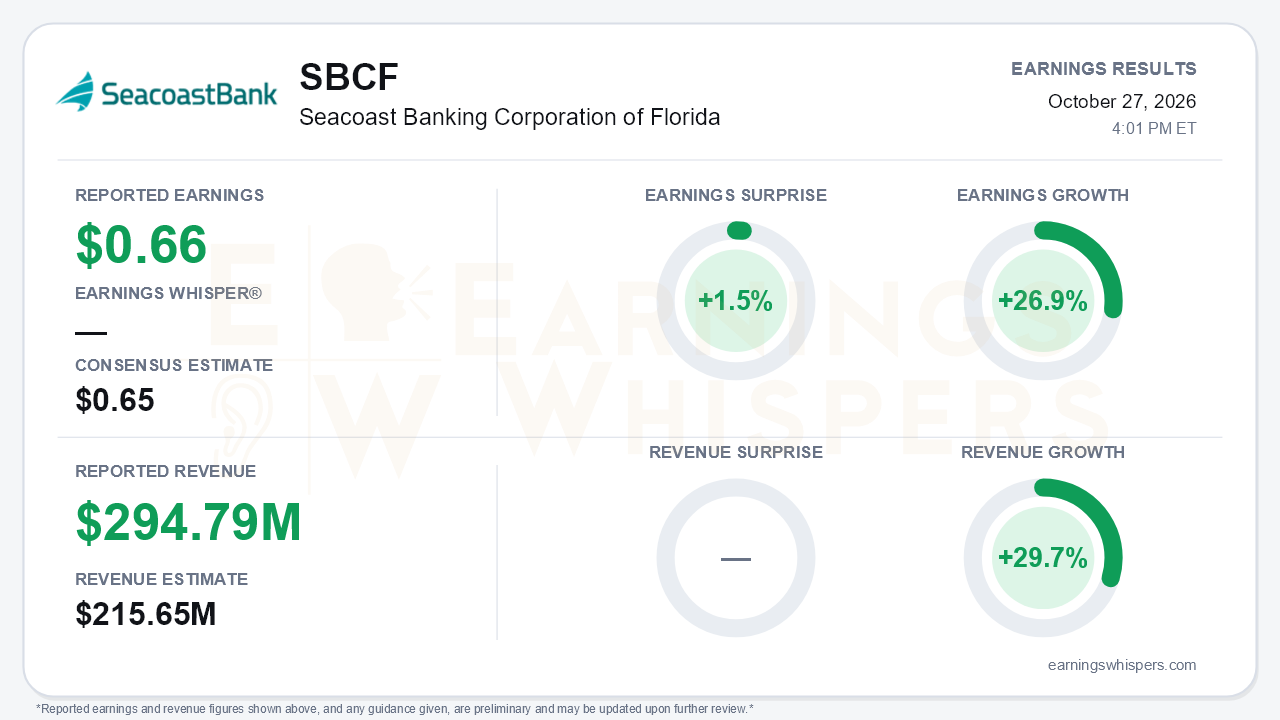
Seacoast Banking Corporation of Florida delivered the quarter it had been promising since the Villages Bancorporation deal closed. Adjusted earnings of $0.66 per share topped the $0.65 consensus by 1.5% and grew 26.9% year over year. Management followed that with the most important forward-looking change of the year. The CEO now expects the bank to reach the high end of its $2.48-$2.52 2026 EPS range, after simply reaffirming the range in the first and second quarters. The central tension is that core profitability is clearly improving while the balance sheet is showing strain. Deposits shrank, tangible book value fell, and management itself warned that higher rates will weigh on loan demand.
The quality of the beat holds up better than the narrow EPS margin suggests, with one caveat on the top line. The reported 36.7% revenue surprise mostly reflects definitions. The normalized $294.79 million revenue figure captures a broader top line than the $215.0 million in net revenue Seacoast reported, and that net figure landed close to the $215.65 million consensus. The earnings improvement itself is real. Adjusted pre-tax pre-provision earnings rose 5% sequentially and 49% year over year to $100.3 million. The adjusted efficiency ratio improved to 53.9% from 54.5% in Q2 and 55.3% in Q1. Adjusted noninterest income jumped 15% to $32.1 million, helped by mortgage servicing valuations, swap and syndication fees, and SBA gains. GAAP EPS was flat at $0.55, held back by $15.5 million in merger and integration costs, up from $8.4 million in Q2. Management says Q3 marks the end of those charges, which should narrow the GAAP-to-adjusted gap going forward.
Margin progress continued, though at a slowing pace. Net interest margin excluding accretion has moved from 3.44% in Q4 2025 to 3.57%, then 3.65%, and now 3.66%. The flattening came as deposit costs rose seven basis points to 1.60%. Loan growth was strong at $429 million, or 13% annualized, following 16% in Q2. Adjusted ROA of 1.34% beat the 1.30% exit target management set last year, and adjusted ROTE of 16.9% beat its roughly 16% goal. Management guided for further margin expansion in Q4 and 2027, citing four drivers:
- a seasonal inflow of about $300 million in public funds, priced well below wholesale funding;
- roughly $600 million of fixed-rate loan maturities in the high-4% range repricing;
- $300-400 million a year in ARM resets at about 150 basis points higher;
- an ongoing shift of securities into loans.
The funding side is where bears have legitimate ammunition. Total deposits fell to $16.6 billion from $16.8 billion. Brokered CDs dropped $159 million and public funds $106 million, and the remaining categories grew only 1.3% annualized. Seacoast sold $234 million of securities to fund loans, and period-end FHLB borrowings rose to $985 million from $835 million. Higher rates also widened unrealized securities losses by $237 million. That cut tangible book value per share, treating preferred as common, to $15.96 from $17.25, and pushed tangible equity to tangible assets down to 8.63%. Credit was mixed:
- Nonperforming loans improved to 0.54% from 0.66%.
- Net charge-offs rose to 16 basis points from 10.
- The bank recorded an $8.4 million purchase-accounting reserve adjustment on an acquired Villages loan.
Management's outlook was confident but measured. It cited a September Fed hike and a 10-year yield near 5-5.5% as likely to dampen demand, particularly in commercial real estate. It is modeling roughly 10% annualized loan growth in Q4, with some pipeline fallout, and high single digits longer term, below the recent pace. The initial 2027 framework calls for:
- adjusted expenses of about $118 million per quarter annualized, plus roughly 5%;
- ROA above 1.30%;
- ROTE above 16%;
- an efficiency ratio of 53-55%.
That framework implies the profitability gains are meant to be durable rather than a peak.
Investors have not yet rewarded the progress. Earnings Whispers sentiment was essentially unchanged at roughly -0.63, firmly negative heading into the report. Shares are up only 2.7% since the open following the July report and sit about 3.8% above the 200-day moving average. Price trend readings are neutral, while AVWAP is positive. The stock is holding modestly above its longer-term trend without signs of a re-rating.
The bottom line is that Seacoast closed out its integration with record core returns, a cleaner earnings profile ahead, and a credible path to further margin expansion, backed by a raised 2026 EPS expectation. The counterweight is a funding base that shrank this quarter, tangible book erosion driven by rates, and management's own caution that higher yields will slow loan demand. Skeptical sentiment suggests the market wants proof that deposit growth can return before giving credit for the earnings upgrade.
Read our earnings preview for Seacoast Banking Corporation of Florida: https://www.earningswhispers.com/article/SBCF/20795
This earnings review was originally published on Earnings Whispers.
This article is for informational purposes only and is not investment advice. Earnings Whispers and its staff may hold positions in the securities mentioned. It is AI-assisted, based on proprietary Earnings Whispers data and company reports, and edited by Earnings Whispers staff.
Mentioned In This Article
Latest News
| Oct-28 | |
| Oct-28 | |
| Oct-27 | |
| Oct-22 | |
| Oct-05 | |
| Jul-29 | |
| Jul-28 | |
| Jul-28 | |
| Jul-28 | |
| Jul-27 | |
| Jul-23 | |
| Jul-06 | |
| Apr-28 | |
| Apr-28 | |
| Apr-28 |
