Frontier's First Adjusted Profit Arrives On 30% RASM Surge, But Fuel Forces A Q4 Guidance Cut And Slower Growth Plan
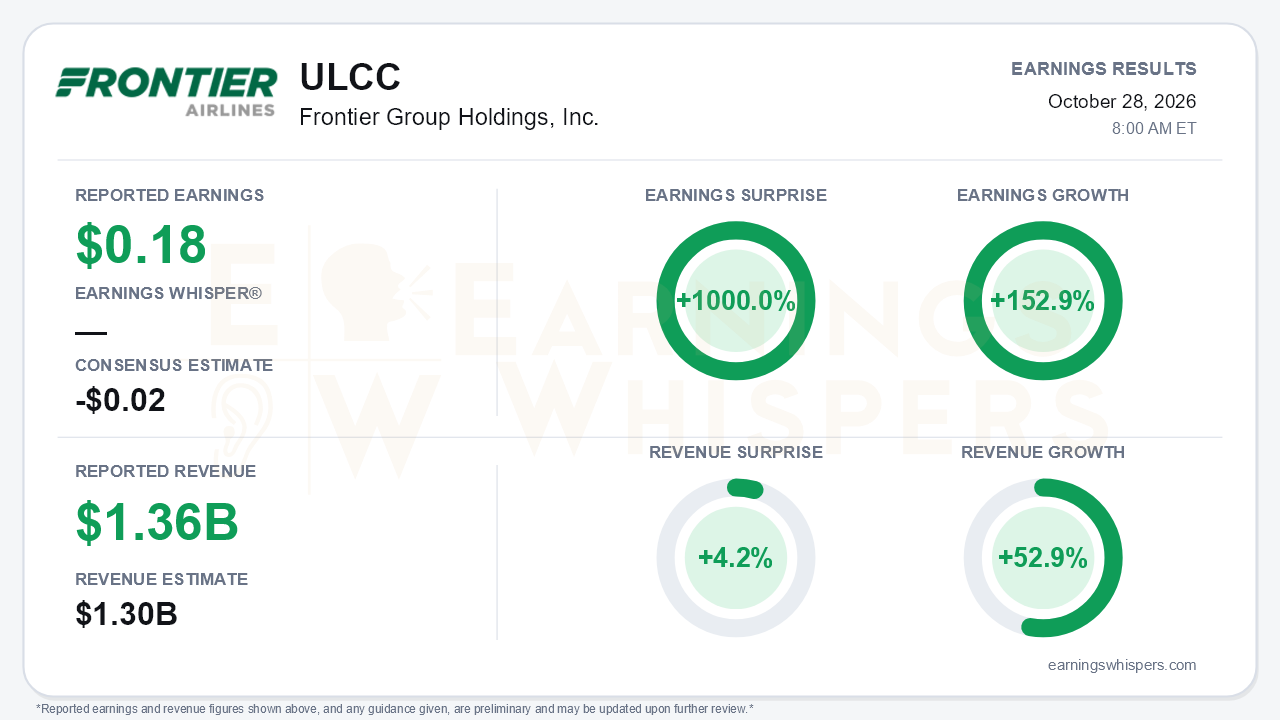
Frontier Group Holdings delivered the quarter its turnaround needed, then immediately warned that fuel could erase the momentum. Adjusted earnings of $0.18 per share compared with a consensus estimate for a $0.02 loss, a 1000.0% surprise, and earnings growth of 152.9% from the year-ago $0.34 adjusted loss. Revenue reached a record $1.355 billion, beating the $1.30 billion consensus by 4.2% and growing 52.9% year over year. It was the first adjusted profit of the recovery, following adjusted losses of $0.30 in the first quarter and $0.10 in the second, and it came in well above management's own -$0.10 to +$0.10 range. That is the central tension: the revenue engine is accelerating, but the earnings trajectory is about to bend backward because of a cost the company does not control.
The quality of the beat deserves scrutiny. On a GAAP basis Frontier lost $104 million, or $0.45 per share, wider than the $0.34 loss a year ago, after $143 million of pre-tax charges led by $134 million tied to the second early return of 13 A320neos. Those charges are reasonably classified as non-recurring, but a subtler issue sits inside the adjusted figures. Adjusted pre-tax income was $39 million, and $32 million of sale-leaseback gains helped reduce costs during the quarter. Those gains end after the third quarter, so a substantial portion of the cushion beneath this profit will not return. Excluding those gains, stage-adjusted CASM-ex fell about 2.5% year over year, which is real cost progress but not dramatic progress.
The revenue story is undeniably strong. RASM rose 30% on 18% more capacity, accelerating from 17% stage-adjusted growth in the first quarter and 28% in the second. Fare revenue per passenger jumped 71% to $67.82, and aircraft utilization climbed to 10.3 daily hours from 8.7. Management attributed the RASM gain roughly equally to its revenue management initiatives, Spirit's exit, and fuel-driven fare increases, and described the improvement as 'sticky.' That breakdown also shows the vulnerability. Two of the three drivers are external, and the call acknowledged tougher comparisons in 2027 as Spirit's exit and fuel-driven fare gains are lapped. Load factor slipped 1.9 points to 78.8%, a reminder that pricing, not volume, is doing the work. Loyalty revenue grew 37%, faster than the roughly 30% pace earlier in the year.
Guidance is where the setup changed. Fourth-quarter adjusted EPS is now projected at -$0.15 to +$0.05, down from $0.00 to +$0.20 on the second-quarter call. The fuel assumption rose to $4.75 per gallon from $3.45, a headwind management sized at more than $100 million. Earnings Whispers characterizes the new range as in line with expectations, so the market may have anticipated much of the reset. Against the company's own prior outlook, however, it is plainly a cut, and it breaks the promised third consecutive quarter of earnings improvement despite fourth-quarter RASM guided up more than 20%. Capacity growth was trimmed to 5% to 6%, and 2027 growth is now framed at about 5% to 7%, down from roughly 10% in February. Additional risks include unresolved pilot contract timing amid union leadership changes and mediation, aircraft delivery delays, and a first-class rollout that has slipped again to late first quarter 2027.
The balance sheet and fleet work offer bulls legitimate support. Liquidity rose to $1.18 billion from $974 million in the first quarter, and leverage fell from 7x adjusted EBITDAR at year-end 2025 to just over 4x. The fleet reshaping is now complete. Thirteen A320neo returns are being replaced with 10 direct-leased A321neos, 11 aircraft are being sold, and management expects about $400 million of maintenance savings over five years from the 37 aircraft returned in 2026. The $200 million run-rate cost savings target for 2027 was reaffirmed.
Investor sentiment heading into the report remained negative but improved meaningfully, rising from -0.40 to -0.14. Price action has been far less forgiving. Shares closed at $5.53 before the report, down 8.4% since the open following the July release. They are roughly 33% below the $8.32 inter-earnings high set in early August, though nearly 23% above the $4.50 low reached just a week before earnings. The stock sits only 2.4% above its 200-day moving average. Earnings Whispers trend readings are mixed, with momentum positive while price and AVWAP trends remain negative, consistent with a stock that rebounded from lows without repairing its post-August damage.
The bottom line is that Frontier proved its commercial strategy can generate an adjusted profit even with fuel costs 56% higher, and its balance sheet is materially healthier than it was a year ago. The fourth-quarter outlook, however, shows how dependent that profit remains on fuel prices, sale-leaseback gains that are now ending, and fare tailwinds that become harder to repeat in 2027. The beat was real, but the path to sustainable profitability just got longer.
Read our earnings preview for Frontier Group Holdings, Inc.: https://www.earningswhispers.com/article/ULCC/20887
This earnings review was originally published on Earnings Whispers.
This article is for informational purposes only and is not investment advice. Earnings Whispers and its staff may hold positions in the securities mentioned. It is AI-assisted, based on proprietary Earnings Whispers data and company reports, and edited by Earnings Whispers staff.
Mentioned In This Article
Latest News
| 4 hours | |
| 6 hours | |
| 11 hours | |
| Oct-20 | |
| Oct-20 | |
| Oct-19 | |
| Sep-16 | |
| Sep-15 | |
| Sep-01 | |
| Aug-31 | |
| Aug-07 | |
| Jul-29 | |
| Jul-29 | |
| Jul-27 | |
| Jul-24 |
