Banc Of California's Repositioning Pays Off With Clean Q3 Beat And Higher Margin Guidance, But Slowing Loan Growth And Falling Book Value Keep The Stock On The Defensive
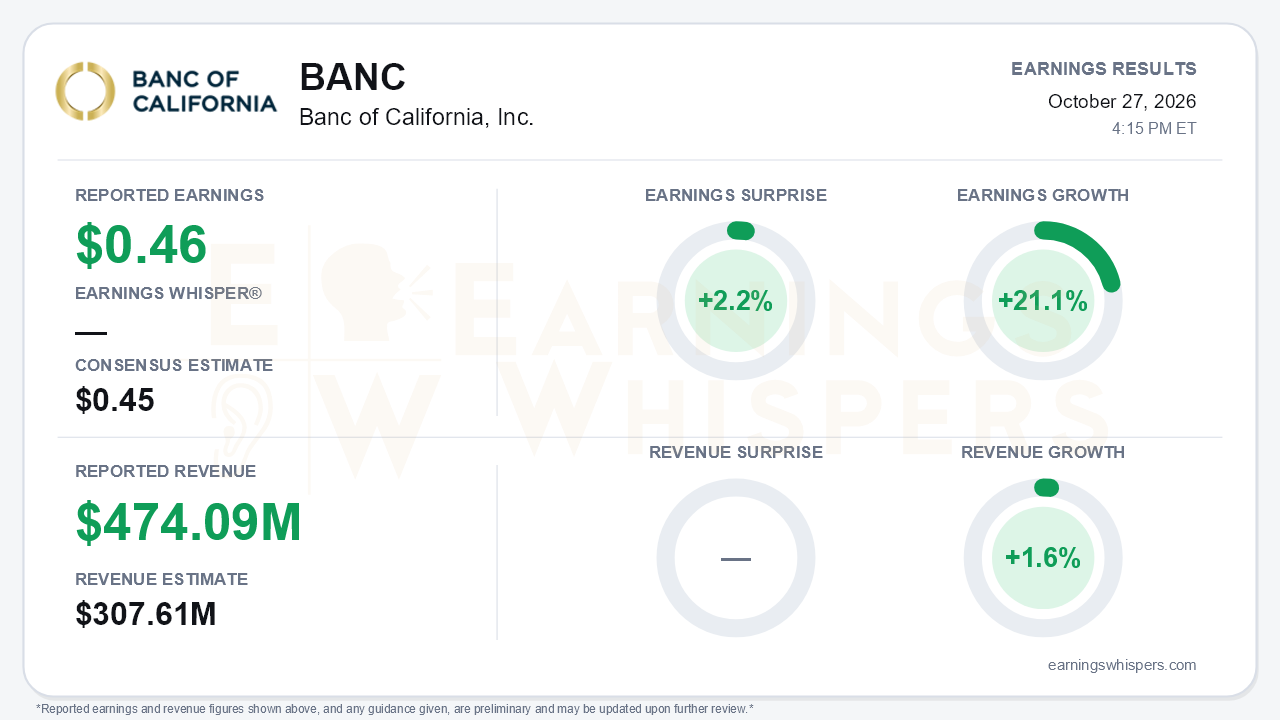
Banc of California delivered what its second-quarter balance sheet surgery promised. Third-quarter EPS was $0.46, edging past the $0.45 consensus by 2.2% and up 21.1% from a year ago. That is a sharp swing from the $(1.61) per-share loss in the second quarter, which absorbed $256.7 million of securities losses and a $161.8 million provision tied to the repositioning. Against the pre-repositioning first quarter, EPS rose 18% from $0.39. This was the clean quarter the story needed. The question now is how much more the restructuring can add once its one-time lift is fully in the numbers.
The revenue comparison needs context. Earnings Whispers records revenue of $474.09 million, 54.1% above the $307.61 million consensus and up 1.6% year over year. That figure appears to reflect gross interest income plus noninterest income. On the company's own net revenue basis, total revenue was $303.8 million, up 6% year over year and roughly in line with, or slightly below, the consensus figure. Investors should not read the headline revenue surprise as an operating blowout.
The real drivers were the margin and the funding mix:
- **Net interest income** rose 9% sequentially to $272.4 million.
- **Net interest margin** expanded 21 basis points to 3.34%, from 3.13% in Q2 and 3.24% in Q1. Investment securities yields jumped 142 basis points to 4.86% as repositioning proceeds were reinvested.
- **Expenses** were flat year over year at $185.4 million.
- **Pre-tax pre-provision income** climbed 16% to $118.4 million, and the efficiency ratio improved to 59.1% from 67.2%.
- **Return on average tangible common equity** reached 11.93%.
- **Funding** improved: brokered time deposits fell by about $634 million at period end, while money market and checking balances grew.
- **Credit** cleaned up. Classified loans dropped to 2.06% of loans, delinquencies fell to 0.47%, and all roughly $825 million of targeted loan sales closed at June marks.
The quality of the beat does deserve some scrutiny. Net interest income included a $2.8 million special FHLB dividend. Loan discount accretion declined to $8.7 million from $11.2 million, and a lower effective tax rate (23.1%) helped the bottom line.
On the call, management shifted its language from "repositioning" to durable, "rinse and repeat" earnings growth, and it backed that tone with numbers:
- Fourth-quarter margin guidance narrowed upward to 3.35%–3.40%, helped by a full quarter of securities reinvestment that management sized at roughly 12–15 basis points of AFS yield benefit.
- The $125–$130 million Q4 pre-tax pre-provision target was reaffirmed.
- CET1 of 9.70% beat the 9.5%–9.6% range guided last quarter. Management reiterated 9.8%–9.9% at year-end and about 10% in early 2027.
Other catalysts include a private banking launch, a pending payments partnership aimed at roughly 5% of fee income in 2027, and a September 2027 preferred redemption framed as worth about $0.11–$0.12 per share. Potential Basel capital relief could also reopen buybacks as soon as the fourth quarter.
Bears have legitimate ammunition, however. Loan production slipped to $2.6 billion from $2.8 billion, and held-for-investment growth slowed to 6% annualized from 9%. Analysts characterized core commercial lending outside residential and warehouse as roughly flat. New production yields are down about 50 basis points year over year on mix. Special mention loans rose 19 basis points, and the allowance ratio drifted to 1.10% from 1.14%. Deposit costs are creeping higher, with an exit cost of 1.87% against a 1.83% average.
Most visibly, tangible book value fell to $16.09 from $16.44 as rising rates widened AOCI losses. That leaves it well below the $17.77 of the first quarter. The macro framing also turned more cautious. The Fed is now hiking, and CEO Jared Wolff said a couple more increases would probably stall the economy. That backdrop threatens both the margin tailwind and credit.
The market has not been rewarding the turnaround. Shares closed at $18.24, down 8.0% from the opening price after the July report and about 3.9% below the 200-day moving average of $18.97. Price and AVWAP trend readings remain negative. Investor sentiment stayed positive but weakened meaningfully, sliding to 0.14 from 0.26. Investors appear to be weighing book-value erosion and rate risk more heavily than the improved earnings run rate.
The bottom line is that Banc of California proved the repositioning works: margin, profitability, capital and credit all moved in the right direction, and guidance edged higher. The next leg is harder. Once the reinvestment benefit is fully absorbed, earnings growth must come from loan and fee expansion at a time when production is slowing, deposit costs are rising, and higher rates are eating into tangible book value. That is the central tension a skeptical market is pricing.
Read our earnings preview for Banc of California, Inc.: https://www.earningswhispers.com/article/BANC/20738
This earnings review was originally published on Earnings Whispers.
This article is for informational purposes only and is not investment advice. Earnings Whispers and its staff may hold positions in the securities mentioned. It is AI-assisted, based on proprietary Earnings Whispers data and company reports, and edited by Earnings Whispers staff.
Mentioned In This Article
Latest News
| Oct-28 | |
| Oct-28 | |
| Oct-27 | |
| Oct-20 | |
| Oct-02 | |
| Sep-17 | |
| Sep-02 | |
| Aug-07 | |
| Jul-29 | |
| Jul-29 | |
| Jul-29 | |
| Jul-29 | |
| Jul-21 | |
| May-08 | |
| Apr-24 |
