Viking Therapeutics Misses As Spending Jumps, But Maintenance Data And A $960 Million Cash Pile Strengthen The VK2735 Story
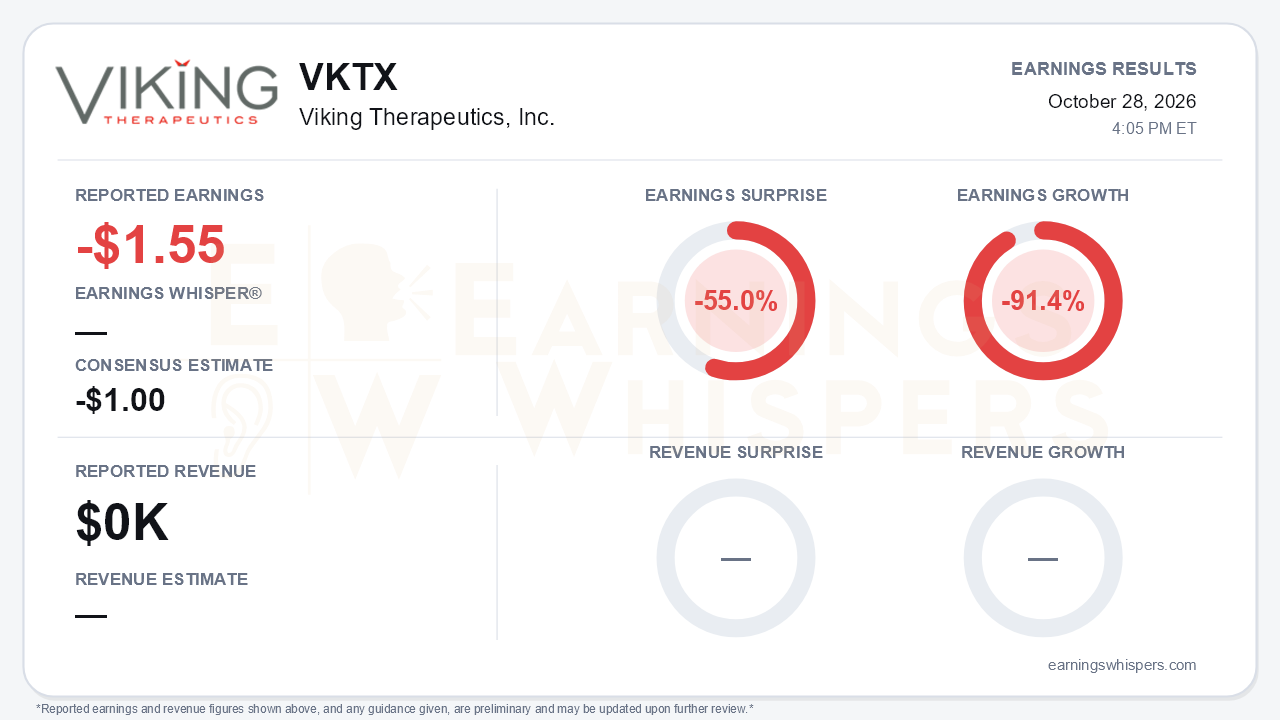
Viking Therapeutics (NASDAQ: VKTX) posted a third-quarter loss of $1.55 per share, well short of the $1.00 consensus estimate. That was a 55.0% miss, and earnings fell 91.4% from a year ago. Revenue was again zero. The net loss roughly doubled to $183.2 million from $90.8 million. For a clinical-stage company, the miss matters less than the reason behind it: spending accelerated sharply just as the obesity program reached its most important de-risking milestones. That is the central tension of the quarter. The clinical story got materially better while the cost of telling it rose faster than management had signaled.
The quality of the miss deserves scrutiny, because it is not a one-off. Research and development expense rose to $166.8 million, up about 44% from $115.8 million in the second quarter and above the $153.5 million peak in the fourth quarter of 2025. General and administrative expense climbed to $20.3 million from $16.9 million. The per-share loss widened from $1.10 in Q2 and $1.37 in Q1. In Q2, the CFO had suggested cash usage would taper. That did not happen.
The drivers are not mysterious. Viking now has four Phase 3 trials running, with VANQUISH-1 and VANQUISH-2 for subcutaneous VK2735 joined by SUNRISE-1 and SUNRISE-2 for the oral tablet. It is also scaling manufacturing and building a commercial team, including market access, medical affairs and HEOR hires. Interest income fell to $4.0 million from $7.8 million a year earlier, which removed some of the cushion beneath the operating loss.
The operating news was more encouraging. The maintenance study arrived on schedule and met or beat the bar management set late last year. Patients first lost roughly 16% to 19% of body weight over 21 weeks of weekly induction dosing. Those switched to every-other-week dosing then retained 83% to 97% of that loss at Week 33, and those on monthly dosing retained 82% to 90%. Patients moved to placebo retained 61%. GI tolerability during maintenance was generally no different from placebo, which supports Viking's argument that VK2735's long half-life allows flexible dosing without patients becoming sensitive to nausea again. A cohort kept on 17.5 mg weekly reached about 22% weight loss with no plateau.
The oral SUNRISE program also started in October as guided. That timeline had slipped once, so hitting it carries some credibility value. Management sounded more confident on the call. It discussed potential maintenance label language, cited a roughly 2.5-year path to potential launch, and expressed openness to in-licensing external obesity assets.
Bears still have legitimate ammunition. The maintenance data will likely support a later supplemental filing rather than the initial approval, so the most differentiated feature may not appear on the launch label. The oral Phase 3 tops out at 55 mg, a range narrowed partly for gross-margin and pill-burden reasons, which could cap efficacy against competitors. Data from combinations pairing Zepbound with an amylin agonist raise the bar for the field, and Viking's own amylin candidate, VK3019, is only finishing its single-ascending-dose study, with a multiple-dose trial planned for 1Q27.
The September financing added roughly $550 million in net proceeds and lifted cash to $960 million from $502 million at the end of Q2. That buys runway through VANQUISH completion in 2027 and the commercial build. The cost was about $251 million of convertible notes and a share count that rose to 127.5 million from 114.8 million at year-end.
The market has treated Viking harshly. Shares closed at $24.89 the day before the report. That is down 25.7% from the $33.52 opening price after the July report and 23.4% below the 200-day moving average. The stock peaked at $43.10 on September 23 and then fell 42.3%, setting a 52-week low of $23.82 on October 27, the eve of earnings. Price, sequential-growth and AVWAP trend readings are all negative. Investor sentiment, however, improved meaningfully into the print, rising from -0.44 to -0.07. Investors are noticeably less pessimistic, though not yet positive, even as the stock sits near its lows.
The bottom line is that Viking delivered the clinical and financing milestones it promised but missed badly on earnings because spending is accelerating rather than leveling off. The maintenance data and dual-formulation strategy make VK2735 look more differentiated. The $960 million balance sheet removes near-term funding anxiety, although the convertible notes add debt and potential dilution. Near-term catalysts include ObesityWeek presentations in November, the VANQUISH extension start in early 2027, and VANQUISH completion later that year. With the stock just above its 52-week low, the market has not yet rewarded the progress. The burden now falls on Phase 3 execution to justify the rising cost of getting there.
Read our earnings preview for Viking Therapeutics, Inc.: https://www.earningswhispers.com/article/VKTX/21263
This earnings review was originally published on Earnings Whispers.
This article is for informational purposes only and is not investment advice. Earnings Whispers and its staff may hold positions in the securities mentioned. It is AI-assisted, based on proprietary Earnings Whispers data and company reports, and edited by Earnings Whispers staff.
Mentioned In This Article
Latest News
| 3 hours | |
| 3 hours | |
| 5 hours | |
| 11 hours | |
| Oct-22 | |
| Oct-21 | |
| Oct-14 | |
| Oct-14 | |
| Oct-08 | |
| Oct-06 | |
| Sep-28 | |
| Sep-28 | |
| Sep-28 | |
| Sep-24 | |
| Sep-24 |
