Regional Management's Record Revenue And 13% EPS Gain Mask Worsening Credit And A Cut Fourth-Quarter Outlook
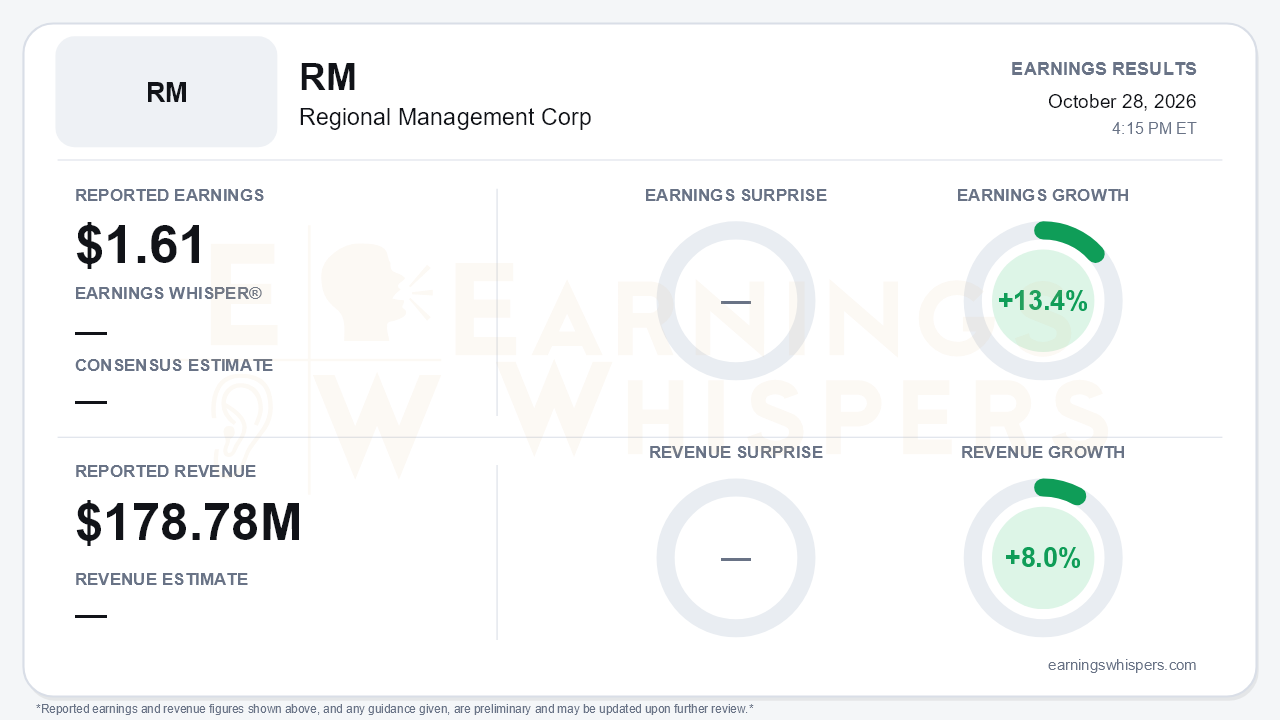
Regional Management (NYSE: RM) reported third-quarter diluted earnings of $1.61 per share, up 13.4% year over year, on record revenue of $178.78 million, up 8.0%. No consensus estimate was available for comparison, so the quarter has to be judged against the company's own targets. On that basis it was mixed. The headline numbers look like a clean rebound from a weak second quarter, when EPS fell to $0.85. Underneath, however, credit continued to slip and management lowered its fourth-quarter earnings outlook. That is the central tension: revenue is accelerating on the bank partnership, while credit is deteriorating and the near-term earnings path has weakened.
The quality of the beat over last year deserves scrutiny. Net income rose only 5.3%, to $15.1 million, and pre-tax income rose just 4.6%. Much of the gap between profit growth and per-share growth came from a 7.6% drop in diluted shares, supported by continued buybacks of 265,645 shares at an average price of $37.64. The revenue line also had a narrow driver. Other income, mostly fee income from bank partnership originations, more than doubled to $12.3 million from $5.4 million. That increase supplied roughly half of the $13.3 million year-over-year revenue gain. Core interest and fee income grew only 4.8%. Interest and fee yield fell 100 basis points to 28.7%, reflecting:
- the deliberate shift toward large and auto-secured loans;
- pricing changes;
- the revenue drag from higher losses.
Revenue growth of 8% did edge up from 7% in the second quarter, but the improvement is fee-led rather than spread-led.
Credit is where the story weakens. The 10.9% net credit loss rate improved seasonally from 12.2% in the second quarter. It was still 70 basis points worse than a year ago and, according to the call, 20 basis points above management's own outlook. Thirty-plus-day delinquencies rose to 7.5%, up 50 basis points both sequentially and year over year. The later buckets look worse: loans 90 to 149 days past due all increased. Large-loan delinquency climbed to 6.4% from 5.7% a year earlier, so the problem is not confined to the shrinking small-loan book. Management traced the weakness to 2025 vintages and the digital affiliate channel. Its response includes:
- tighter underwriting;
- new fraud controls;
- a proprietary scorecard due for full rollout in the fourth quarter;
- Liz Canini joining as Chief Credit Risk Officer.
The tightening has a visible cost. Small-loan originations fell 21.9%, digitally sourced originations dropped 13%, and total originations grew just 1.5%.
Guidance carried the most important change. Management reaffirmed the full-year outlook it had already cut in July: net income growth of 6%-9%, EPS growth of 10%-13%, and portfolio growth of 5%-7%. That outlook is a long way from the 20%-25% net income growth and 10%-plus portfolio growth originally guided for 2026. Within the reaffirmed range, the fourth quarter now looks worse. Fourth-quarter net income is expected to come in below the third quarter, whereas July's call pointed above it. Fourth-quarter credit losses are guided to about 11.5%, above the prior outlook. Funding is also tightening on two fronts:
- Cost of funds is expected to rise to roughly 4.7% as older securitizations amortize.
- Unused revolver capacity has fallen to $324 million, from $442 million in the second quarter and $516 million in the first.
Bears have legitimate ammunition here. Holding the annual range while lowering the quarterly cadence suggests the year will land closer to the bottom of the range than the top.
The call did preserve a credible longer-term growth story, centered on Column. The partnership has extended to North Carolina, Louisiana, and Missouri, and it accounted for roughly 40% of October originations, up from about 28% at the second-quarter run rate. Management still targets substantially all branches by the end of 2027 and at least 200 basis points of pre-tax margin lift. It expects strategic initiatives to contribute about $5 million of net income in the fourth quarter, up from about $3 million in the third. Early first-payment-default data on July vintages were better than a year ago in every channel. Management also introduced an 18% long-term ROE target and framed 2027 as a year of strong bottom-line growth. Two caveats apply. Those are management expectations, not results. And the partnership's upfront origination costs are already adding roughly 40 basis points to the operating expense ratio, which rose sequentially for a second quarter to 12.6%.
Market data offer limited context this time. Investor sentiment and a current price were not available. Shares opened at $40.50 after the July report, comfortably above the 200-day moving average of $35.38. The company's average third-quarter buyback price of $37.64 indicates the stock traded below that post-report level for at least part of the quarter.
The bottom line is that Regional delivered record revenue and a solid per-share gain, but buybacks and partnership fees did much of the work while credit metrics, funding costs, and fourth-quarter expectations all moved the wrong way. The investment case now rests on 2027: whether Column pricing, the new scorecard, and new credit leadership can turn deteriorating 2025 vintages into the margin expansion management is promising.
This earnings review was originally published on Earnings Whispers.
This article is for informational purposes only and is not investment advice. Earnings Whispers and its staff may hold positions in the securities mentioned. It is AI-assisted, based on proprietary Earnings Whispers data and company reports, and edited by Earnings Whispers staff.
Mentioned In This Article
Latest News
| 3 hours | |
| 5 hours | |
| 5 hours | |
| 6 hours | |
| Oct-12 | |
| Oct-01 | |
| Jul-30 | |
| Jul-29 | |
| Jul-29 | |
| Jul-01 | |
| May-21 | |
| Apr-30 | |
| Apr-29 | |
| Apr-29 | |
| Mar-30 |
