Hudson Technologies Misses Badly As Volume Reverses And Pricing Slides; Margin Discipline And Cash Build Can't Offset A Weaker Demand Picture
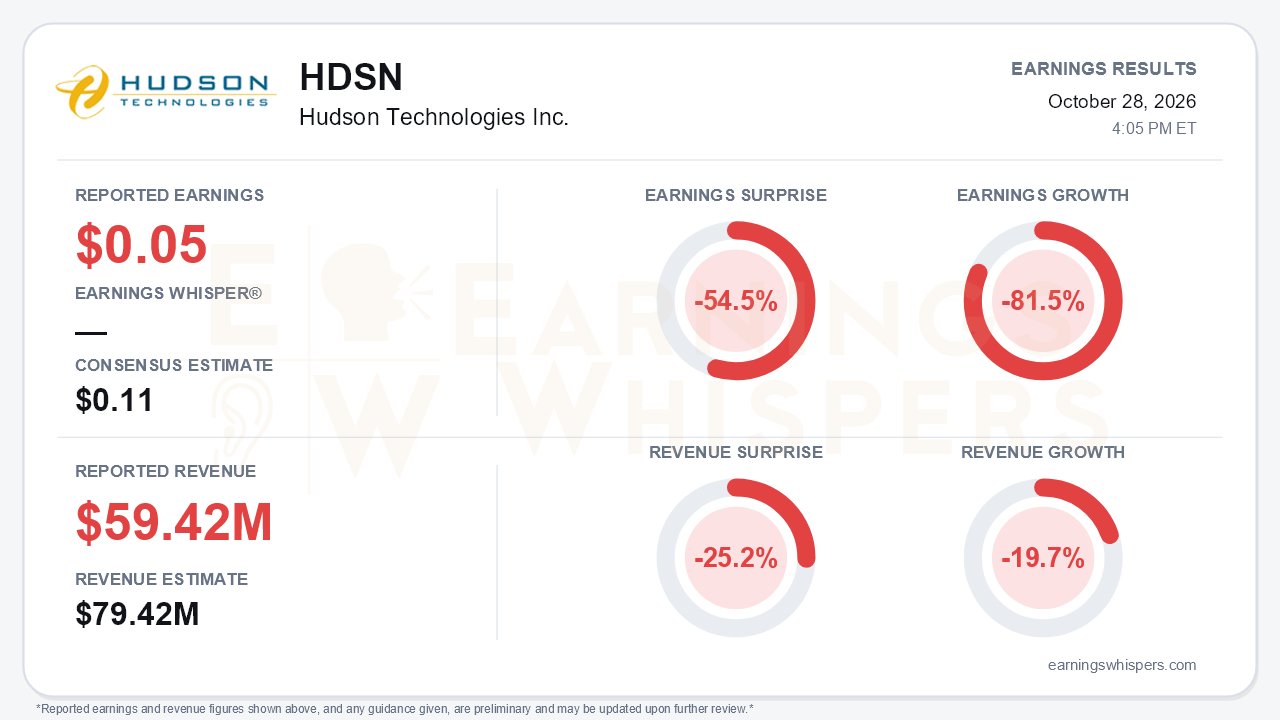
Hudson Technologies (NASDAQ: HDSN) delivered a third quarter that fell well short on both lines. It earned $0.05 per share on revenue of $59.42 million, against consensus of $0.11 and $79.42 million. That is a 54.5% earnings miss and a 25.2% revenue shortfall. Earnings fell 81.5% year over year and revenue declined 19.7%. Net income dropped to $2.0 million from $12.4 million. The size of the revenue gap is the headline, but the more important development is directional. After revenue rose about 9% in Q1 and 8% in Q2, Hudson swung to a 20% decline. The volume growth that had been holding up the story through the first half reversed sharply.
The components of the decline make the quarter look worse than a simple pricing story. Selling prices fell 17% year over year, a much steeper drop than the 6% decline in Q2. Volume also fell 9%, after rising 12% in the prior quarter. Management cited muted customer demand and adequate refrigerant inventories, against a prior-year period inflated by HFO-transition supply constraints. That comparison was always going to be difficult. Still, the abrupt volume reversal is new information. Gross margin compressed to 25% from 32% a year ago. SG&A rose to $10.8 million from $8.9 million on ERP optimization, staffing and consulting costs. Operating income fell to $3.3 million from $14.0 million. The prior-year bottom line also benefited from a $1.6 million earn-out gain and roughly $0.8 million of interest income, neither of which recurred. The DLA contract contributed $11 million of Q3 revenue, which means the core commercial refrigerant business was softer than the consolidated figure suggests.
There were genuine offsets, and management leaned on them. Gross margin of 25% was roughly flat with Q2 and, per the call, beat internal expectations as the company prioritized profitable sales over volume. SG&A fell sequentially from $12.4 million, with ERP expense down 50% from Q2. Cash climbed to $35.3 million from $26 million in Q2 and $19 million in Q1, and the balance sheet remains debt-free. The nine-month cash flow statement is less flattering. Operating cash flow was $4.3 million versus $29.4 million a year earlier, as receivables built by $12.8 million. The sequential cash improvement is real but comes off a weak base.
Guidance is where the quality of the story deserves scrutiny. Hudson reaffirmed a full-year gross margin target in the low-to-mid-twenty percent range. That reaffirmation preserves a target that has already drifted lower all year. Management initially framed 2026 as roughly flat with 2025's ~25%, then moved to "mid-20s" in Q1 and cut to "low to mid 20%" in Q2. Management also said 2027 pricing is assumed flat with 2026, so no price recovery is built in. EPA data showed U.S. HFC inventory fell only 3% in 2025, suggesting a channel overhang that could keep pricing and reclaimed demand subdued into the 2029 step-down. Illegal imports remain unaddressed. Demand was described as muted across the board, particularly in residential and light commercial. Buybacks were paused, with all $2.5 million of year-to-date repurchases made in Q1. The call tone shifted from Q1's talk of firming prices to managing forces outside the company's control.
The longer-dated catalysts are credible but mostly not near-term earnings drivers:
- **DLA contract:** the $210 million re-award resolves a protest overhang and runs through July 2031, with an option to 2036.
- **Icorium:** the partnership advanced to a joint development agreement on separation technology for complex mixed refrigerants.
- **Automotive rules:** California and New York rules requiring certified reclaimed refrigerant in certain automotive applications take effect in January 2027.
- **Other demand drivers:** management also pointed to data center demand, HFC content in HFO blends, and possible future tightening of HFC allowances.
The market had already been leaning skeptical. Shares at $5.23 are down 17.5% from the $6.34 open after the August report and sit 12.2% below the 200-day moving average of $5.96. Investor sentiment was slightly negative heading into the report and became marginally more so, slipping from -0.144 to -0.154, essentially unchanged in magnitude. Earnings Whispers momentum and AVWAP trend readings are negative, consistent with a stock that has been steadily losing ground rather than pricing in a recovery.
The bottom line is that Hudson defended its margin and its balance sheet but lost the volume narrative that had made the pricing downturn tolerable. With prices down 17% and volume now shrinking, 2027 pricing assumed flat, and inventory overhang data pointing to a slow normalization, bears have legitimate ammunition. The DLA re-award, Icorium development and 2027 state rules offer a plausible path to reduced pricing sensitivity. Investors will need evidence of renewed volume growth before those catalysts can outweigh a top line that has turned decisively lower.
Read our earnings preview for Hudson Technologies Inc.: https://www.earningswhispers.com/article/HDSN/20945
This earnings review was originally published on Earnings Whispers.
This article is for informational purposes only and is not investment advice. Earnings Whispers and its staff may hold positions in the securities mentioned. It is AI-assisted, based on proprietary Earnings Whispers data and company reports, and edited by Earnings Whispers staff.
Mentioned In This Article
Latest News
| Oct-29 | |
| Oct-28 | |
| Oct-28 | |
| Oct-20 | |
| Oct-14 | |
| Sep-17 | |
| Aug-19 | |
| Aug-06 | |
| Aug-05 | |
| Aug-05 | |
| Aug-05 | |
| Jul-22 | |
| May-28 | |
| May-18 | |
| May-06 |
