T. Rowe Price Beats By 10.9%, But A $28.3 Billion Outflow Quarter And Carry-Aided Earnings Overshadow The Headline
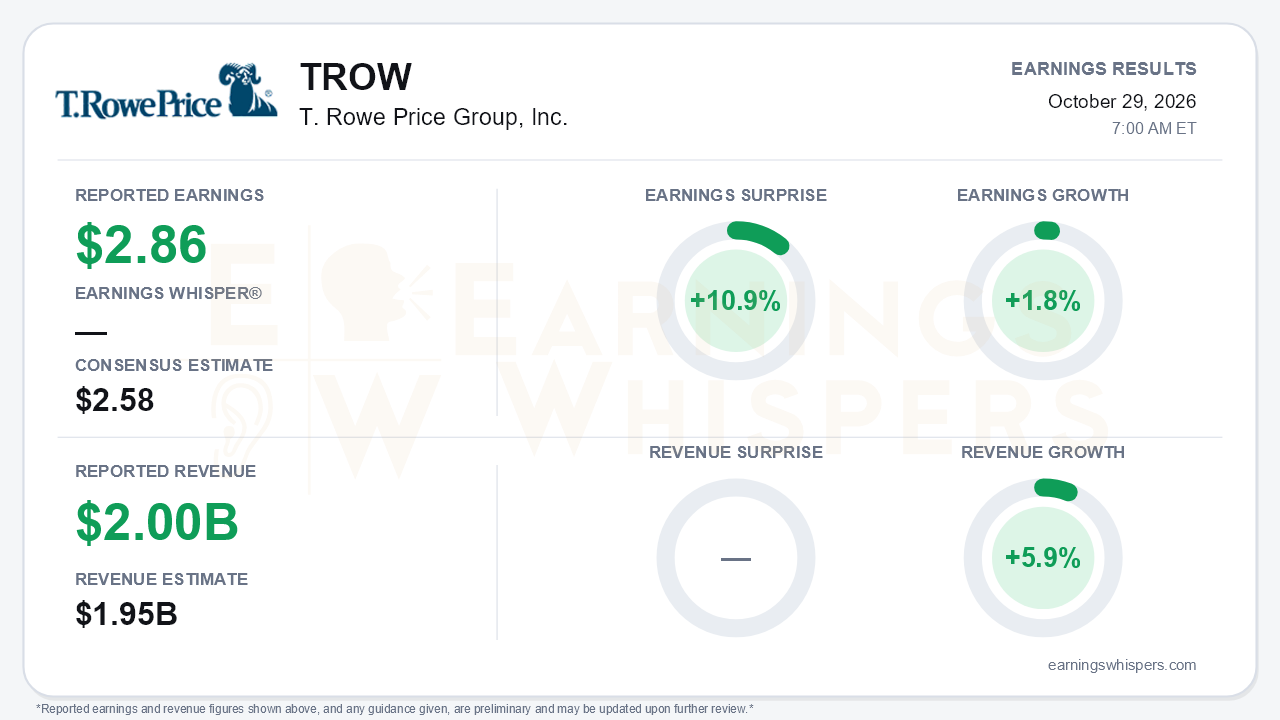
T. Rowe Price Group delivered a clean headline beat for the third quarter. It reported adjusted earnings of $2.86 per share against a $2.58 consensus, a 10.9% surprise. Revenue of $2.005 billion topped the $1.95 billion estimate by 2.8%. The growth picture is more muted than the surprise suggests: earnings grew only 1.8% year over year, against $2.81 a year ago, while revenue rose 5.9%. Sequentially the trajectory looks better, with adjusted EPS climbing from $2.52 in Q1 and $2.57 in Q2. That is the central tension. Earnings are moving up while the firm's core franchise is bleeding assets faster than at any point this year. Net outflows ballooned to $28.3 billion from $6.5 billion in Q2 and $13.7 billion in Q1.
The quality of the beat deserves scrutiny. Adjusted carried interest jumped to $63.1 million from $15.2 million in Q2. That nearly $48 million swing accounts for a meaningful share of the sequential revenue gain, and carry is inherently lumpy rather than a recurring fee stream. Adjusted net revenue reached roughly $2.0 billion, up 5.1% sequentially. The call materials cite 5.3% year-over-year growth on an adjusted net revenue basis, slightly below the 5.9% normalized revenue growth figure, which likely reflects a difference in revenue definitions. Underneath, the effective fee rate kept grinding lower, to 37.8 basis points from 38.1 in Q2, 38.4 in Q1 and 38.8 in Q4 2025. Market appreciation lifted assets to $1.86 trillion and is doing the heavy lifting on revenue. Pricing and flows are working against the firm.
The flow detail was the most important development on the call. Outflows were concentrated in active equity and mutual funds, which management acknowledged as structural pressures. They also included a $7.6 billion multi-asset outflow tied to a large defined-contribution plan termination. Management flagged a subtler shift in its retirement franchise as well. As baby boomers draw down balances and erode net participant contributions, target-date flows are becoming more dependent on lumpy new plan wins. For a firm with about two-thirds of assets tied to retirement, that undercuts what had been a reliable growth engine. Guidance offered limited relief. Management expects only "some sequential improvement" in Q4, with outflows still elevated versus the first-half run rate, and described October flows as weak. That follows Q2 commentary warning the second half would be "meaningfully more challenging," so the deterioration was flagged but arrived in force.
The call did preserve a credible diversification story. ETF assets reached $33.8 billion across 39 funds, up from about $30 billion in Q2 and $21 billion at the end of 2025, with $11 billion of year-to-date inflows. SMA assets hit $20.6 billion across roughly 36,000 accounts. Fixed income posted its 11th straight quarter of inflows at $3.4 billion. New initiatives include:
- the pending acquisition of FM Investments, a roughly $20 billion fixed income, ETF and SMA specialist expected to close in early 2027;
- Robinhood's selection of T. Rowe active ETFs for tokenized versions outside the U.S.;
- the first European UCITS active ETFs;
- an expanded Goldman Sachs interval-fund and model partnership;
- an enterprise AI relationship with Anthropic;
- 50 additional intermediary hires.
Near-term investment performance also improved, with one-year equity outperformance rising to 48%. Ten-year asset-weighted outperformance fell to 60% from 79%, though. The new vehicles remain small relative to $28 billion of quarterly outflows.
Capital return is another yellow flag. Buybacks were paused in Q3 after $497 million in the first half, even as the shares declined and cash and discretionary investments built to $4.9 billion. The FM Investments deal offers a plausible explanation for conserving cash, but management did not explicitly tie the pause to the deal. Investors accustomed to steady repurchases may read it as a step back. Expense guidance was unchanged, with 2026 operating expense growth excluding carry reaffirmed at 4% to 7% and now trending toward the midpoint.
Investor sentiment was already negative heading into the report and slipped modestly further, from -0.12 to -0.19. Shares entered the report at $104, down 9.7% since opening at $115.13 after the July report. They sat 11.1% below the inter-earnings high of $116.92 set in early August and 6.1% above the October 14 low of $98.04. The stock is hovering essentially at its 200-day moving average of $103.70. The Earnings Whispers price and AVWAP trend readings remain negative, consistent with a stock that has steadily lost ground despite rising quarterly earnings.
The bottom line is that T. Rowe Price beat on the numbers, but carry, market appreciation and cost discipline produced much of that beat, while the franchise's organic health worsened. Bears have legitimate ammunition in the surge in outflows, continued fee compression, lumpier retirement flows and the buyback pause. Bulls can point to genuine traction in ETFs, SMAs, fixed income and partnerships. Until the new channels grow large enough to offset active equity redemptions, the earnings beat is unlikely to settle the debate.
Read our earnings preview for T. Rowe Price Group, Inc.: https://www.earningswhispers.com/article/TROW/21140
This earnings review was originally published on Earnings Whispers.
This article is for informational purposes only and is not investment advice. Earnings Whispers and its staff may hold positions in the securities mentioned. It is AI-assisted, based on proprietary Earnings Whispers data and company reports, and edited by Earnings Whispers staff.
Mentioned In This Article
Latest News
| 10 hours | |
| 13 hours | |
| 13 hours | |
| Oct-21 | |
| Oct-19 | |
| Oct-19 | |
| Oct-19 | |
| Oct-16 | |
| Oct-14 | |
| Oct-14 | |
| Oct-12 | |
| Oct-09 | |
| Oct-08 | |
| Oct-08 | |
| Oct-02 |
