Textron Beats And Raises As MV-75 Funding Clears, But A Lighter Tax Bill And A Bigger Bell Charge Temper The Quality
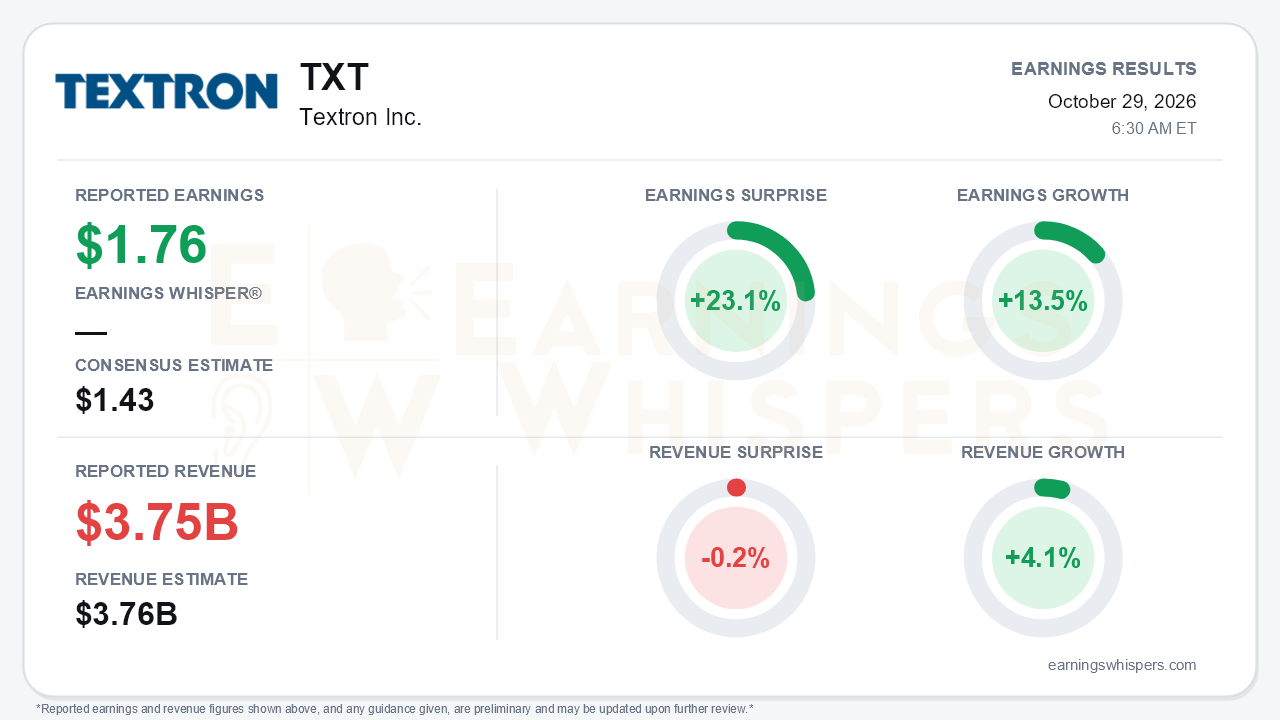
Textron delivered the kind of quarter a beaten-down stock needed on the surface. Adjusted EPS of $1.76 beat the $1.43 consensus by 23.1% and grew 13.5% from a year ago. Management also raised full-year adjusted EPS guidance to $6.55-$6.65 from $6.40-$6.60, the first change to that range after holding it flat across the prior three calls. Revenue was less impressive at $3.751 billion, up 4.1% but 0.2% short of consensus. The central tension is that the earnings beat and the guidance raise came largely from below the operating line and from the removal of a funding overhang. The core operating engine moved far less. Total segment profit was $355 million, slightly below last year's $360 million.
The quality of the beat deserves scrutiny. GAAP EPS rose to $1.56 from $1.31, yet pretax income from continuing operations increased only $6 million, to $322 million. Most of the improvement came from income tax expense falling to $52 million from $81 million. A diluted share count roughly 6.6 million lower, the result of continued buybacks including $239 million this quarter, added further per-share lift. Finance segment profit fell to $5 million from $18 million, but that decline reflects $11 million of asset-disposition gains in the year-ago period. The underlying story is better described as steady than as accelerating, although adjusted EPS did improve sequentially from $1.62 in the second quarter.
Beneath the consolidated numbers, the segments pulled sharply in opposite directions. Textron Aviation revenue jumped 14% to $1.7 billion, compared with just 1% growth in the second quarter. Jet deliveries rose to 51, versus 42 a year ago and 40 last quarter, and the call highlighted the segment's highest third-quarter orders since 2023, along with corresponding deposits. Margin did not keep pace. Aviation profit rose only 4%, to $179 million, a margin near 10.7%. That still tracks to just the low end of the 11-12% target, and management described a roughly 12-month journey back to normal incremental margins as manufacturing inefficiencies persist. Textron Systems was cleaner, with revenue up 16% (versus 7% in Q2) and profit up 21% to $57 million, helped by ship-to-shore connector production at full rate and a $230 million contract modification for two craft. Bell was the weak link. Revenue fell 9% to $933 million, reversing 6% growth in the second quarter, and profit dropped 17% to $76 million on lower MV-75 volume and softer commercial mix.
The MV-75 Cheyenne program is both the quarter's biggest relief and its most important lingering risk. Congress approved the $350 million reprogramming request, and roughly $300 million was obligated through contract modifications. That eliminates the downside management flagged in the second quarter: $0.20-$0.30 of EPS and $150-$250 million of cash at risk if the request had not been approved. The guidance raise explicitly reflects that approval. However, the low-rate initial production award now likely slips into 2027 because of the continuing resolution, which expires December 11. As a result, management raised the expected cumulative catch-up charge to $110-$150 million from $60-$110 million, and the second-quarter estimate-at-completion charge has not been reversed. The cash outlook also needs context. Manufacturing cash flow before pension contributions was strong at $418 million, versus $154 million in Q2, and the full-year range rose to $800-$900 million. But the call indicated the raise is driven mainly by about $100 million of lower capex rather than better operations, and year-to-date cash flow of $344 million still trails last year's $459 million as inventories have built by $563 million.
On the positive side, management's tone was noticeably more confident. Supply-chain parts availability is back to roughly 2021 levels, and attrition is near pre-COVID norms. The CEO also openly discussed transformational M&A in areas such as space and thermal protection. Additional catalysts include the CJ4 Gen 3 heading toward entry into service in the first half of 2027, a new Aviation chief in Brian Roloff, Bell's H-1 upgrade award, and a Navy jet trainer decision expected in mid-2027.
The market had been treating Textron harshly heading into the report. Shares closed at $78.32 the day before the release, down 13.9% from the open after the July report and 11.4% below the 200-day moving average of $88.41. The stock set a 52-week low of $71.87 on October 8 and entered earnings about 9% above that level, but 14.4% below its inter-quarter high. Investor sentiment slipped modestly further into negative territory, from -0.137 to -0.157, a small shift that leaves expectations subdued rather than collapsing. Price and AVWAP trend readings remain negative.
The bottom line is that Textron removed its most acute near-term overhang and delivered an earnings beat and guidance raise that skeptics were not positioned for. Those gains rested more on taxes, buybacks, lower capex, and MV-75 funding relief than on broad operating leverage. Aviation volume and orders are genuinely improving, but margins lag. Meanwhile, Bell faces a larger, later production charge tied to Washington's budget calendar.
Read our earnings preview for Textron Inc.: https://www.earningswhispers.com/article/TXT/21146
This earnings review was originally published on Earnings Whispers.
This article is for informational purposes only and is not investment advice. Earnings Whispers and its staff may hold positions in the securities mentioned. It is AI-assisted, based on proprietary Earnings Whispers data and company reports, and edited by Earnings Whispers staff.
Mentioned In This Article
Latest News
| 2 hours | |
| 2 hours | |
| 5 hours | |
| 6 hours | |
| Oct-28 | |
| Oct-27 | |
| Oct-21 | |
| Oct-21 | |
| Oct-20 | |
| Oct-20 | |
| Oct-07 | |
| Oct-05 | |
| Sep-30 | |
| Sep-29 | |
| Sep-24 |
