Alnylam's Tax-Fueled EPS Blowout Masks A Slowing AMVUTTRA Launch And TTR Guidance Pinned To The Low End
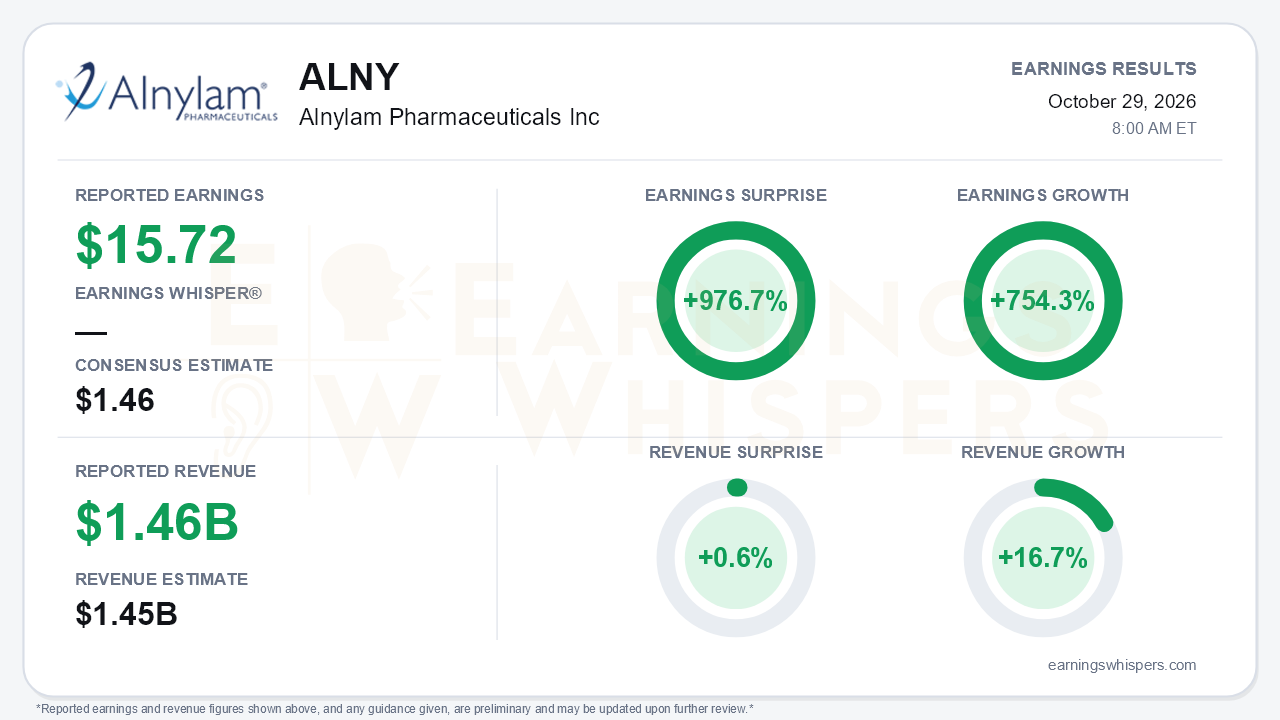
Alnylam Pharmaceuticals (NASDAQ: ALNY) posted third-quarter earnings of $15.72 per share, beating the $1.46 consensus by 976.7% and growing 754.3% year over year. That headline is almost entirely an accounting event. GAAP net income of $2.17 billion included a roughly $1.9 billion income tax benefit from releasing valuation allowances on U.S. deferred tax assets. The release is a meaningful signal that the company now expects sustained profitability, but it says little about the quarter's operations. Revenue of $1.458 billion was the more relevant number. It edged past the $1.45 billion consensus by 0.6% and rose 16.7% year over year. The central tension is that the business behind the giant EPS figure is decelerating, and management effectively conceded as much.
The quality of the quarter deserves scrutiny beyond the tax line. Net product revenues grew 52% to $1.29 billion, led by AMVUTTRA at $1.13 billion, up 65%. Total TTR revenue reached $1.15 billion, up 59%. The growth curve is bending, though. Year-over-year product revenue growth has slowed from 121% in Q1 to 74% in Q2 to 52% in Q3. Total revenue growth was held to 16.7% because the company lapped a $300 million Roche milestone from a year ago, and that same comparison pushed non-GAAP operating income down 11% to $425 million. Cost of goods sold rose to 28.0% of net product revenues from 23.2% a year earlier, as higher AMVUTTRA sales triggered higher royalty tiers. Product gross margin has slipped from 80% in Q1 to 75% in Q2 to 72% in Q3. Success is getting more expensive at the margin.
The call sharpened the concern. U.S. TTR revenue rose $99 million sequentially, but only $81 million of that came from demand, down from $129 million in Q2. The rest came from a $17 million inventory build and about $10 million of favorable gross-to-net adjustments, and management expects both to reverse as Q4 headwinds. The press release reiterated the full-year range and said the company remains on track, but management said on the call that it now expects TTR revenue at the low end of the $4.2-$4.5 billion range, roughly $4.2 billion. That range had already been cut from $4.4-$4.7 billion. Management also said the expanded field force has not yet translated into demand, assumed no contribution from it, and expects no Q4 acceleration. The CEO said she was "not satisfied." Leading indicators offer some offset. Unique new prescribers topped 2,000, up from more than 1,700 in Q2. New-to-brand share held above 30%, and international TTR revenue grew 10% sequentially on ATTR-CM launches in Japan, Germany and Italy.
Bears have legitimate new ammunition on the risk side. A proposed CMS 340B Part B reimbursement rule, effective January 2027, is already causing Q4 ordering volatility, and its price and volume impact is uncertain. UnitedHealth's Medicare Advantage first-line restriction on AMVUTTRA took effect October 1 and could slow new starts. Two items were pushed back: 2027 guidance moves from the January healthcare conference to February, and the HHT and obesity readouts slip to the February call. The pipeline keeps the long-term story credible. Brezosiran showed a 60-64% mean reduction in CSF mutant huntingtin with no NfL or ventricular-volume signals, and a pivotal study is planned for 2027. Cemdisiran faces a November PDUFA date with royalties of up to 15% at stake. TRITON-CM's second upsizing, to about 2,250 patients, preserves the 2030 launch target, but it implies caution about event rates.
Investors were already leaning skeptical. Earnings Whispers sentiment fell from -0.285 at the prior report to -0.451, a meaningful move deeper into negative territory. The stock set a 52-week low of $197.81 on the day of the last report. It rallied to $272.08 in early September, then gave back much of that gain to enter this report at $232.40, up only 3.3% from the post-Q2 open. Shares sit 19.3% below the 200-day moving average and roughly mid-range between the quarter's high and low. Some internal trend readings, including sequential growth and AVWAP, are positive, but price action shows a market that has not rebuilt confidence in the launch trajectory.
The bottom line is that Alnylam's eye-popping EPS beat is a balance-sheet milestone, not an operating one. Underneath, AMVUTTRA demand growth slowed sharply and Q3 was flattered by items that will reverse. TTR guidance is now anchored to the low end, margins are compressing, and 340B and payer headwinds add uncertainty heading into 2027. The pipeline and $3.6 billion cash position keep the long-term thesis intact. Near term, the stock's direction likely hinges on whether February's 2027 outlook shows the expanded commercial effort finally reaccelerating demand.
Read our earnings preview for Alnylam Pharmaceuticals Inc: https://www.earningswhispers.com/article/ALNY/21021
This earnings review was originally published on Earnings Whispers.
This article is for informational purposes only and is not investment advice. Earnings Whispers and its staff may hold positions in the securities mentioned. It is AI-assisted, based on proprietary Earnings Whispers data and company reports, and edited by Earnings Whispers staff.
Mentioned In This Article
Latest News
| 3 hours | |
| 5 hours | |
| 5 hours | |
| Oct-23 | |
| Oct-21 | |
| Oct-19 | |
| Oct-18 | |
| Oct-16 | |
| Oct-16 | |
| Oct-16 | |
| Oct-15 | |
| Oct-12 | |
| Oct-09 | |
| Sep-29 | |
| Sep-24 |
