Quad Misses By A Penny As Pass-Through Sales Prop Up Guidance While EBITDA And Long-Term Margin Targets Slip
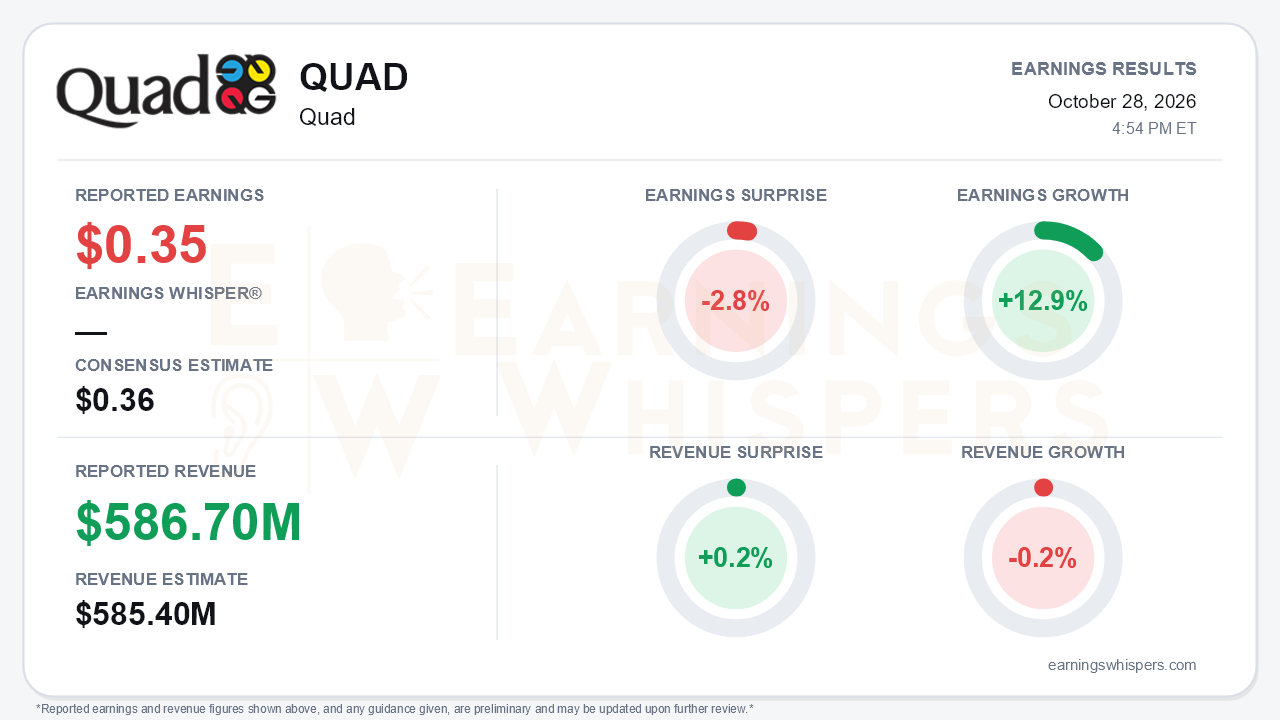
Quad (NYSE: QUAD) delivered a quarter where the improving top-line narrative ran ahead of the profit picture. Adjusted earnings of $0.35 per share missed the $0.36 consensus by 2.8%, even as they grew 12.9% from a year ago. Revenue of $586.7 million edged past the $585.4 million estimate by 0.2% and slipped 0.2% year over year, essentially flat. Management raised the midpoint of its full-year sales outlook, but trimmed the Adjusted EBITDA midpoint and softened its longer-term targets. That is the central tension. Sales are stabilizing, but the profitability and mix story behind the turnaround looks less robust than it did a year ago.
The quality of the earnings growth deserves scrutiny. Adjusted EBITDA fell to $51.1 million from $52.6 million, and margin narrowed to 8.7% from 8.9%, which the company attributed to sales mix. The double-digit adjusted EPS gain came mainly from below the operating line. Interest expense dropped to $9.7 million from $12.8 million, depreciation and amortization declined, and pension costs swung to a small benefit. GAAP results moved the other way, with diluted EPS falling to $0.11 from $0.21 as restructuring, impairment and transaction charges climbed to $19.2 million from $7.3 million. Those charges included a $10.8 million credit-loss reserve on the note receivable from the European divestiture, which the call identified as the Capmont note, with the first $6 million installment still unpaid. They also included Peru-related impairment, partially offset by a $13.6 million gain on the sale of the Lima assets.
The call preserved a credible commercial story. The quarterly revenue path has improved from a 4.3% decline in the first quarter to growth of 1% in the second and a flat third quarter. Management described accelerating new-logo and expansion wins and launched Direct, a branded full-service direct marketing agency. In-Store Connect signed its first national retailer, which launches across 30 Florida stores this winter. On the call, management described it as a discount chain with more than 1,000 stores, while the release referenced "thousands of stores." The network is now tracking toward roughly 160 stores by year-end versus about 130 cited last quarter. Management also said retailer decision cycles are shortening substantially.
The guidance carries an important caveat. Management raised the Adjusted Annual Net Sales Change range to a 1%–3% decline from 1%–5%, but attributed most of the improvement at the midpoint to pass-through of paper, fuel and ink costs. That revenue dilutes margins rather than reflecting organic momentum. Adjusted EBITDA guidance was narrowed to $185–$195 million, lowering the midpoint to $190 million from $195 million and placing it below 2025's $196 million. Year-to-date Adjusted EBITDA margin is flat at 7.9%, short of the 8.4% full-year target cited earlier in the year. Agency solutions are still declining. Most telling, the 2028 integrated-solutions mix target was reduced to roughly 25% from 31%, and the explicit 9.4% 2028 EBITDA margin target gave way to vaguer language about increased margins. Bears have legitimate ammunition in that retreat.
The balance sheet and cash flow add both comfort and execution risk. Year-to-date free cash flow was negative $100 million versus negative $87 million, reflecting working capital and a Mexico tax payment. That matter settled at $12 million, below the $17 million accrued. Net debt of $422 million is down from $465 million a year ago, but trailing leverage sits at 2.19x. Reaching the reaffirmed 1.5x year-end target depends on a fourth quarter that management expects to produce $145–$155 million of free cash flow. Seasonality makes that plausible, but it leaves little margin for error. On the positive side, the USPS is limited to one rate increase per year, with the next marketing-mail hike not until July 2027, which reduces a recurring cost headwind for clients.
Investor sentiment remained slightly negative but improved modestly, rising to -0.0589 from -0.0948. The shares entered the report at $9.40, up 5.1% from the open following the July release and about 16.6% above the 200-day moving average of $8.06. That positioning suggests the market had already been rewarding the stabilization narrative. A small EPS miss paired with a lower EBITDA midpoint is therefore an awkward setup. The Earnings Whispers trend readings add little conviction, with the price trend neutral and the AVWAP trend negative.
The bottom line is that Quad's commercial momentum is real, with new agency offerings, faster In-Store Connect expansion and better sales guidance. However, the headline masks a weaker profit trajectory. Pass-through revenue is inflating the top-line improvement, EBITDA is drifting lower, and management has retreated from its 2028 mix and margin targets. Adjusted EPS growth is leaning on lower interest and depreciation rather than operating leverage. With shares trading well above their long-term average, the burden now shifts to a heavy fourth-quarter cash delivery and proof that new business can lift margins, not just revenue.
Read our earnings preview for Quad: https://www.earningswhispers.com/article/QUAD/20982
This earnings review was originally published on Earnings Whispers.
This article is for informational purposes only and is not investment advice. Earnings Whispers and its staff may hold positions in the securities mentioned. It is AI-assisted, based on proprietary Earnings Whispers data and company reports, and edited by Earnings Whispers staff.
Mentioned In This Article
Latest News
| Oct-29 | |
| Oct-28 | |
| Oct-28 | |
| Oct-21 | |
| Oct-20 | |
| Oct-14 | |
| Oct-08 | |
| Oct-06 | |
| Sep-16 | |
| Sep-02 | |
| Aug-26 | |
| Aug-19 | |
| Aug-10 | |
| Aug-05 | |
| Jul-29 |
