Saia Beats On Pricing And A Better Margin Outlook, But Stalling Shipment Growth Tempers The Story
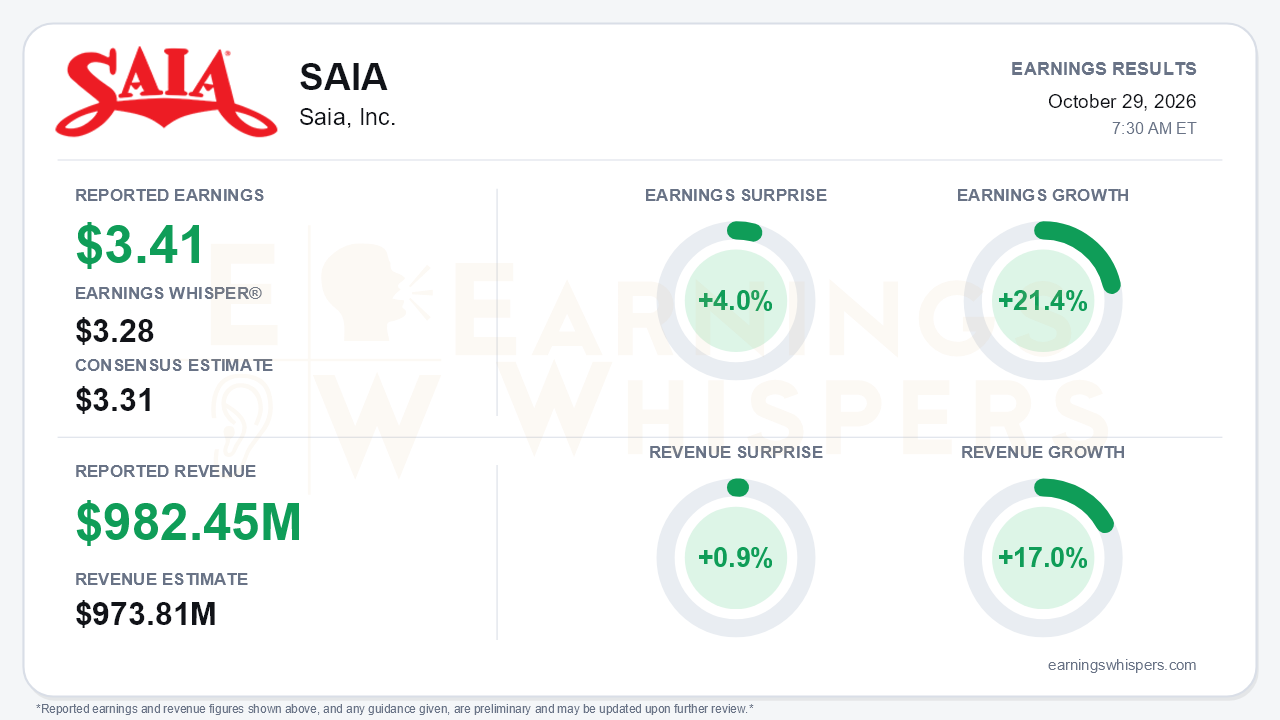
Saia delivered a clean beat on the numbers that matter most to the market. Third-quarter earnings of $3.41 per share topped the $3.31 consensus by 4.0% and cleared the $3.28 Earnings Whisper number. Revenue reached a record $982.45 million, 0.9% above expectations. Earnings grew 21.4% year over year and revenue rose 17.0%, keeping top-line growth near the 17.1% pace of the second quarter, well above the low single digits of late 2025 and early 2026. The more consequential development came on the call. Management beat its own margin guide, raised the bar for fourth-quarter operating ratio, and authorized its first $250 million buyback. The central tension is that pricing and margin momentum are improving just as shipment growth has nearly stalled.
The quality of the beat holds up, with one caveat on the comparison. Prior-year GAAP EPS of $3.22 included a $0.41 net real estate gain. Against the adjusted $2.81, the underlying improvement is larger than the headline year-over-year comparison suggests. Operating income rose 17.5% against the adjusted prior-year figure. Still, the adjusted operating ratio was flat at 87.6%, after a 90-basis-point year-over-year improvement in the second quarter. That figure looks weak in isolation. Management argued it beat seasonal norms, since the ratio deteriorated only about 70 basis points sequentially versus the roughly 100 basis points guided and a historical 150-200. Cost pressure is real. Purchased transportation expense climbed to $90.4 million from $59.3 million, and fuel expense rose 55%. Claims and insurance expense fell, helped by a record 0.3% cargo claims ratio.
Pricing is where the story strengthened most. Revenue per shipment excluding fuel rose 5.8%, accelerating from +1.5% in the second quarter and -1.2% in the first. Contract renewals reached 10.8%, up from 6.7% two quarters ago and 4.9% in the fourth quarter of 2025. The quality of that metric deserves scrutiny, however. Pounds per shipment jumped 8.1%, while revenue per hundredweight excluding fuel fell 2.2%. Part of the per-shipment gain reflects heavier freight and mix actions rather than pure rate. The same mix effect flatters tonnage: record tonnage per workday rose 8.9%, but shipments per workday grew just 0.8%, down sharply from 4.4% in the second quarter. October shipments are running only about 2% higher. Management's description of demand also cooled, moving from 'improving' last quarter to a 'mixed freight environment.'
The forward-looking pieces give bulls the most to work with. Management guided fourth-quarter operating ratio to deteriorate about 200 basis points sequentially, against a historical 250-300. That implies more than 200 basis points of year-over-year improvement, a meaningful step up from the roughly 100 basis points of full-year improvement management was reaching for on the second-quarter call. It also floated about 200 basis points or better of operating ratio improvement in 2027. The capital story has turned decisively. Year-to-date free cash flow was $244.9 million versus $11.6 million a year ago, cash stands at $202.5 million against $100 million of debt, and 2027 capex is framed at 13-14.5% of revenue now that heavy real estate spending is behind the company. Bears still have legitimate ammunition. Year-over-year operating ratio improvement at ramping terminals slowed to 40 basis points from about 300 basis points, and those terminals still run in the low 90s. The high-yield Los Angeles region remains down low single digits. Tighter truckload markets could inflate purchased transportation costs, and possible 2027 headcount additions could add expense.
The market setup is more complicated than the surprise implies. Shares closed at $324.62 ahead of the report, down 15.2% since the open after the July release and 16.4% below the 200-day moving average. The stock sat just 1.0% above its inter-earnings low, set the day before results, after peaking at $390 on the day of the prior report. Investor sentiment was roughly unchanged, edging up to 0.135 from 0.123, a mildly positive but hardly enthusiastic reading. Price trend and AVWAP readings remain negative even as momentum has turned positive. The stock has been priced for disappointment that the margin guidance did not deliver.
The bottom line is that Saia's quarter shifted the debate from whether its network investments can earn a return to how quickly margins expand. The improved fourth-quarter and 2027 operating-ratio framing, accelerating pricing and a new buyback all support that narrative. However, near-flat shipment growth, a mix-driven yield picture and slowing ramp-terminal gains mean margin delivery, not volume, will have to carry the next leg. With the stock near its lows, management's operating-ratio guidance is now the measure investors will hold it to.
Read our earnings preview for Saia, Inc.: https://www.earningswhispers.com/article/SAIA/21126
This earnings review was originally published on Earnings Whispers.
This article is for informational purposes only and is not investment advice. Earnings Whispers and its staff may hold positions in the securities mentioned. It is AI-assisted, based on proprietary Earnings Whispers data and company reports, and edited by Earnings Whispers staff.
Mentioned In This Article
Latest News
| 3 hours | |
| 3 hours | |
| 11 hours | |
| 11 hours | |
| 11 hours | |
| Oct-21 | |
| Oct-13 | |
| Sep-30 | |
| Sep-29 | |
| Sep-10 | |
| Sep-03 | |
| Sep-03 | |
| Aug-20 | |
| Aug-12 | |
| Jul-31 |
