Ares Edges Past Estimates, But Guidance Trims And Slowing Fee Growth Overshadow Record Fundraising
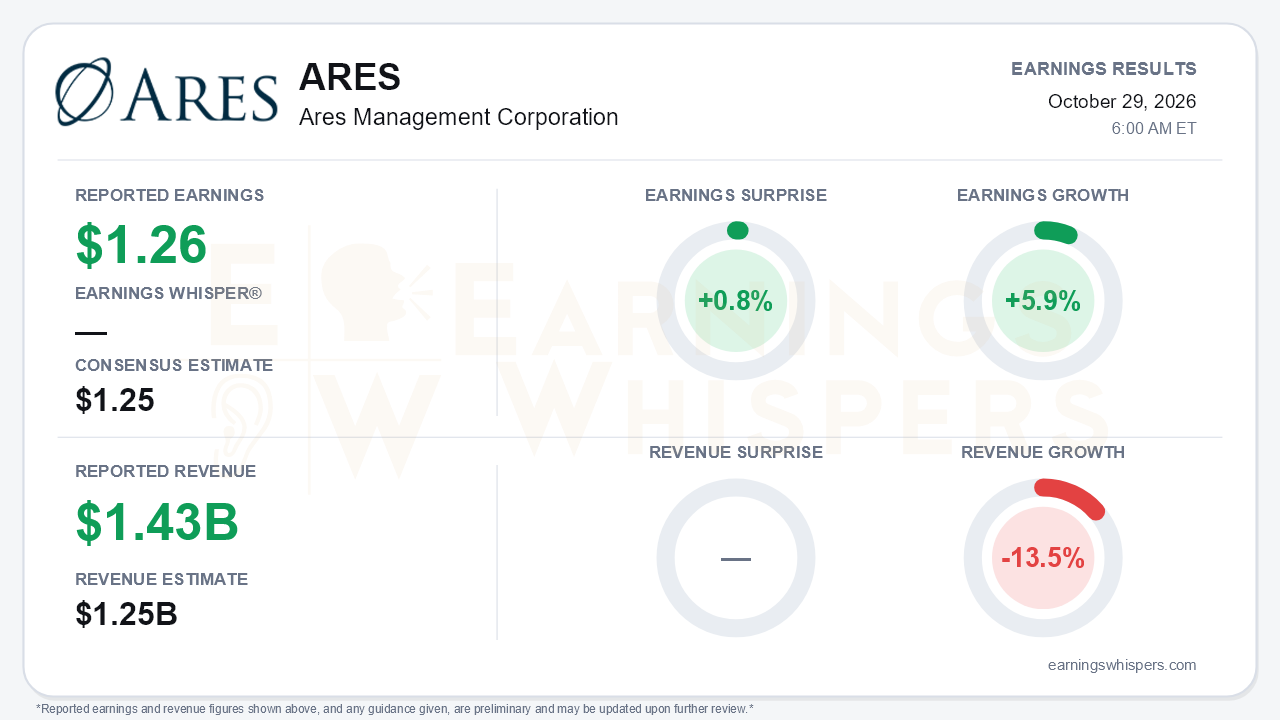
Ares Management (NYSE: ARES) cleared the bar in the third quarter, but only narrowly, and the more important news came from the guidance. After-tax realized income of $1.26 per share topped the $1.25 consensus by 0.8% and grew 5.9% year over year. Revenue of $1.433 billion beat the $1.25 billion estimate by 14.7%, although it fell 13.5% from a year ago. The fundraising story remains intact: Ares raised more than $31 billion in gross commitments and still expects a record year. The central tension is that this was also the quarter when management made its first meaningful cuts to 2026 targets, while the growth rates behind its fee engine continued to slow.
The quality of the beat deserves scrutiny. GAAP net income attributable to Ares was $85.3 million, or $0.21 per share, far below the $449.6 million of after-tax realized income that drives the headline figure. Fee related earnings of $524.2 million and an FRE margin of 42.5%, up from 41.4% a year earlier, show that the core management business remains profitable and expanding. The sequential picture is softer. Realized income slipped to $490 million from $522 million in the second quarter, and after-tax realized income per share eased from $1.29 to $1.26. Gross fundraising of $31 billion was strong, but it was below the record $36 billion raised in the second quarter.
The call showed deceleration beneath a still-impressive capital-raising machine. Management fee growth slowed to 10% year over year from 22% in the first quarter. Fee-paying AUM growth cooled to 13% from 19% in the first quarter and 17% in the second, against total AUM growth of 16%. Several ramps slipped further. The first close of the digital infrastructure fund has moved from summer to late third or fourth quarter, and now to later in the fourth quarter. US direct lending deployment stayed sluggish amid muted M&A, pushing the expected second-half pickup into the fourth quarter. Those delays cost Ares two targets. Management lowered 2026 FRE margin expansion from the high end of its 0-150 basis point range to slightly above the midpoint. It also cut net realized performance income to $300-325 million from roughly $350 million, as European waterfall timing slipped, in many cases by a year or more. The wealth inflow outlook was trimmed as well, from meeting or exceeding last year to roughly in line with about $16 billion.
The forward pipeline still gives bulls something concrete. The new SDL vintage and open-ended SDL Core held a first close above $8 billion, 60% above the prior vintage's first close. JDP-5 closed at its $4 billion hard cap. Global Structured Solutions closed at $4.2 billion against a $1 billion target, and the infrastructure debt fund is expected to close above $6 billion. Wealth raised $4.2 billion, lifting wealth AUM 41% to $82 billion, and BDC net new redemptions fell 60% sequentially. Other forward indicators improved too: $117 billion of AUM is not yet paying fees, available capital reached $174 billion, and US direct lending non-accruals edged down to 1.8%. Management expects digital infrastructure catch-up fees to lift the 2027 FRE margin into the top half of the range. ARCC's agreement to acquire MFIC and a $1.1 billion portfolio purchase add inorganic growth. Bears have legitimate ammunition, however. Rising rates, sovereign yield widening, volatility in data center financing spreads and possible commercial real estate disruption were all newly emphasized risks, and analysts pressed on the slowdown.
Investor sentiment improved materially heading into the report, rising from roughly neutral at -0.02 to a moderately positive 0.30. That shift collides with a guidance-trim quarter, and the market setup is more complicated than the surprise implies. As of the pre-report snapshot, the shares traded at $123.82, down 3.6% since the open following the July report and about 1.3% below the 200-day moving average of $125.41. The stock peaked at $149.87 in mid-August, then slid to $110.30 on October 15 before rebounding. That leaves it 17.4% below the quarter's high and 12.3% above its low. The Earnings Whispers price and AVWAP trend readings remain negative, even as momentum has turned positive. That pattern fits a rebound that has not yet repaired the broader damage.
The bottom line is that Ares delivered a narrow beat and another strong fundraising quarter, but the investment case now rests more heavily on timing than on momentum. Management fee and fee-paying AUM growth are decelerating, and the 2026 margin and performance-income targets have come down. The upside depends on a crowded fourth quarter, including the digital infrastructure close, a direct lending deployment rebound and European realizations, followed by a 2027 lift from fees on capital already raised. Improved sentiment suggests investors are willing to look through the delays, but the stock still needs evidence that those delays will not keep recurring.
Read our earnings preview for Ares Management Corporation: https://www.earningswhispers.com/article/ARES/21025
This earnings review was originally published on Earnings Whispers.
This article is for informational purposes only and is not investment advice. Earnings Whispers and its staff may hold positions in the securities mentioned. It is AI-assisted, based on proprietary Earnings Whispers data and company reports, and edited by Earnings Whispers staff.
Mentioned In This Article
Latest News
| Oct-29 | |
| Oct-29 | |
| Oct-29 | |
| Oct-29 | |
| Oct-29 | |
| Oct-27 | |
| Oct-27 | |
| Oct-27 | |
| Oct-26 | |
| Oct-21 | |
| Oct-21 | |
| Oct-21 | |
| Oct-19 | |
| Oct-14 | |
| Oct-12 |
