GATX Raises Its Outlook Again On Lumpy Gains And Wells Fargo Upside As Lease-Rate Momentum Keeps Fading
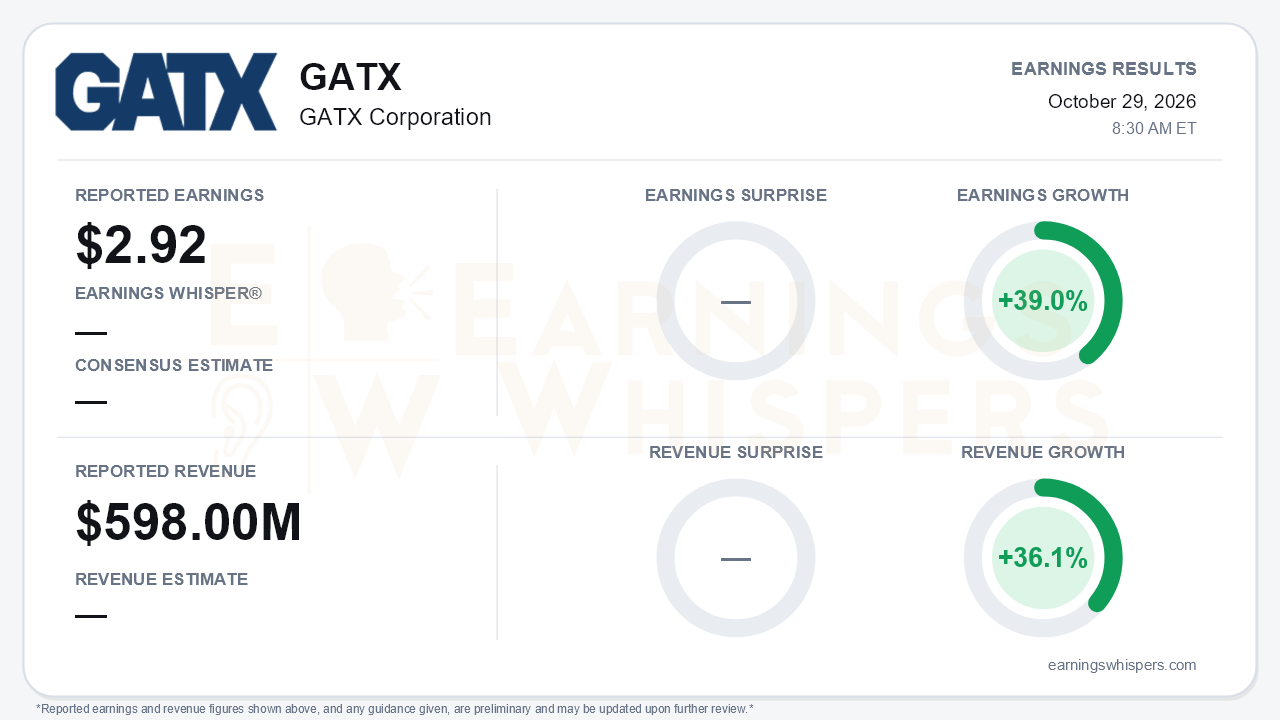
GATX delivered another strong quarter and raised its full-year outlook for the second consecutive report. Third-quarter diluted EPS came in at $2.92, up 39.0% from $2.25 a year earlier. Revenue rose 36.1% to $598.0 million. Management now expects 2026 earnings to modestly exceed the top of its $9.90-$10.30 range. That range had already been lifted from the original $9.50-$10.10. No consensus or Whisper figure was available, so the quarter has to be judged against the company's own trajectory. On that basis it looks impressive. The year-ago figure also included a $0.15 net benefit from insurance proceeds and acquisition costs, which makes the underlying comparison even better than the headline. The central tension is what is driving the upside. The beat is increasingly coming from gains and fees, while the core lease-pricing engine keeps losing altitude.
The quality of the quarter deserves scrutiny. Net gains on asset dispositions more than doubled to $51.7 million from $23.1 million, and Rail North America alone booked $50.3 million. Management fees on the Brookfield-owned finance lease portfolio jumped to roughly $15 million, up from about $2.8 million per quarter in the first half. Asset-sale fees drove that increase. Together, these two items explain much of Rail North America's leap in segment profit to $121.3 million from $70.7 million. The Wells Fargo acquisition roughly doubled the North American fleet, which lifted lease revenue to $514.2 million from $377.1 million. It also pushed interest expense up to $143.7 million from $98.2 million and depreciation to $165.7 million from $109.5 million. Engine Leasing segment profit fell to $51.4 million from $60.4 million. However, the prior-year figure included a $10.9 million one-time benefit, and the company says results improved on a clean basis because of stronger RRPF operating and remarketing income.
The call reinforced both sides of the story. The positives are real:
- Fleet utilization rose to 98.4% from 98.0% in the second quarter.
- The renewal success rate climbed for a second straight quarter, from 79.1% to 82.6% to 86.1%.
- Rail Europe utilization improved to 96.1%.
- Management described sequential pricing as flat to slightly up across most of the fleet.
- The Wells deal has contributed about $0.50 year to date, versus an original full-year expectation of $0.20-$0.30.
But the Lease Price Index has slid from 22.3% in the first quarter to 16.8% to 12.4%. That is now below management's own high-teens to low-20s full-year target. The average renewal term has shortened every quarter, from 60 months a year ago to 52. Management attributes the LPI decline to the trailing-twelve-month absorption of the Wells fleet, mix, and the weak small-cube sand hopper fleet. It sizes the revenue impact at under $5 million a year. That explanation is plausible, but bears have legitimate ammunition. Lease rates are still rising on renewal, just at a steadily slower pace.
The forward catalysts lean on the same lumpy sources. Remarketing gains are now expected to slightly exceed the $200 million full-year target, with $167.8 million already booked. Management declined to quantify how far it would beat the top of guidance, citing uncertain fourth-quarter timing for gains and Brookfield sale fees. Engine Leasing is expected to beat its roughly $180 million target. Rail International may come in slightly light of about $130 million. Other items to watch:
- Buybacks accelerated to $78.5 million in the quarter.
- Groundwork is being laid to insource joint-venture maintenance on a modest scale in 2027.
- Potential tank-car tariffs could raise replacement costs and the value of the installed fleet.
- Investment outside the Wells deal, about $1 billion, is lighter than in prior years.
- Expectations for further rate increases weigh on a balance sheet carrying roughly $11.9 billion of recourse debt.
The market has not been rewarding the story. Shares opened at $190.94 after the July report, which turned out to be the high of the inter-earnings period. The stock then slid to a low of $158.88 on October 8 and entered this report at $168.87. That is 11.6% below the post-report open and 5.6% under the 200-day moving average. Investor sentiment flipped from modestly positive (0.13) to modestly negative (-0.11), a meaningful swing for this scale. The Earnings Whispers trend readings are split: price and AVWAP trends are negative, while sequential growth and momentum are positive. That split fits a stock whose reported numbers keep improving even as investors question their durability.
The bottom line is that GATX keeps raising expectations, and the Wells Fargo acquisition is outperforming. However, the upside increasingly rests on secondary-market gains and fee income, while LPI and renewal terms continue to decelerate. Investors who sold the stock down after July were focused on that slowing pricing engine, and this report did not remove the concern. A stabilizing LPI in the coming quarters would do more for the setup than another gain-driven beat.
Read our earnings preview for GATX Corporation: https://www.earningswhispers.com/article/GATX/21075
This earnings review was originally published on Earnings Whispers.
This article is for informational purposes only and is not investment advice. Earnings Whispers and its staff may hold positions in the securities mentioned. It is AI-assisted, based on proprietary Earnings Whispers data and company reports, and edited by Earnings Whispers staff.
Mentioned In This Article
Latest News
| 5 hours | |
| Oct-29 | |
| Oct-29 | |
| Oct-29 | |
| Oct-21 | |
| Oct-08 | |
| Sep-22 | |
| Sep-15 | |
| Sep-11 | |
| Aug-05 | |
| Jul-31 | |
| Jul-30 | |
| Jul-30 | |
| Jul-30 | |
| Jul-08 |
