Southside Bancshares Beats On A Margin Rebound, But A Shrinking Pipeline And Pricier Funding Cloud The Outlook
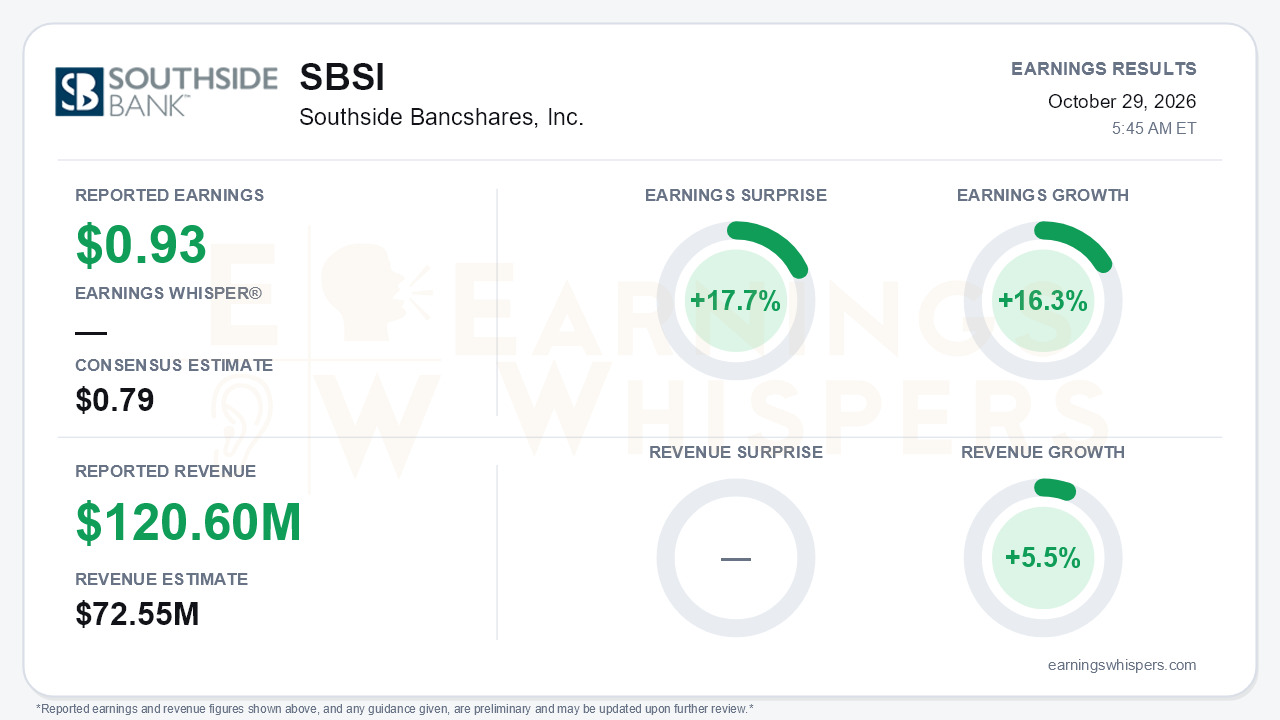
Southside Bancshares (NYSE: SBSI) delivered a clean earnings beat for the third quarter, posting $0.93 per share against a $0.79 consensus, a 17.7% surprise. Earnings Whispers measures earnings growth at 16.3% year over year, and revenue growth at 5.5%. GAAP EPS jumped from $0.16, but the year-ago quarter absorbed a $24.4 million loss on the sale of available-for-sale securities, so the normalized growth rate is the better gauge of the underlying business. The reported 66.2% revenue surprise ($120.6 million versus $72.55 million) appears to reflect a broader revenue definition than the consensus figure. The company's own total revenue measure was $76.1 million, up from $72.8 million in the second quarter. That makes the EPS beat the more meaningful signal. The central tension is that the margin story improved materially while the growth story got weaker.
The quality of the beat holds up reasonably well. Net interest income rose $3.0 million, or 5.2%, from the prior quarter to $60.3 million. The tax-equivalent net interest margin climbed 12 basis points to 3.02%. In the second quarter, management had framed the outlook around continued margin pressure absent a rate hike, so this rebound beat its own expectations. The drivers were higher securities yields (mortgage-backed yields rose to 5.23% from 5.00%), firmer loan yields and a five-basis-point drop in total deposit costs to 1.89%. Expenses stayed contained, and the tax-equivalent efficiency ratio improved to 51.55% from 52.96%. EPS has now stepped up from $0.70 to $0.78, $0.90 and $0.93 over four quarters, though the sequential gain this quarter was the smallest of that run. One caveat is that part of the linked-quarter NII gain came from an extra day, and the effective tax rate rose to 18.3%.
Beneath the margin improvement, the balance sheet tells a less comfortable story. Loans grew just $9.1 million, because roughly $276 million of funded production was offset by $281 million of payoffs. Management cut its 2026 loan growth outlook to low-to-mid single digits, after holding at mid single digits for three straight quarters, and flagged similar growth for 2027. The pipeline fell to $1.2 billion from $1.47 billion in the second quarter and roughly $2 billion in January. Deposits fell $155.6 million, or 2.5%, led by a $200.2 million drop in public funds, including about $141 million of CDs the bank chose not to match on price. Wholesale funding rose $334 million to $1.7 billion. The mix is shifting in a constructive direction, with C&I loans now 18% of the book and 24% of the pipeline. Still, a bank funding flat loan balances with more borrowed money is not a growth story.
The near-term catalysts are real. Management said it is bullish on fourth-quarter loan yields. About 55% of the loan book reprices within 90 days of the September Fed hike, and the third quarter captured only about two weeks of that benefit. Another $131 million of fixed-rate loans at roughly 4.75% also reprice in the fourth quarter. Trust fees rose 27% year to date on $1.8 billion of assets under management, and the company is launching a HELOC push and pursuing team lift-outs expected in 2027. Bears have legitimate ammunition on the other side, however. About $517 million of fourth-quarter CDs reprice to roughly 3.90% from 3.62%, and fourth-quarter operating expenses are guided to $40.5 million from $39.0 million. Unrealized AFS losses widened to $93.3 million from $9.8 million, which pushed tangible book value down to $21.50 from $22.84 and tangible equity to 7.40% of tangible assets. The rise in nonperforming assets to 0.18% of assets came from a single $5.2 million CRE loan that paid off October 1, and classified loans declined.
Investor sentiment improved sharply heading into the report, rising from -0.41 to -0.07. Expectations have moved from clearly pessimistic to roughly neutral. The stock has not followed. At $31.63 before the release, shares were down 8.3% since the open after the July report and sat 2.3% below the 200-day moving average of $32.38. That left them about 9% below the inter-earnings high and 6.9% above the October 7 low of $29.59. The company resumed buybacks after quarter end, purchasing shares near $30. Price and AVWAP trend readings remain negative.
The bottom line is that Southside earned its beat through genuine margin expansion and cost discipline, and the September rate hike gives fourth-quarter asset yields a visible tailwind. Offsetting that are a shrinking pipeline, reduced loan growth guidance, rising wholesale funding and CD repricing pressure, all of which limit how far that margin story can carry earnings. The setup now hinges on whether repricing gains outrun higher funding costs, while loan growth looks likely to stay muted into 2027.
Read our earnings preview for Southside Bancshares, Inc.: https://www.earningswhispers.com/article/SBSI/21127
This earnings review was originally published on Earnings Whispers.
This article is for informational purposes only and is not investment advice. Earnings Whispers and its staff may hold positions in the securities mentioned. It is AI-assisted, based on proprietary Earnings Whispers data and company reports, and edited by Earnings Whispers staff.
Mentioned In This Article
Latest News
| Oct-29 | |
| Oct-29 | |
| Oct-29 | |
| Oct-21 | |
| Oct-15 | |
| Aug-06 | |
| Jul-24 | |
| Jul-24 | |
| Jul-24 | |
| Jul-24 | |
| Jul-10 | |
| May-06 | |
| May-01 | |
| Apr-30 | |
| Apr-30 |
