Green Brick Misses As Margin Erosion, Softer Orders And A Smaller Land Budget Point To A Tougher Housing Cycle
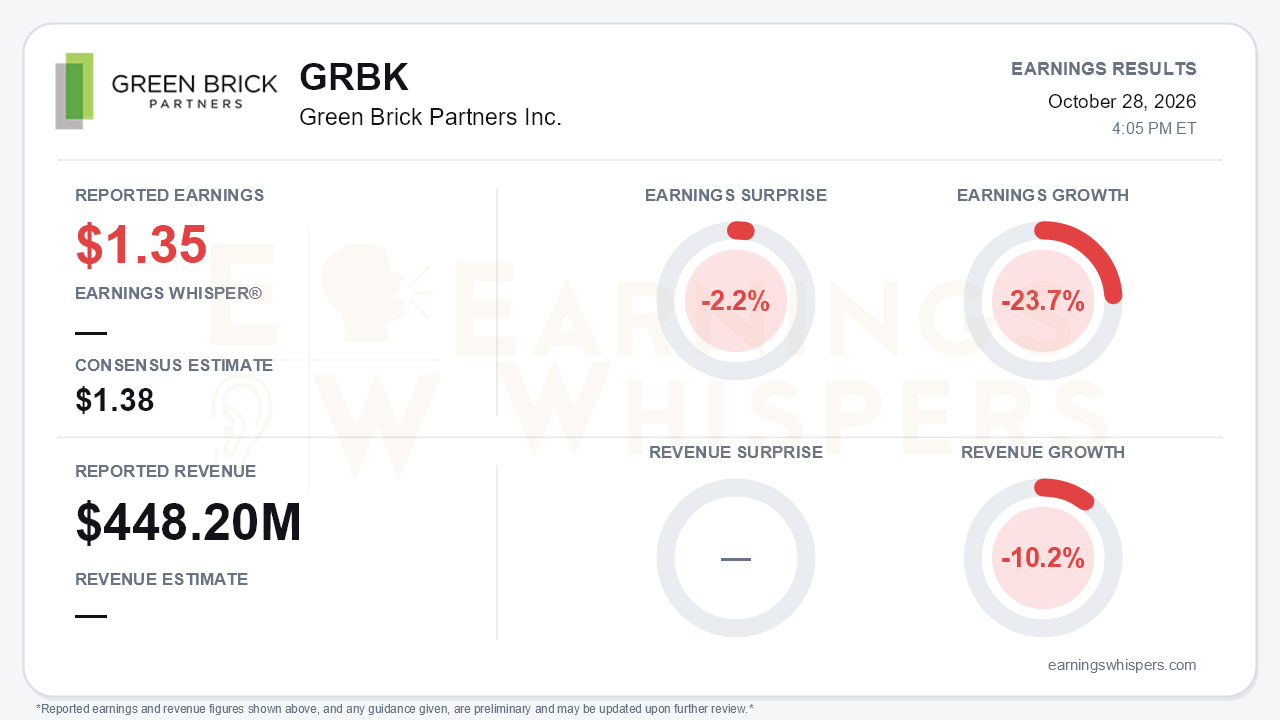
Green Brick Partners earned $1.35 per share in the third quarter, missing the $1.38 consensus by 2.2%. EPS fell 23.7% year over year and revenue fell 10.2% to $448.2 million. The miss itself was small. The bigger issue is that the quarter showed a clear slowdown from a strong second quarter. Order growth slowed sharply, gross margin fell, the land budget was cut, and management's language shifted from a market "finding stable footing" to a "difficult housing market." Green Brick is still one of the most profitable and least leveraged builders in the group. However, this report suggests the down-cycle is now affecting its results more directly.
The quality of the quarter deserves scrutiny. Deliveries rose 2.6% to 978 homes, but the average sales price fell 12.1% to $446,700. As a result, home closing revenue declined 9.8%. Homebuilding gross margin fell to 28.0%, down 410 basis points from 32.1% a year ago, and down from 29.8% in Q2 and 28.9% in Q1. The Q2 figure included a 60-basis-point warranty benefit, but Q3 was still below Q1. Pre-tax income dropped 26.9%. Two items softened the hit to EPS: net income attributable to noncontrolling interests fell to $2.3 million from $5.6 million, and the diluted share count was slightly lower. Financial services was the clear bright spot. Operating income rose 69% to $5.6 million on 42% more loan originations. That segment is still small relative to the homebuilding decline.
The forward indicators are weaker than the headline order growth suggests. Net orders rose 3.1% to 926, compared with growth of about 19% in Q2. The dollar value of those orders fell 1.1% because the average order price dropped 4.1%. Monthly sales pace slowed to 2.8 per community from 3.3 in Q2. The cancellation rate rose to 8.2% from 6.7%. Backlog units fell 6.8%, and backlog dollar value fell 17%, which points to lower revenue ahead.
Incentives on new orders reached 11%, and closing incentives rose to 9.9% from 8.8% in Q2. Management also said base-price cuts are not reflected in those incentive figures and guided ASP lower again in Q4. In other words, the reported incentive figures likely understate the full pricing pressure.
There is also a contradiction in management's messaging. Co-CEO Jim Brickman called demand "resilient" while also saying the company is responding to "deteriorating market conditions" to maintain sales pace. The data supports the second description more than the first.
The call added several new risks:
- **Labor costs:** Immigration enforcement is creating labor constraints, especially in Austin. This is the first cost pressure management has flagged, after describing falling direct costs in Q2. Management also suggested cycle-time gains have bottomed, even though cycle time improved to 116 days.
- **Move-up demand:** The $500,000-$800,000 move-up buyer in Atlanta and North Dallas was described as "frozen."
- **Mortgage expansion:** The long-term mortgage capture target was cut again, to roughly 70% from 75-85% at the start of the year. The Atlanta mortgage rollout slipped to possibly 2027.
- **Land spending:** The 2026 land investment guide was cut to $780 million from $850 million. Land underwriting now assumes elevated incentives of about 10%.
- **Spec inventory:** Completed spec homes jumped to 562 from 410 in Q2. That raises the risk that more incentives will be needed to clear inventory.
The main offsets are real. Trophy Signature Homes reached 60% of both orders and deliveries for the first time, and its monthly pace rose to 5.2 from 4.7 a year ago. Average community count increased 5.8% to 109. The company retired its remaining $50 million of 2026 senior notes, and book value per share grew 14% to $46.10. Management also argued that competitors with lower margins have little room to add incentives, which could help Green Brick gain market share. Liquidity, however, fell to $325 million from $462 million in Q2, and homebuilding debt to capital rose to 13.1% from 11.2% in Q2, although it is still below 15.3% a year ago.
The market had already priced in part of this slowdown. Shares closed at $62.92, down 14.0% from the opening price after the July report and 9.6% below the 200-day moving average of $69.64. The Earnings Whispers price and AVWAP trend readings are both negative, consistent with sustained selling pressure. Investor sentiment is modestly negative at -0.13, which suggests caution rather than capitulation. That leaves room for opinion to move either way depending on how margins and orders develop.
The bottom line is that Green Brick's narrow EPS miss understates how much the quarter weakened compared with Q2. Margin compression, falling order and backlog values, a reduced land budget, rising spec inventory, and new labor-cost pressure all point to more earnings pressure ahead. Low leverage, peer-leading margins, and Trophy's momentum give the company a strong position for a down-cycle. Still, bears have legitimate ammunition until incentives stabilize and the decline in gross margin slows.
This earnings review was originally published on Earnings Whispers.
This article is for informational purposes only and is not investment advice. Earnings Whispers and its staff may hold positions in the securities mentioned. It is AI-assisted, based on proprietary Earnings Whispers data and company reports, and edited by Earnings Whispers staff.
Mentioned In This Article
Latest News
| Oct-29 | |
| Oct-28 | |
| Oct-28 | |
| Oct-01 | |
| Sep-18 | |
| Sep-17 | |
| Sep-15 | |
| Sep-11 | |
| Aug-27 | |
| Aug-26 | |
| Jul-30 | |
| Jul-30 | |
| Jul-29 | |
| Jul-29 | |
| Jul-07 |
