Edison International Tops EPS Estimates, But The Failed Wildfire-Reform Push Now Overshadows Reaffirmed Guidance
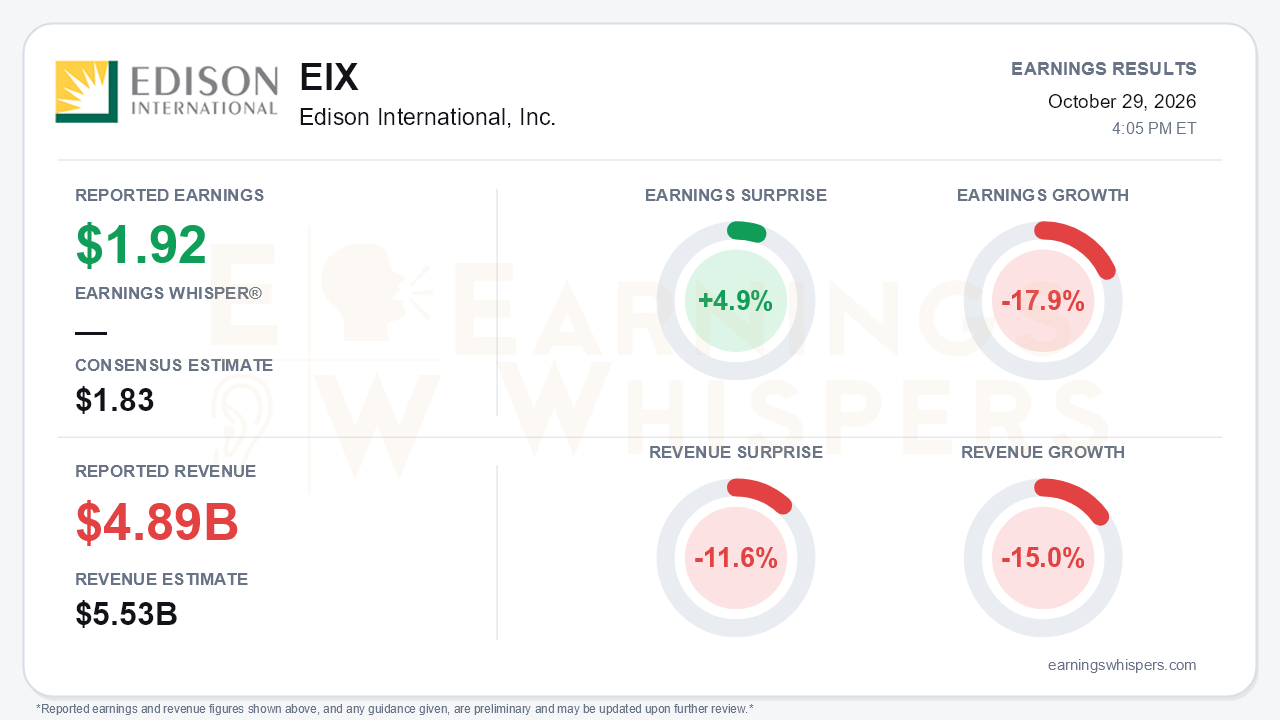
Edison International delivered a quarter that looks acceptable on paper and is largely beside the point. Core EPS of $1.92 beat the $1.83 consensus by 4.9%, and management reaffirmed 2026 core EPS guidance of $5.90 to $6.20. But earnings fell 17.9% from a year ago. Revenue of $4.886 billion missed the $5.53 billion consensus by 11.6% and declined 15.0%. The bigger change came after the numbers. California's legislative session ended without durable wildfire reform, and the call turned noticeably more defensive. That is the central tension: the near-term earnings plan is intact, but the policy framework underpinning the long-term investment case is now openly in question.
The year-over-year decline is less alarming than it looks. The prior-year quarter included roughly $0.55 of retroactive earnings recognized when SCE implemented its 2025 GRC final decision, an item that cannot repeat. Excluding that comparison, SCE benefited from the GRC's escalation mechanism. Year-to-date core EPS of $4.89 is ahead of last year's $4.68. GAAP EPS fell to $1.88 from $2.16. The quality of the beat still deserves scrutiny. Pretax income was roughly halved, from $1.063 billion to $548 million, and interest expense rose to $545 million from $488 million. Net income was supported by a $203 million income tax benefit, compared with $175 million of tax expense a year ago. Lower preferred dividends, following $538 million of preferred repurchases, also helped the parent segment. Operating cash flow improved to $5.39 billion for nine months, aided by regulatory balancing-account collections. Capital spending rose to $5.21 billion and long-term debt climbed to $39.0 billion, which keeps financing costs central to the story.
On the call, management reiterated the full long-term framework:
- 5% to 7% core EPS growth through 2030;
- no equity issuance through 2030;
- a 15% to 17% FFO-to-debt target.
The tone around those targets weakened, however. Management now describes 2026 guidance as having a "bias toward the middle of the range," a step back from last quarter's "strong start" framing. Its hope for a comprehensive wildfire bill by August 31 did not materialize. The company is now pointing to a November 15 deadline for a possible special session, and called a fallback to 2027 "significant and costly." Management also quantified the damage already occurring. Elevated credit spreads are expected to add about $300 million of customer costs on 2027 bond issuances alone. With S&P already rating the utility BBB-, executives openly raised the possibility of a sub-investment-grade rating.
The most consequential forward-looking risk is capital deployment. Absent reform, management said the 2029 GRC, to be filed in about six months, could request less capital for load growth and clean energy. That category represents roughly 22% of CPUC-jurisdictional capex through 2030. No formal cut has been made, but this threatens the roughly 7% rate base growth and the $8 billion to $9 billion 2029 capex outlook cited earlier this year. The Eaton Fire exposure has also hardened. Los Angeles County Fire Department reports concluded SCE equipment caused the ignition. More than 30,000 plaintiffs are pursuing claims, bellwether trials begin in January 2027, and there is still no loss estimate.
There are genuine offsets:
- The Wildfire Recovery Compensation Program has scaled to more than 3,200 offers totaling about $1.1 billion, up from roughly $775 million last quarter, with October the strongest month ahead of the November 30 deadline.
- A third subrogation settlement was reached at about 55 cents on the dollar.
- OEIS approved SCE's 2026-2028 Wildfire Mitigation Plan.
- Roughly 90% of distribution lines in high-fire-risk areas have been hardened.
These steps reduce risk, but they do not replace a legislative liability cap.
The market has already rendered a harsh verdict. Shares closed at $58.83 heading into the report, down 22.5% from the $75.94 opening price after the July release. They sat 13.2% below the 200-day moving average of $67.79. The stock set a 52-week low of $51.10 on September 29 and has since recovered about 15%, but it remains about 23% below the inter-earnings high. Investor sentiment was already negative and slipped modestly further, from -0.49 to -0.55. The Earnings Whispers price and AVWAP trend readings remain negative, while momentum is neutral.
The bottom line is that Edison's earnings beat and reaffirmed guidance matter far less than Sacramento's calendar. The 2026 plan looks achievable, though the beat leaned on tax and financing items rather than pretax strength. Meanwhile, the long-term growth algorithm now depends on wildfire reform that has already missed one deadline. Credit ratings, the 2029 capital request and Eaton litigation all hinge on that outcome. Bears have legitimate ammunition until a special session or a credible 2027 path produces a durable liability framework.
Read our earnings preview for Edison International, Inc.: https://www.earningswhispers.com/article/EIX/21186
This earnings review was originally published on Earnings Whispers.
This article is for informational purposes only and is not investment advice. Earnings Whispers and its staff may hold positions in the securities mentioned. It is AI-assisted, based on proprietary Earnings Whispers data and company reports, and edited by Earnings Whispers staff.
Mentioned In This Article
Latest News
| 5 hours | |
| 7 hours | |
| 7 hours | |
| Oct-21 | |
| Oct-16 | |
| Oct-15 | |
| Oct-15 | |
| Oct-14 | |
| Oct-14 | |
| Oct-13 | |
| Oct-12 | |
| Oct-12 | |
| Oct-08 | |
| Oct-01 | |
| Sep-30 |
