TFI International Misses As U.S. LTL Unravels And Q4 Guidance Steps Down, Overshadowing A Truckload Revival
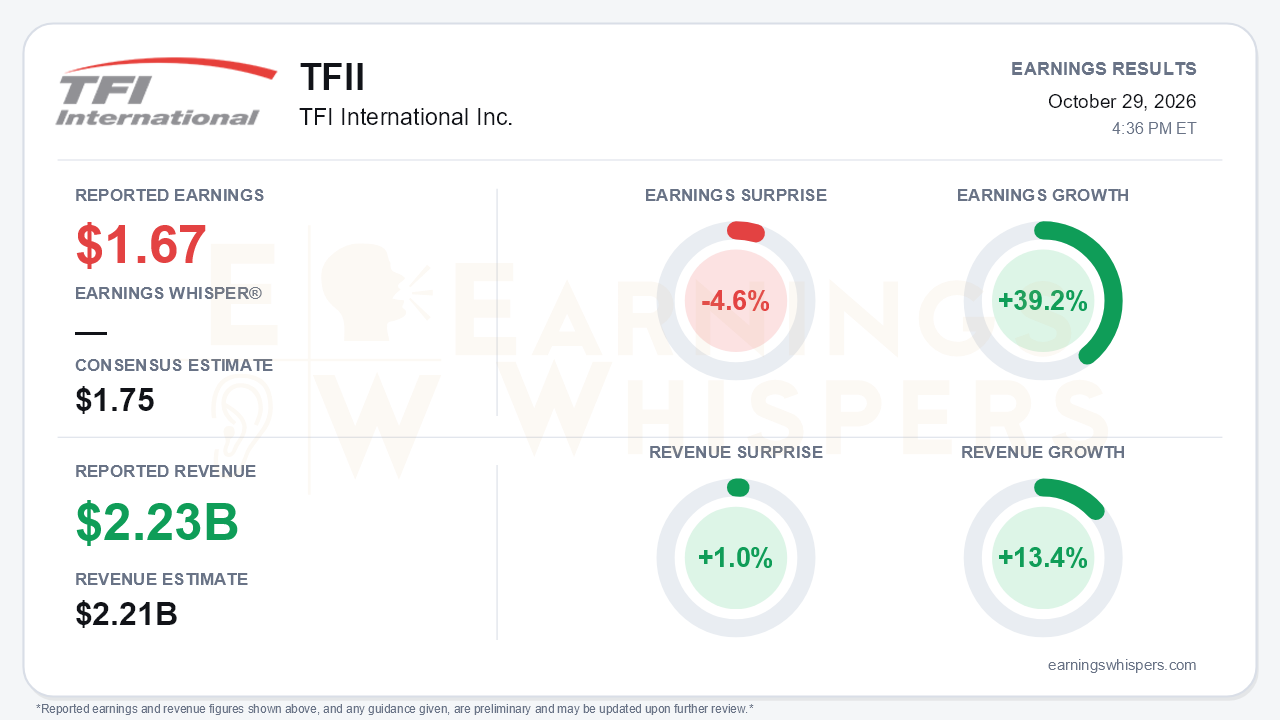
TFI International delivered strong year-over-year growth that still fell short of expectations. Adjusted EPS of $1.67 rose 39.2% from $1.20 a year ago but missed the $1.75 consensus by 4.6%. Revenue of $2.232 billion grew 13.4% and beat consensus by 1.0%. The central tension is that two of TFI's three segments are firing while the third, U.S. less-than-truckload, is deteriorating. Q4 adjusted EPS guidance of $1.30 to $1.40 sits below estimates and well below Q3's $1.67, which itself trailed Q2's $1.85. Year-over-year growth looks impressive, but the sequential earnings path is pointing down.
The quality of the quarter deserves scrutiny in both directions. On the positive side, Truckload operating income nearly doubled to $100.2 million from $52.6 million. Its operating margin widened to 13.3% from 7.7% even with fewer trucks, helped by 13% growth in revenue per truck per week and 49% growth in brokerage revenue. Logistics operating income jumped 59% to $49.4 million at an 11.3% margin. Logistics revenue before fuel surcharge rose about 19% to $437 million, an acceleration from roughly 10% in Q2; total segment revenue including fuel rose 22%.
LTL went the other way. Revenue before fuel surcharge slipped to $677.7 million, and operating income fell 43% to $44.4 million at a 6.6% margin. That figure includes a $14.4 million office-related building impairment, but even setting that charge aside, LTL profitability fell sharply. GAAP EPS rose a more modest 25% to $1.28 because the impairment is excluded from the adjusted figure. Corporate expense also rose to $14.1 million against a prior-year quarter that benefited from a $5.0 million accident-reserve reversal. Consolidated operating margin improved year over year to 9.7% but fell from 11.6% in Q2.
The call made the LTL problem sound worse than the segment numbers. CEO Alain Bédard estimated U.S. LTL is running near a 97 operating ratio, compared with sub-75 in Canada. He called it a "broken story" and attributed it to management and culture, and he said bluntly that service had failed through the first nine months of 2026. Q2 volume overflow pushed freight to discounted third-party carriers just as spot linehaul costs spiked to roughly $2.75 to $2.90 a mile from about $2.20. Meanwhile, U.S. LTL shipment growth slowed to 4% from 7.5%, and weight per shipment is declining. Management's response includes:
- a new executive hired from an LTL peer;
- terminal reductions in Chicago and the New York area;
- a gradual buildout of a non-union, asset-light network;
- pricing actions that began helping late in the quarter.
That remedy will take time. Q4 guidance calls for LTL operating ratio to worsen 0 to 100 basis points year over year, compared with a flat guide for Q3.
Guidance and tone cooled more broadly. The Q4 improvement ranges narrowed for Truckload (400–500 basis points versus 500–600 previously) and Logistics (100–200 versus 250–350). The 2027 Truckload operating-ratio aspiration moved to around 85 "best case," versus the 80–83 floated last quarter. Management still described a freight recession and framed 2026 EPS of roughly $5.50 as far from the prior-cycle $8. Full-year guidance has not been restored. New risks include:
- the end of the UPS GFP reseller partnership in January 2027, worth $4 million-plus in quarterly operating income;
- emerging driver wage inflation;
- high fuel costs;
- steel tariffs;
- the loss of Canadian bank last-mile business.
The offsets are real. Truckload contract renewals are being pushed up around 20%, and leverage fell to 2.1x from 2.6x in Q1. Buybacks resumed with about 400,000 shares repurchased in October. Management guided to $700 million to $800 million of 2027 free cash flow even in a soft market. Q3 free cash flow did drop to $116.4 million from $199.4 million, largely because planned equipment deliveries lifted capex to $132.7 million.
Investor expectations have already reset hard. Earnings Whispers sentiment swung from a moderately positive 0.38 at the prior report to -0.14, a meaningful shift from optimism to mild pessimism. Shares at $112.54 are down 20.2% since the open following the July report and sit 13.1% below the 200-day moving average of $129.53. Price and AVWAP trend readings remain negative. Because the sentiment and price snapshot is dated the day of the release, it may not fully reflect reaction to the call's blunter commentary.
The bottom line is that TFI's Truckload and Logistics turnarounds are genuine and arguably ahead of the cycle, but the miss, the lower Q4 guide and a candid admission that U.S. LTL is broken give bears legitimate ammunition. The stock has already absorbed a steep drawdown. The next leg of the story depends less on Truckload pricing than on whether new leadership and network pruning can stop the LTL bleed before the 2027 targets slip further.
Read our earnings preview for TFI International Inc.: https://www.earningswhispers.com/article/TFII/21253
This earnings review was originally published on Earnings Whispers.
This article is for informational purposes only and is not investment advice. Earnings Whispers and its staff may hold positions in the securities mentioned. It is AI-assisted, based on proprietary Earnings Whispers data and company reports, and edited by Earnings Whispers staff.
Mentioned In This Article
Latest News
| Oct-30 | |
| Oct-30 | |
| Oct-29 | |
| Oct-29 | |
| Oct-29 | |
| Oct-28 | |
| Oct-22 | |
| Oct-16 | |
| Oct-07 | |
| Oct-01 | |
| Sep-23 | |
| Sep-17 | |
| Sep-15 | |
| Sep-04 | |
| Aug-05 |
