Oxford Square Cuts Its Payout By 57% As Falling NII And NAV Force A Reset To Its Earnings Power
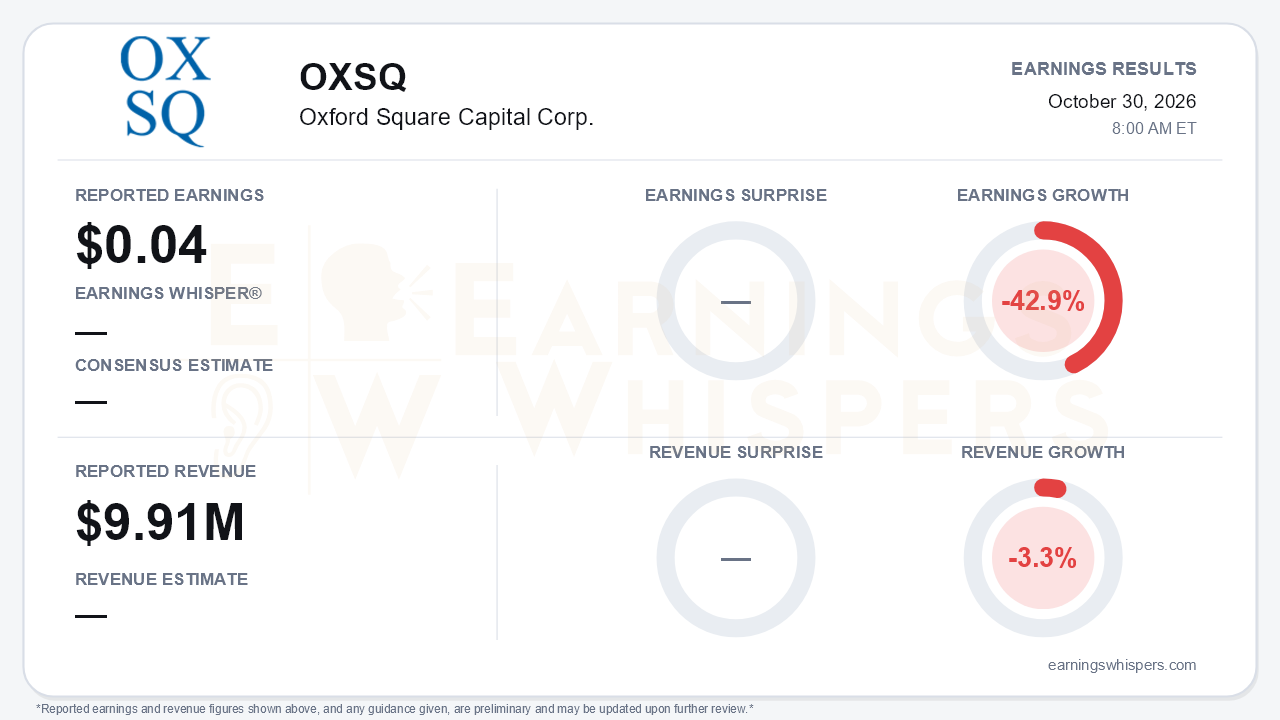
The distribution cut is the story of Oxford Square Capital's third quarter. The board reduced the monthly common distribution from 3.5 cents to 1.5 cents for January through March 2027, a cut of roughly 57%, and management tied it to the company's near-term earnings power. Net investment income was $0.04 per share on total investment income of $9.91 million. No consensus was available for comparison. Earnings fell 42.9% year over year and revenue declined 3.3%, so this was a decelerating quarter. The cut acknowledges what the numbers had been signaling for several quarters: the old 10.5-cent quarterly payout was not being earned, and paying it was eroding the capital base.
The gap was large. NII per share has slid from 7 cents in the fourth quarter of 2025 to 5 cents in the second quarter and 4 cents now. Over the same period the company kept distributing 10.5 cents a quarter. NAV per share fell to $1.21 from $1.29 in June, $1.32 in March and $1.69 at year-end. The new quarterly rate of 4.5 cents still sits slightly above third-quarter NII, so even the reset payout leaves little margin for error.
The quality of the quarter deserves scrutiny.
- **Operations:** Net assets from operations rose $1.6 million, or $0.01 per share, compared with a loss a year ago. That result depended on $7.9 million of unrealized appreciation, largely from loan price gains, which offset $11.3 million of realized losses. Those losses included two CLO equity positions that reached their terminus points. Realized losses now total $47.2 million for the first nine months.
- **Income mix:** Income from securitization vehicles fell to $3.6 million from $4.3 million a year earlier, and the cash distribution yield on CLO equity slipped to 12.0% from 12.4%. Payment-in-kind interest rose to $0.94 million from $0.71 million, which modestly dilutes the cash quality of debt income.
Sequentially the top line did improve. Total investment income climbed from $8.9 million in the first quarter to $9.4 million in the second and $9.9 million in the third. Per-share earnings still fell, for two reasons:
- **Expenses rose.** Total expenses increased to $5.0 million from $4.3 million in the prior quarter, and interest expense ran well above last year's level.
- **The share count swelled.** The company issued 14.1 million shares through its at-the-market program during the quarter. Weighted average shares reached 111.3 million, versus 79.4 million a year earlier.
The issuance carries a nuance. It raised $19.4 million at roughly $1.38 per share, a premium to NAV that added about a penny per share to NAV. But it also spreads a stagnant income stream across a much larger base.
The call marked a clear change in tone. Last quarter management sounded optimistic about deploying capital; this quarter the emphasis was de-risking and deleveraging. The company highlighted the following moves:
- **Lower leverage.** Debt-to-equity fell from 1.26 at the end of the first quarter to 1.07 at quarter-end, and management indicated additional paydown has taken it lower. The September 30 balance sheet, however, shows both unsecured note issues essentially unchanged from December. The improvement through quarter-end therefore came mainly from the larger equity base, not from retiring debt. The lower payout is meant to free cash for actual deleveraging.
- **Portfolio rotation.** Management is shifting toward first-lien secured debt and away from second-lien loans and CLO equity.
- **Secondary-market CLO equity.** Management still calls opportunities there strong.
- **Few primary-market opportunities.** Management described these as scarce, and portfolio turnover slowed to 4.1% from 12.7% a year ago. The artificial-intelligence investment theme highlighted earlier in the year went unmentioned.
The credit backdrop is mixed. On the positive side, the LSTA loan index rose to 95.32% of par and the trailing default rate fell to 0.55%. On the negative side:
- The default rate including liability-management exercises rose to 2.97%.
- The distress ratio climbed to 7.05%.
- CCC loan prices fell 286 basis points.
Oxford Square's own weighted average credit rating moved to 2.2 from 2.1, and preferred equity in one portfolio company, with a fair value of $6.8 million, sits on non-accrual. Bears have legitimate ammunition here. Benign headline default rates are masking stress in the weaker tiers of the loan market, which is where CLO equity returns are most exposed.
The market had largely anticipated trouble. Shares opened at $1.47 after the July report and ended September at $1.28. The 200-day moving average sits at $1.56, well above that quarter-end price. Even after the slide, the stock still traded at a premium to the $1.21 NAV. That premium is what makes accretive ATM issuance possible, but it also leaves the price vulnerable if income investors exit after the cut.
The bottom line is that Oxford Square finally aligned its payout with reality, and that is a necessary step rather than a positive surprise. Sequential income growth, lower leverage and premium-priced equity raises give the company tools to stabilize. However, NII per share is still falling and NAV has dropped by nearly a third since year-end. Management also sees few attractive new investments. Until NII stops shrinking and NAV holds steady, the reset looks more like a defensive retreat than the start of a recovery.
This earnings review was originally published on Earnings Whispers.
This article is for informational purposes only and is not investment advice. Earnings Whispers and its staff may hold positions in the securities mentioned. It is AI-assisted, based on proprietary Earnings Whispers data and company reports, and edited by Earnings Whispers staff.
Mentioned In This Article
Latest News
| Oct-30 | |
| Oct-30 | |
| Oct-23 | |
| Jul-31 | |
| Jul-27 | |
| Apr-29 | |
| Apr-22 | |
| Mar-11 | |
| Mar-03 | |
| Mar-03 | |
| Feb-24 | |
| Feb-20 | |
| Nov-10 | |
| Nov-04 | |
| Nov-03 |
