Mammoth Energy Posts Thin Profit As Aviation Drives 27% EBITDA Margin, While Shrinking Cash And First Debt Raise The Stakes
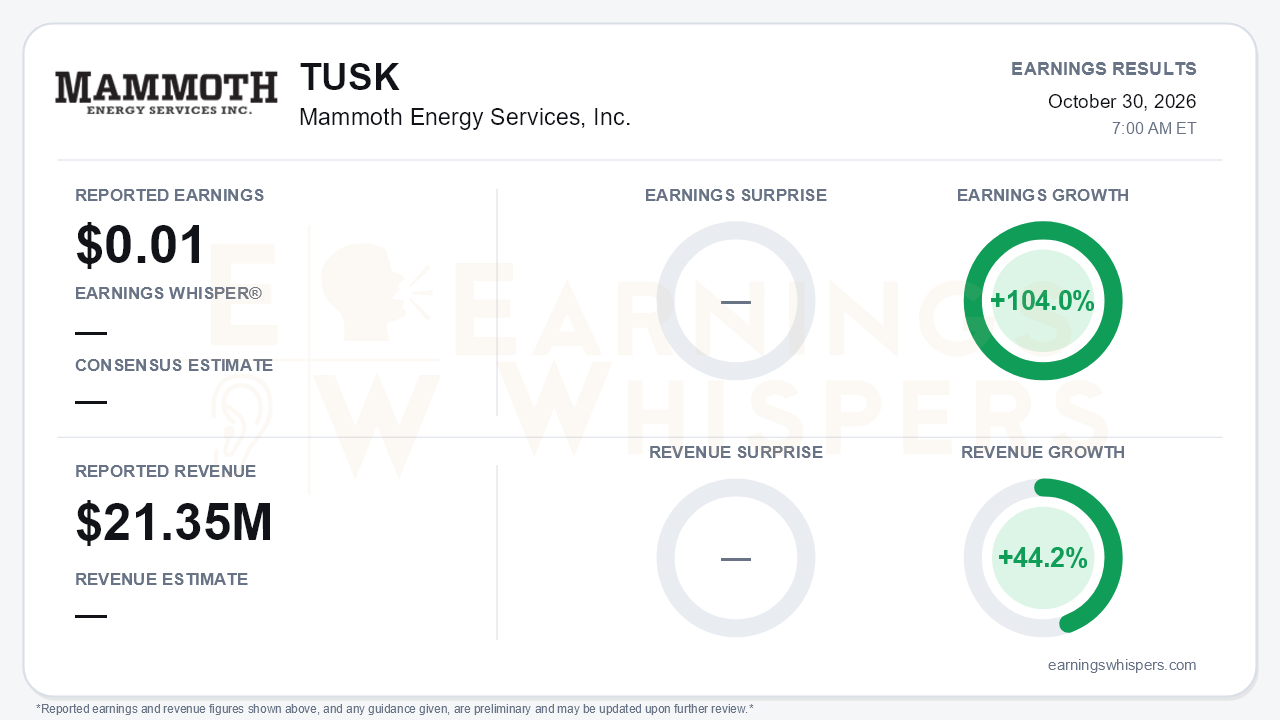
Mammoth Energy Services (NASDAQ: TUSK) returned to profitability in the third quarter, earning $0.01 per share from continuing operations versus a $0.26 loss a year earlier. Earnings Whispers calculates that as earnings growth of 104.0%. The more important number, though, is operating leverage. Adjusted EBITDA more than doubled sequentially to $5.8 million, and margin jumped to 27.2% from 10.0% in the second quarter. Management raised its full-year margin outlook for the third straight quarter. That is the central development: Mammoth's pivot toward aviation leasing is now visibly reshaping its profit profile, even though the funding of that pivot is consuming the balance sheet faster than the earnings are rebuilding it.
The headline revenue comparison needs a caveat. Earnings Whispers' normalized data shows revenue of $21.35 million, up 44.2% year over year. The company describes a 95% increase on a continuing-operations basis against $10.9 million in the prior-year quarter. The gap appears to reflect differing comparison bases. Either way, revenue fell sequentially from $26.1 million. Two factors drove the decline: there were no aviation asset sales, and sand freight revenue dropped by $3.0 million. The quality of the GAAP profit also deserves scrutiny. Mammoth posted an operating loss of $0.4 million as depreciation climbed to $6.6 million from $4.6 million alongside fleet growth. A $1.2 million gain on marketable securities is what pushed pretax income into the black. The $0.3 million net profit is real, but it does not yet show the core business covering the depreciation that comes with an asset-heavy leasing model.
Beneath that, the operating mix improved sharply. Gross margin before depreciation rose to 47% from 26%. Rentals generated $5.0 million of EBITDA at a margin above 50%, up from $3.7 million at 36%. The aviation fleet reached 44 assets, with 29 on lease, compared with 38 and 23 in the second quarter. Portfolio cost climbed to $134.9 million. Sand swung to $1.5 million of EBITDA from a $0.4 million loss on nearly identical tonnage of about 228,000 tons. Pricing also improved to $22.18 per ton. Accommodations margin widened to 32% from 25%. Part of the margin leap is mix, since low-margin freight pass-through fell away. Still, the step-up in rentals profitability is structural rather than cosmetic.
Guidance carries the forward story. Mammoth reaffirmed full-year revenue growth above 90% and now targets a mid-teens adjusted EBITDA margin, which it describes as roughly a year ahead of its March plan. Its initial 2027 outlook calls for adjusted EBITDA growth above 40%. That outlook explicitly excludes material aviation asset sales, which strengthens the credibility of the target. There is a catch, however. With year-to-date margin already at 15%, a mid-teens full-year figure implies a fourth quarter far below the third quarter's 27%. That is consistent with the seasonal softness management flagged in sand, drilling and accommodations. Drilling utilization already fell to 32% from 43%, and infrastructure is still losing about $0.9 million a quarter at under 50% utilization.
Bears have legitimate ammunition on the balance sheet. Cash and marketable securities fell to $37.6 million from $77 million in the second quarter and $125.1 million in the first, and had slipped to $27.5 million by October 27. Nine-month operating cash flow from continuing operations was negative $9.9 million, as receivables and inventory absorbed more than $19 million. The balance sheet also carries $42.3 million of income taxes payable. The new $58 million Bank7 term loan, Mammoth's first financing against its aviation fleet, extends its runway. It also ends the company's no-funded-debt profile. Meanwhile, the actionable aviation pipeline shrank to about $24.5 million from more than $40 million, and no shares were repurchased.
Market context is limited. Shares opened at $3.00 after the August report, and the 200-day moving average sits at $2.77. Investor sentiment and current price data were not available, so it is unclear how much of the margin inflection the market has already priced.
The bottom line is that Mammoth delivered the clearest evidence yet that aviation leasing can turn a struggling oilfield-services collection into a high-margin, recurring-revenue business. The 15 idle aviation assets give 2027 a credible source of upside. However, the profit is still thin at the GAAP line, the fourth quarter will look softer, and liquidity is falling fast enough that execution on deployment now matters more than ever.
This earnings review was originally published on Earnings Whispers.
This article is for informational purposes only and is not investment advice. Earnings Whispers and its staff may hold positions in the securities mentioned. It is AI-assisted, based on proprietary Earnings Whispers data and company reports, and edited by Earnings Whispers staff.
Mentioned In This Article
Latest News
| Oct-30 | |
| Oct-30 | |
| Oct-30 | |
| Oct-14 | |
| Aug-07 | |
| Aug-07 | |
| Jul-14 | |
| May-11 | |
| Apr-20 | |
| Mar-07 | |
| Mar-06 | |
| Mar-06 | |
| Mar-06 | |
| Feb-05 | |
| Dec-02 |
