Mohawk Beats On Buybacks And Pricing, But Weakening Demand And A Soft Q4 Guide Shift The Story To Cash Returns
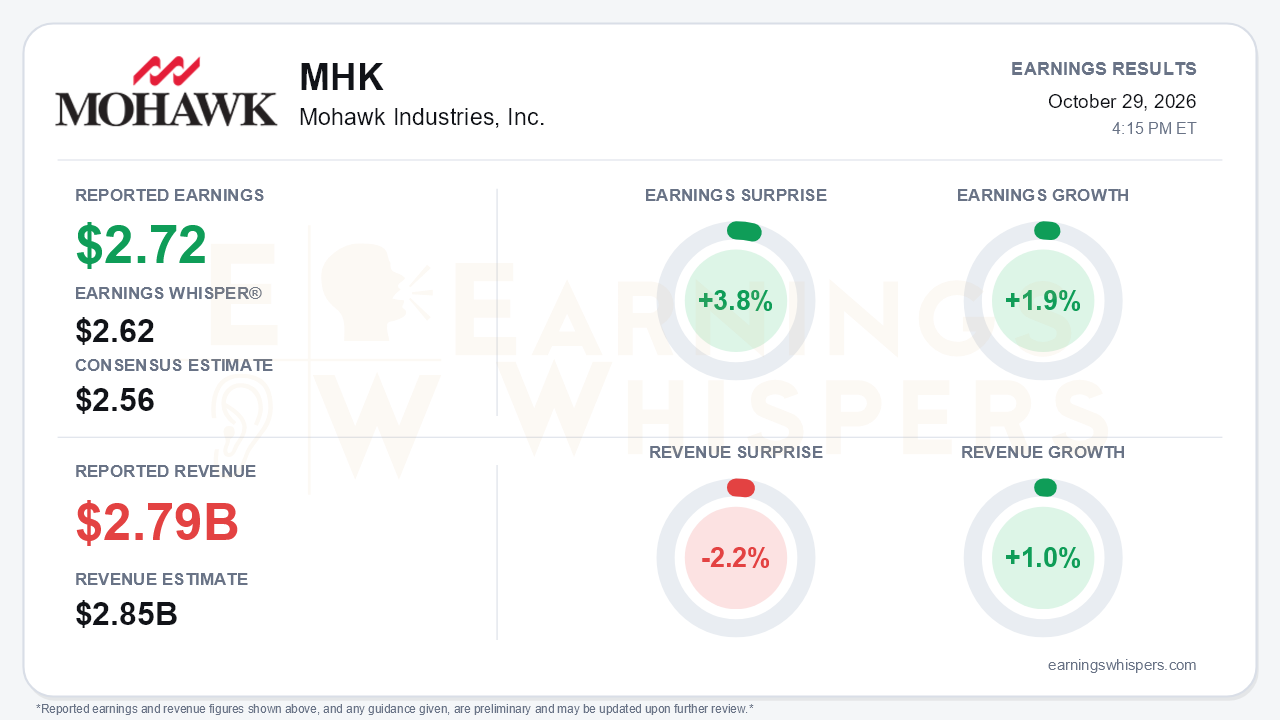
Mohawk Industries (NYSE: MHK) delivered a third-quarter earnings beat that looks stronger on the surface than underneath. Adjusted EPS of $2.72 topped the $2.56 consensus by 3.8% and cleared the $2.62 Earnings Whisper number. It also beat the $2.50 to $2.60 range management guided to on the prior call. Earnings grew just 1.9% year over year, however, and revenue of $2.786 billion rose 1.0% while missing the $2.85 billion consensus by 2.2%. The fourth-quarter outlook of $1.35 to $1.45 in adjusted EPS came in below estimates. That is the central tension: Mohawk is now an inflation-pressured, volume-challenged flooring business whose per-share results depend increasingly on capital returns rather than operating improvement.
The quality of the beat deserves scrutiny. Adjusted pretax earnings were essentially flat at $202.3 million versus $200.6 million a year ago. Adjusted net earnings actually slipped to $163.1 million from $166.5 million because the adjusted tax rate rose to 19.3% from 17.0%. Per-share growth came from a diluted share count that fell to 60.0 million from 62.3 million. Adjusted operating income declined about $5 million to $200 million, and adjusted operating margin narrowed to 7.2% from 7.5%. The call analysis also notes that the quarter benefited from tariff refunds, which the press release does not quantify. GAAP diluted EPS jumped about 55%, but that mostly reflects far smaller restructuring and legal charges than a year ago, not a better business.
The operating picture deteriorated from the second quarter. Adjusted sales were flat with volume down roughly 4%, compared with roughly 5% constant-currency growth and rising volume in Q2. Price and mix contributed about 4%, and together with productivity generated $132 million that more than offset $117 million of underlying inflation. As the call made clear, those offsets are dollar-neutral, not margin-neutral. Segment results diverged sharply. Flooring North America's adjusted margin rose 80 basis points to 8.1%. Flooring Rest of the World gained 100 basis points to 9.3% on 7% price/mix, despite volumes falling about 10%. Global Ceramic was the weak spot: its adjusted margin fell 160 basis points to 6.5% as energy costs bit and commercial projects were deferred.
The forward commentary is where bears have legitimate ammunition. Management said demand weakened exiting the quarter and stayed soft through October, particularly in the U.S. builder channel after renewed rate increases. Underlying inflation has stepped up from low single digits in the first half to mid single digits, and European natural gas prices have roughly doubled since the start of Q3. Management expects the cost headwind to persist into early 2027 and is now planning for market volumes to decline next year. That is a notable retreat from the recovery narrative offered in February. The Q4 guide compares with $2.00 a year ago, reflecting four fewer shipping days (about a 6% sales headwind) and an implied operating margin decline of roughly 100 basis points.
Against that backdrop, new CEO Paul De Cock used his first call to recast the investment case around cash. Q3 free cash flow rose 26% to $390 million, and year-to-date free cash flow of $626 million is up 78%. Buybacks of $261 million in the quarter compare with roughly $60 million per quarter in the first half. The board approved a new $500 million authorization. A net leverage ceiling of up to 2.0x, versus 0.7x today, implies substantial additional repurchase capacity. Capex was trimmed again to about $445 million, with a $375 million baseline going forward. A comprehensive portfolio review raises the possibility of exiting underperforming businesses. On the commercial side, management cited new builder wins, six straight months of rising commercial LVT orders, and further price increases slated for November and January.
Investor sentiment entered the report only mildly positive and slightly softer. It edged down to 0.098 from 0.120 at the prior report, a modest cooling rather than a meaningful shift. The stock has held up better than the fundamentals. Shares sat at $129.99, about 4% above the open following the July report and roughly 12% above the 200-day moving average of $116.25. The market has given Mohawk credit for its cash generation and buybacks. A below-consensus Q4 guide and a declining-volume 2027 assumption leave less cushion for that premium.
The bottom line is that Mohawk's beat was built on pricing discipline, a lower share count and possibly tariff refunds rather than demand. The underlying trajectory weakened: volumes are falling, Ceramic margins are compressing and management is bracing for a softer 2027. The new capital-return framework and portfolio review give shareholders a credible source of per-share support. Investors should recognize, though, that the story has shifted from recovery to cash harvesting in a difficult market.
Read our earnings preview for Mohawk Industries, Inc.: https://www.earningswhispers.com/article/MHK/21217
This earnings review was originally published on Earnings Whispers.
This article is for informational purposes only and is not investment advice. Earnings Whispers and its staff may hold positions in the securities mentioned. It is AI-assisted, based on proprietary Earnings Whispers data and company reports, and edited by Earnings Whispers staff.
Mentioned In This Article
Latest News
| Oct-30 | |
| Oct-29 | |
| Oct-29 | |
| Oct-29 | |
| Oct-21 | |
| Oct-07 | |
| Oct-07 | |
| Oct-06 | |
| Oct-01 | |
| Sep-03 | |
| Jul-31 | |
| Jul-30 | |
| Jul-30 | |
| Jul-01 | |
| Jun-11 |
