Lifezone Metals Puts A Name And A Number On Kabanga Financing, But An Unsigned Tanzania Deal And Shrinking Liquidity Keep The Clock Running
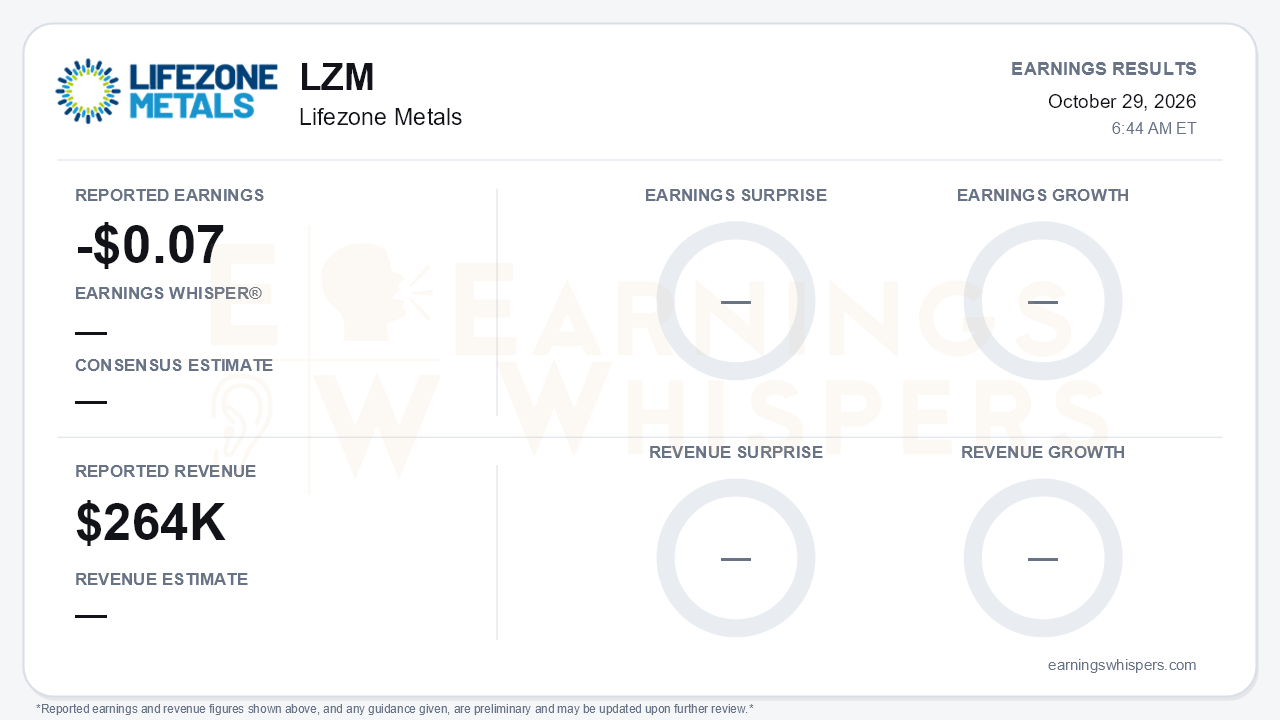
Lifezone Metals (NYSE: LZM) reported a third-quarter loss of $0.07 per share on revenue of just $0.26 million. There was no consensus estimate to measure against, and for a pre-production nickel developer the income statement was never going to be the story. What mattered was whether the long-promised Kabanga financing moved from aspiration to structure. It did, but not all the way. Management named the Orion Critical Mineral Consortium (Orion CMC) as its strategic equity partner and said commercial negotiations are concluded. On the call, it disclosed for the first time total project equity of just over $500 million and project-finance debt of up to roughly $800 million. Yet the Tanzanian Framework Agreement amendment and Joint Financial Model, the gating items for everything else, remain unsigned while cash keeps draining. That is the central tension.
The financial details deserve scrutiny. The nine-month net loss of $13.5 million, or $0.15 per share, was cushioned by $8.9 million of non-cash fair-value gains. Most of that came from the deferred BHP consideration, the warrant liabilities, and the convertible-debenture derivatives, and those gains arose largely because Lifezone's own share price fell from $4.27 to $3.76. A weaker stock flattering the bottom line is not a quality signal. G&A rose to $16.3 million from $12.5 million, driven by $4.9 million of share-based compensation. The underlying cash burn was more disciplined: nine-month operating outflow improved to about $7.9 million from $9.1 million. Simulus revenue reached $1.93 million for nine months versus $0.48 million a year earlier, though the $0.26 million third-quarter figure points to a softer quarter for the lab business.
The liquidity picture changes depending on the reference point. Measured from December, cash rose to $22.2 million from $20.1 million, helped by a $23.3 million equity raise in April and Taurus bridge-loan draws. Measured from the second quarter, cash fell to $22 million from $37.3 million, and total liquidity including the undrawn Taurus facility dropped to $40.5 million from $56 million. Worse, the final $18.3 million Taurus tranche is contingent on the Framework Agreement amendment and expires November 29. A delay in Dar es Salaam therefore has a direct and near-dated balance-sheet consequence.
Operationally, the call carried the most confident tone of the year, including talk of a "material re-rating." Execution readiness supports some of that confidence:
- **Procurement:** Management cited 600+ packages issued. The release more narrowly reports 34 significant packages released to market and 24 tenders received, including EPCM, mining and bulk earthworks.
- **Safety:** LTI-free hours topped 3 million.
- **Asset value:** Kabanga's book value rose to $172 million from $140 million.
- **BHP:** Meeting the IFC resettlement standard cut the BHP consideration cap by $8 million, and BHP has fully exited the shareholder register.
- **PGM recycling:** The Glencore joint venture has selected a site and targets FID in the first quarter of 2027. However, one Department of Energy application was rejected, and the remaining $25.6 million request is still under review.
Bears have legitimate ammunition. FID is now expected in the first quarter of 2027, versus mid-2026 implied two quarters ago. The Framework Agreement described in July as being at the "final courtesy call" stage is still not signed. DFC political-risk insurance is unresolved and separate from the Orion closing. Project-level equity will dilute Lifezone's economic interest in Kabanga, although management intends to remain operator and controlling shareholder. The commodity backdrop has also cooled, with management's nickel outlook shifting from a potential 2026 deficit to "mixed, contradictory signals" as Indonesian ore prices and sulfur eased and Class 1 stocks rose.
Investor sentiment improved meaningfully, rising to -0.56 from -0.94. It remains negative, but the move suggests the named, U.S.-government-linked partner has thawed some of the deepest skepticism. The tape is less forgiving. At $3.63, shares are down 45.4% since the open following the prior report and sit 14.6% below the 200-day moving average of $4.25. Market capitalization of about $307 million is well below the $435 million seen at the first quarter, so the market is still discounting execution and timing risk heavily.
The bottom line is that Lifezone delivered the most concrete Kabanga financing update in its public life: a named sovereign-backed consortium, quantified equity and debt, and a lighter BHP obligation. It did not deliver the one signature that unlocks all of it. Until the Framework Agreement and Joint Financial Model are executed, ideally before the Taurus tranche lapses on November 29, the gap between improving deal visibility and a deteriorating liquidity runway will keep the stock trading on proof rather than promise.
This earnings review was originally published on Earnings Whispers.
This article is for informational purposes only and is not investment advice. Earnings Whispers and its staff may hold positions in the securities mentioned. It is AI-assisted, based on proprietary Earnings Whispers data and company reports, and edited by Earnings Whispers staff.
Mentioned In This Article
Latest News
| Oct-30 | |
| Oct-29 | |
| Oct-28 | |
| Oct-23 | |
| Oct-19 | |
| Oct-07 | |
| Jul-29 | |
| Jul-28 | |
| Jul-27 | |
| Jul-09 | |
| Jun-08 | |
| May-11 | |
| May-05 | |
| Apr-30 | |
| Apr-27 |
