Acadia Realty Trust Matches FFO Estimates As Street Retail Strength Outruns A Flat Guide And A Sliding Stock
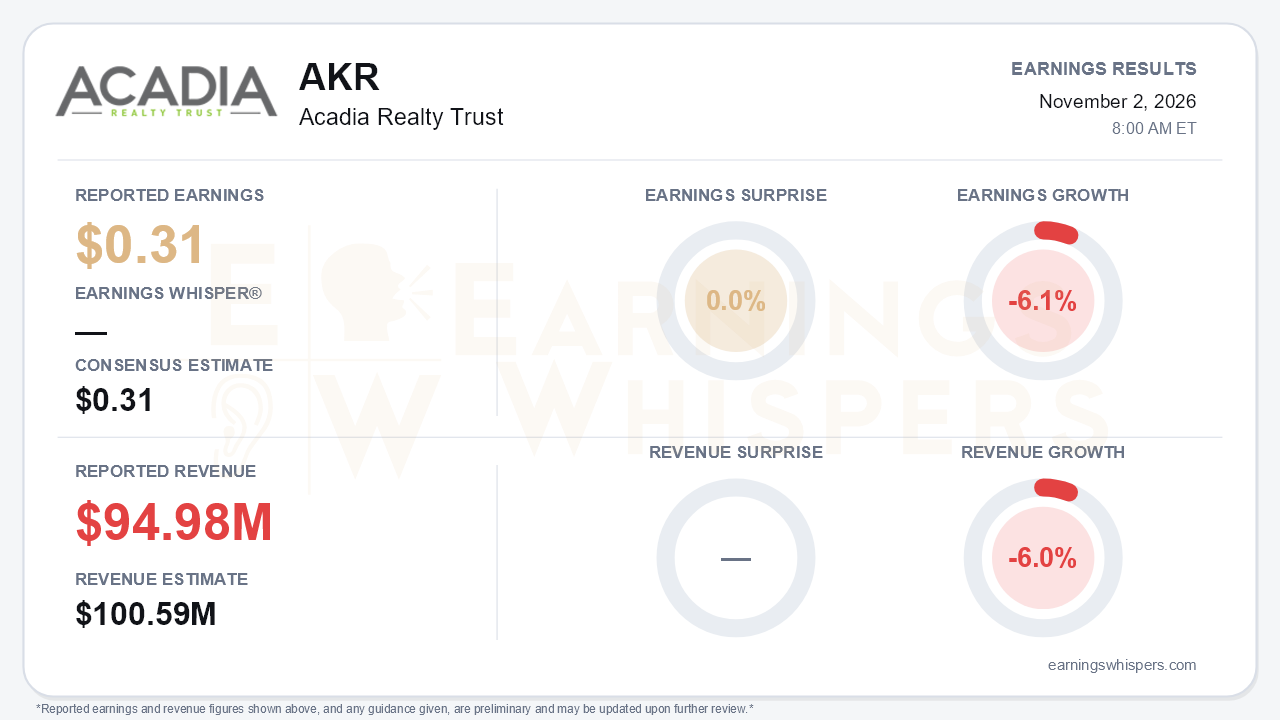
Acadia Realty Trust (NYSE: AKR) delivered a quarter in which the property-level story and the headline numbers point in different directions. FFO As Adjusted of $0.31 per share matched the $0.31 consensus exactly. Revenue of $94.98 million missed the $100.59 million consensus by 5.6% and fell 6.0% year over year. Earnings Whispers' normalized comparison shows earnings down 6.1% from a year ago. The company's own reconciliation frames it more favorably, with FFO As Adjusted rising from $0.29 to $0.31, and investors should be aware that the two prior-year bases differ. That is the central tension: the street retail engine is running as hot as it ever has, yet consolidated revenue is shrinking and management chose not to raise FFO guidance.
The revenue decline reflects how Acadia's business is being reshaped more than any operating weakness. Consolidated rental revenue fell to $90.4 million from $98.7 million as Investment Management dispositions and recapitalizations removed fund-level income. The noncontrolling interest share of consolidated NOI dropped to $10.6 million from $19.6 million. Inside the wholly owned business, the trend ran the other way. REIT Portfolio NOI climbed to $46.6 million from $39.2 million. Same-property NOI rose 10.2%, and street retail grew 15.2%. On a GAAP basis, Acadia swung to a $0.03 loss from $0.03 of net earnings, driven by an $11.7 million ($0.08 per share) impairment on two properties being sold. That charge, along with higher depreciation, pushed net EPS guidance down to $0.29-$0.30 from $0.40-$0.41, though FFO is unaffected.
The call added to the sense that internal growth is accelerating:
- **Same-store guidance:** Management broke from its usual practice of not revising guidance mid-year and lifted 2026 same-property NOI guidance to 7.5%-8.5%, from the original 5%-9% range.
- **Signed-not-open pipeline:** It reached a record $21.8 million, up from $16.5 million in Q2 and $8.9 million at year-end. Management now pegs its FFO run-rate at about $0.11, with the 2027 contribution lifted to roughly $0.06-$0.08 from $0.03-$0.05.
- **Leases in negotiation:** This pipeline exceeds $15 million of annual base rent.
- **Broadening demand:** Large-format demand is reaching markets that lagged, including North Michigan Avenue and San Francisco.
- **Pricing power:** Street market rents are compounding above 12% annually, with SoHo still described as about 30% below market.
- **New leasing spreads:** GAAP and cash spreads on new leases were 98% and 62%.
- **Occupancy:** It slipped 20 basis points, but only because of vacancy in newly acquired Soho and Westport buildings.
The forward catalysts are tangible. Henderson Avenue in Dallas is roughly 90% leased or in advanced negotiation, with tenants including Lululemon and Vuori. Openings are slated through 2027, NOI is weighted to the back half, and the project is targeting an 8%-10% yield on cost. The 129 Fifth Avenue building, acquired vacant, was fully leased within 30 days at a projected yield above 9%. Another $152 million of street acquisitions brought the year-to-date REIT Portfolio total to $351 million.
Bears have legitimate ammunition, however:
- **Flat FFO guidance:** The $1.24-$1.26 range was held after raises in Q1 and Q2. The NOI upside is being absorbed by dilution from Investment Management dispositions and what management called a less favorable interest rate environment.
- **Rate exposure:** Acadia carries about $250 million of floating-rate REIT debt. The recent rate move is also introducing transaction uncertainty and dampening suburban fund activity.
- **Shrinking liquidity:** Liquidity fell to more than $600 million from about $1 billion after deployment.
- **Sunset Park credit risk:** Acadia invested roughly $120 million of incremental capital to become the sole lender on the loan after the borrower failed to fund reserves. That increases its credit exposure.
- **Leasing comparison:** Quarterly new leasing of $8.4 million was a touch below Q2's record, and blended cash spreads of about 25% compared with an outsized 91% in Q2.
The market has leaned toward the cautious reading. Shares closed at $19.03 heading into the report, down 16.3% from the $22.74 open after the July release. The stock set a 52-week high of $23.03 that day, then slid to a 52-week low of $17.96 on October 14. It sits about 6% above that low and 7.7% below its 200-day moving average of $20.62. Investor sentiment slipped from modestly positive (0.11) to slightly negative (-0.05), a meaningful but not dramatic cooling. The Earnings Whispers trend readings are mixed: sequential growth and momentum are positive, while price and AVWAP trends remain negative.
The bottom line is that Acadia's operating fundamentals improved again: record SNO, raised same-store guidance, and a lengthening runway into 2027. Meanwhile, the in-line FFO, revenue miss and unchanged guidance show that rates and portfolio repositioning are capping near-term per-share upside. The stock's slide suggests investors are weighing the rate and capital-markets headwinds more heavily than the leasing momentum. Converting the pipeline into 2027 FFO is what will test whether that discount is warranted.
Read our earnings preview for Acadia Realty Trust: https://www.earningswhispers.com/article/AKR/21339
This earnings review was originally published on Earnings Whispers.
This article is for informational purposes only and is not investment advice. Earnings Whispers and its staff may hold positions in the securities mentioned. It is AI-assisted, based on proprietary Earnings Whispers data and company reports, and edited by Earnings Whispers staff.
Mentioned In This Article
Latest News
| 3 hours | |
| 8 hours | |
| 9 hours | |
| Oct-26 | |
| Oct-19 | |
| Oct-13 | |
| Sep-14 | |
| Sep-08 | |
| Aug-19 | |
| Aug-18 | |
| Aug-05 | |
| Jul-28 | |
| Jul-28 | |
| Jul-02 | |
| Jun-10 |
