DigitalOcean Accelerates To 40% Growth And Lifts 2027 Outlook To 60%+, But The AI Buildout Is Squeezing Per-Share Earnings
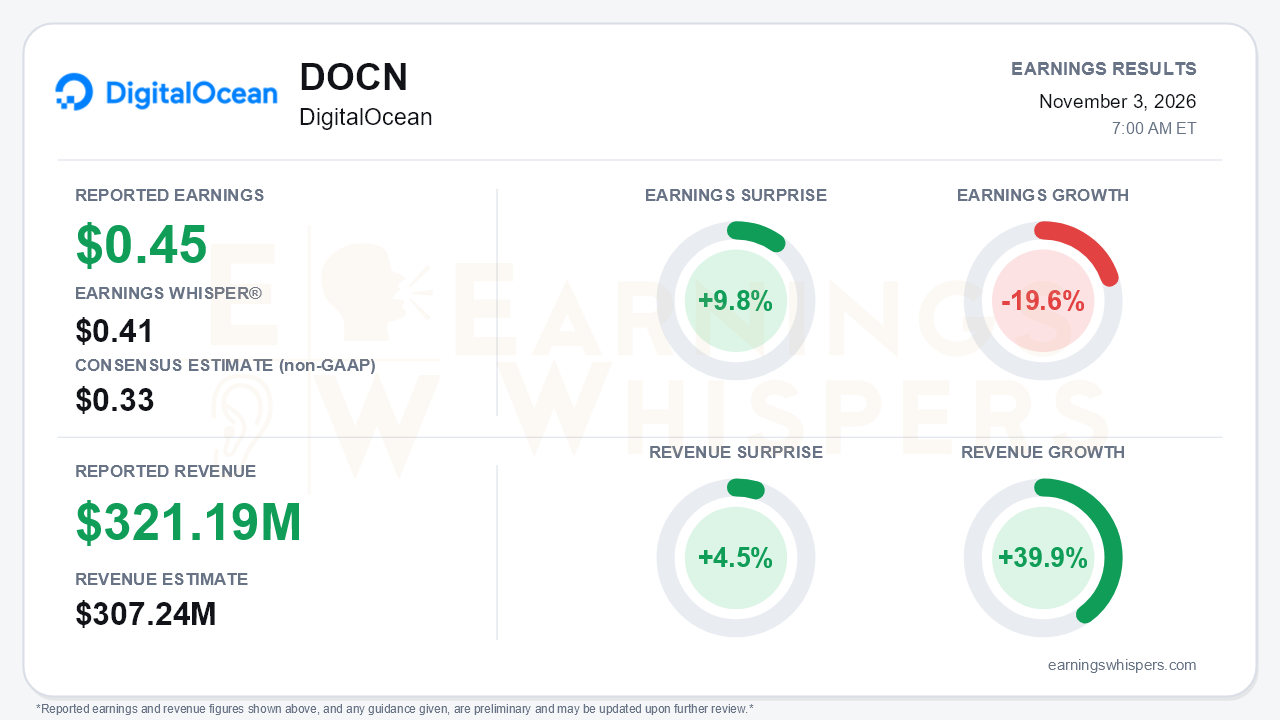
DigitalOcean (NYSE: DOCN) delivered the kind of top-line acceleration that rarely shows up in a mature cloud franchise. Third-quarter revenue rose 39.9% to $321.19 million, topping the $307.24 million consensus by 4.5%. That was the fifth straight quarter of faster growth, following 18%, 22% and 29% in the prior three periods. Non-GAAP earnings of $0.45 per share cleared the $0.33 consensus and the $0.41 Earnings Whisper number, beating expectations by 9.8%. Earnings still fell 19.6% from a year ago. That is the central tension. DigitalOcean is turning AI demand into revenue at an extraordinary pace, but the capital, depreciation, financing and dilution needed to serve that demand are growing faster than per-share profit.
The quality of the beat deserves a closer look. Adjusted EBITDA rose 45% to $144 million, and the 45% margin crushed management's 38-39% guide. Below EBITDA, however, the picture is less flattering. Depreciation and amortization more than doubled to $75 million. Interest expense more than tripled to $16.4 million. Non-GAAP diluted shares climbed to 123.4 million from 105.5 million. GAAP gross margin compressed to about 50% from nearly 60% a year earlier as new data centers and GPUs ramp, and adjusted operating margin slipped to 23% from 30%. GAAP results swung to a $43 million net loss, or $0.37 per share, mostly because of a $57 million induced conversion charge tied to repurchasing about $472 million of 2030 convertible notes. That loss looks worse than it is. The year-ago $158 million GAAP profit was itself inflated by a $68 million tax benefit and a $48 million debt-extinguishment gain, so the GAAP comparison says little about the operations.
Underneath, the demand data is genuinely strong. Incremental ARR hit a record $160 million, up from $93 million in the second quarter and $51 million two quarters before that. AI customer ARR jumped 288% to $376 million. Revenue from $1M+ customers grew 273% and now accounts for 30% of the total. Remaining performance obligations reached $800 million versus $61 million a year ago, and deferred revenue swelled to $53 million from under $6 million at year-end, which suggests customers are making real commitments rather than simply consuming spot capacity. Cash generation also improved: operating cash flow reached $161 million and adjusted free cash flow was $130 million, a 41% margin. Investors should note that adjusted free cash flow excludes equipment acquired under financing arrangements, and finance lease and equipment financing obligations have climbed to roughly $924 million from about $131 million at year-end.
Guidance carried the quarter. Management now expects fourth-quarter revenue of $348-351 million, up 44-45%, versus a prior exit-rate target of 35%+. It also raised its 2027 growth outlook to 60%+ from 50%+. Full-year 2026 targets moved up across the board: revenue of $1.208-1.211 billion, adjusted EBITDA margin of 41-42%, adjusted FCF margin of 20-22% (up from 11-13%), and non-GAAP EPS of $1.60-1.62 (up from $1.35-1.40). Several developments support the forecast. Token volume grew roughly 10x sequentially, the company launched managed agents and related services, Memphis came online early, and committed capacity rose to about 180 MW. The company also disclosed a $785 million equipment lease facility, and management cited deals well north of $20 million of ARR per megawatt. Management's tone was the most confident it has been. One caution: the fourth-quarter EPS guide of $0.30-0.32 is well below the third quarter's $0.45 even as revenue rises, a reminder that capacity costs land before the revenue fully matures.
Bears have legitimate ammunition. A new $1 billion at-the-market equity program raises the prospect of further dilution. Top-25 customer concentration rose to 27% of revenue from 20% in the second quarter. Capex per megawatt is climbing toward the mid-$30 million range for GB300 and about $40 million for Vera Rubin. Analysts pressed management on the risk of spot GPU pricing normalizing and on non-AI ARR growth estimated at only 10-11%. The legacy cloud business is not accelerating; the AI cohort is doing all the work.
The market had been treating the story harshly before the release. Shares closed at $89.79 ahead of the report, down 25.1% from the open after the August release. That left the stock 19.4% below its $111.39 200-day moving average, 40.9% under its September 22 high of $151.83, and just 3.9% above its October 30 low. Investor sentiment nevertheless improved, rising from 0.13 to 0.29. It remains modestly positive rather than euphoric. The trend readings are mixed, with sequential growth and momentum positive while price and AVWAP remain negative.
The bottom line is that DigitalOcean delivered a convincing beat-and-raise that strengthens its growth credentials, with accelerating revenue, record ARR additions and a 60%+ outlook for 2027. The open question is not demand but economics per share. Gross-margin compression, rising capital intensity, heavier leverage through equipment financing, customer concentration and potential ATM dilution all stand between top-line acceleration and earnings growth. That is why a stock trading near its quarterly lows despite these numbers is less contradictory than it first appears.
Read our earnings preview for DigitalOcean: https://www.earningswhispers.com/article/DOCN/21473
This earnings review was originally published on Earnings Whispers.
This article is for informational purposes only and is not investment advice. Earnings Whispers and its staff may hold positions in the securities mentioned. It is AI-assisted, based on proprietary Earnings Whispers data and company reports, and edited by Earnings Whispers staff.
Mentioned In This Article
Latest News
| 4 hours | |
| 7 hours | |
| Oct-29 | |
| Oct-27 | |
| Oct-26 | |
| Oct-21 | |
| Oct-20 | |
| Oct-20 | |
| Oct-13 | |
| Oct-12 | |
| Oct-12 | |
| Oct-01 | |
| Sep-22 | |
| Sep-14 | |
| Sep-10 |
