Rhythm Pharmaceuticals Beats As Hypothalamic Obesity Launch Accelerates, But New Debt And LG Chem Payments Recast The Story
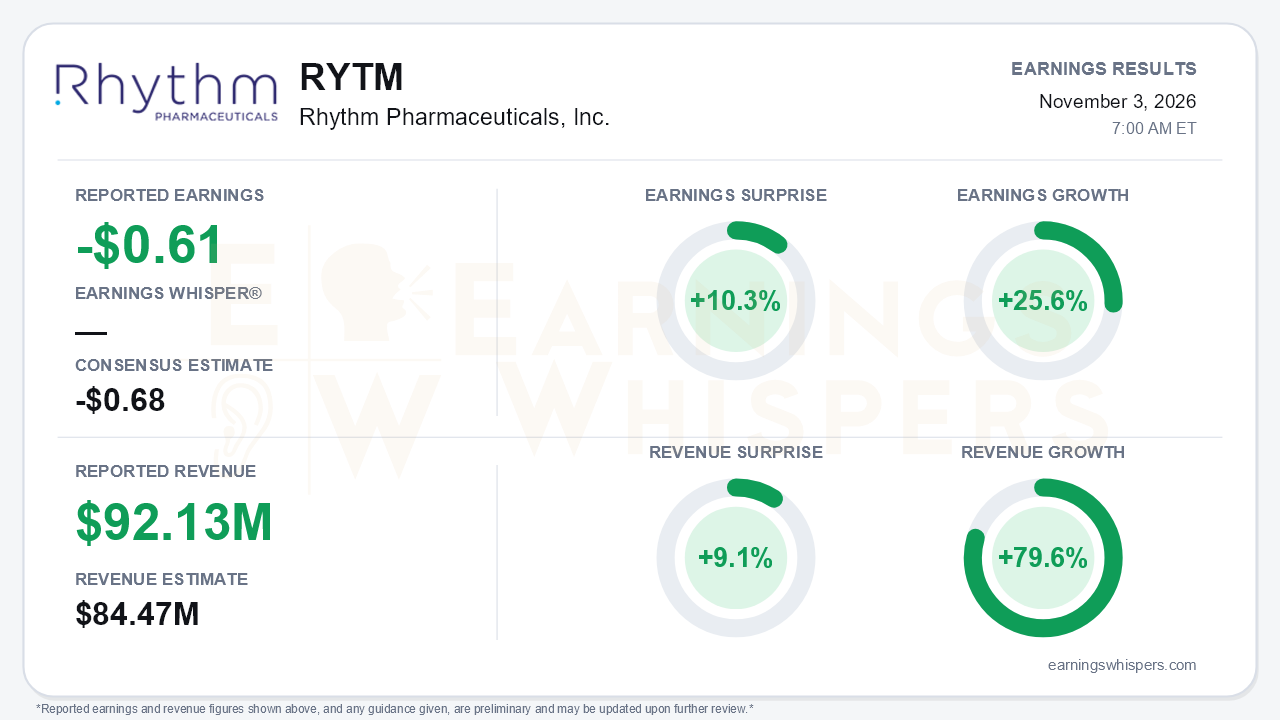
Rhythm Pharmaceuticals delivered the cleanest commercial quarter in its history and paired it with its most aggressive capital commitment. The company reported a loss of $0.61 per share, beating the consensus estimate of a $0.68 loss by 10.3%. Revenue of $92.13 million topped the $84.47 million consensus by 9.1%. Revenue grew 79.6% year over year, and the per-share loss improved 25.6% from the $0.82 loss a year earlier. The more telling figure is the sequential trajectory. IMCIVREE sales have gone from $57.3 million in the fourth quarter of 2025 to $60.1 million, then $71.3 million, and now $92.1 million. That 29% sequential gain is the fastest step-up of the launch so far. The central tension is that, just as the acquired hypothalamic obesity (HO) launch began to carry the income statement, management chose to load the balance sheet with new obligations to protect long-term economics.
The quality of the quarter holds up well. U.S. revenue rose 32% sequentially to $67.5 million, driven primarily by acquired HO, with continued growth in Bardet-Biedl syndrome. International revenue rose 22% to $24.7 million, and global reimbursed patients increased 20%. GAAP operating loss narrowed to $39.3 million from $52.7 million a year ago, because revenue added roughly $41 million while total costs rose about $27 million. Management put operating cash burn at roughly $3 million, down from about $9 million in the second quarter and $44 million in the first, which puts Rhythm close to operating cash breakeven. There is one soft spot: cost of sales climbed to 13.2% of revenue from 12.5% and 11.9% in the prior two quarters. SG&A also rose 27% year over year on personnel and stock-based compensation.
The call reinforced that demand is broadening rather than concentrating. Cumulative HO patient start forms passed 700, up from more than 400 at the second-quarter call and 150 at the first. Prescribers grew to more than 500 from about 300, and repeat prescribers rose to 25% from 20%. The biggest change was payer access. Coverage policies now span roughly 60% of Medicaid lives and 75% of commercial lives, up from 25% and 35% a quarter ago, with more than 80% of approvals arriving within 60 days. Management said start-form pace has not slowed into the fourth quarter. It also described U.S. uptake as "steady" rather than accelerating, and it flagged a seasonal first-quarter dip tied to insurance resets. The start-form increments of roughly 250 and 300 per quarter support that measured framing. Revenue momentum is now being driven more by reimbursement conversion than by an expanding funnel.
The forward story is now about capital allocation. Rhythm agreed to pay LG Chem $350 million over four years, plus a $200 million milestone if annual sales reach $3 billion. In return, the royalty on its MC4R portfolio falls to a flat 1%, versus a projected 5% to 7%. That is a bet that bivamelagon and RM-718 will become large franchises. To fund it, Rhythm secured an up to $750 million term loan with an initial $250 million draw at SOFR plus 4.6%. The near-term costs are concrete:
- a $70 million initial payment to LG Chem;
- a large fourth-quarter GAAP R&D charge for the present value of the LG Chem payments;
- a new interest burden from the term loan.
The $320.9 million quarter-end cash figure excludes both the loan draw and the LG Chem payment. Full-year non-GAAP operating expense guidance was cut again, to $360 million to $380 million. The cut is welcome on spending, but it largely reflects CMC and formulation work slipping into 2027 rather than pure efficiency. Japan launched in October at about 60% of U.S. pricing with more than 1,000 patients identified. However, a two-week prescription limit through November 2027 will cap its first-year contribution. Bivamelagon Phase 3 trials in HO and Prader-Willi syndrome add upside but carry real execution risk in an indication where most therapies have failed.
Investors entered the report in a cautious mood. Earnings Whispers sentiment deteriorated meaningfully, from roughly neutral at -0.04 to -0.27. That reading was taken on the same day the LG Chem amendment and loan were announced. Shares were down 7.2% since the open after the August report and sat 3.9% below the 200-day moving average. They were also 22% below the August 13 high of $119.75, though 9.4% above the October 14 low. Price and AVWAP trend readings remain negative even as sequential growth and momentum readings are positive. The market has been discounting a fundamentally improving business.
The bottom line is that Rhythm's commercial engine is working: revenue is accelerating, payer access has more than doubled, and cash burn has nearly vanished. Bears still have legitimate ammunition in the new leverage, a looming GAAP charge, pipeline timing slippage and a deliberately muted U.S. growth narrative. The investment case has shifted from whether the HO launch works to whether management's expensive bet on the next-generation MC4R portfolio pays off.
Read our earnings preview for Rhythm Pharmaceuticals, Inc.: https://www.earningswhispers.com/article/RYTM/21510
This earnings review was originally published on Earnings Whispers.
This article is for informational purposes only and is not investment advice. Earnings Whispers and its staff may hold positions in the securities mentioned. It is AI-assisted, based on proprietary Earnings Whispers data and company reports, and edited by Earnings Whispers staff.
Mentioned In This Article
Latest News
| 2 hours | |
| 6 hours | |
| Nov-02 | |
| Oct-26 | |
| Oct-21 | |
| Oct-21 | |
| Oct-13 | |
| Sep-22 | |
| Sep-15 | |
| Sep-10 | |
| Sep-03 | |
| Aug-28 | |
| Aug-24 | |
| Aug-17 | |
| Aug-11 |
