Great Elm Capital Misses As NII Falls To $0.17 And No Longer Covers The $0.25 Dividend
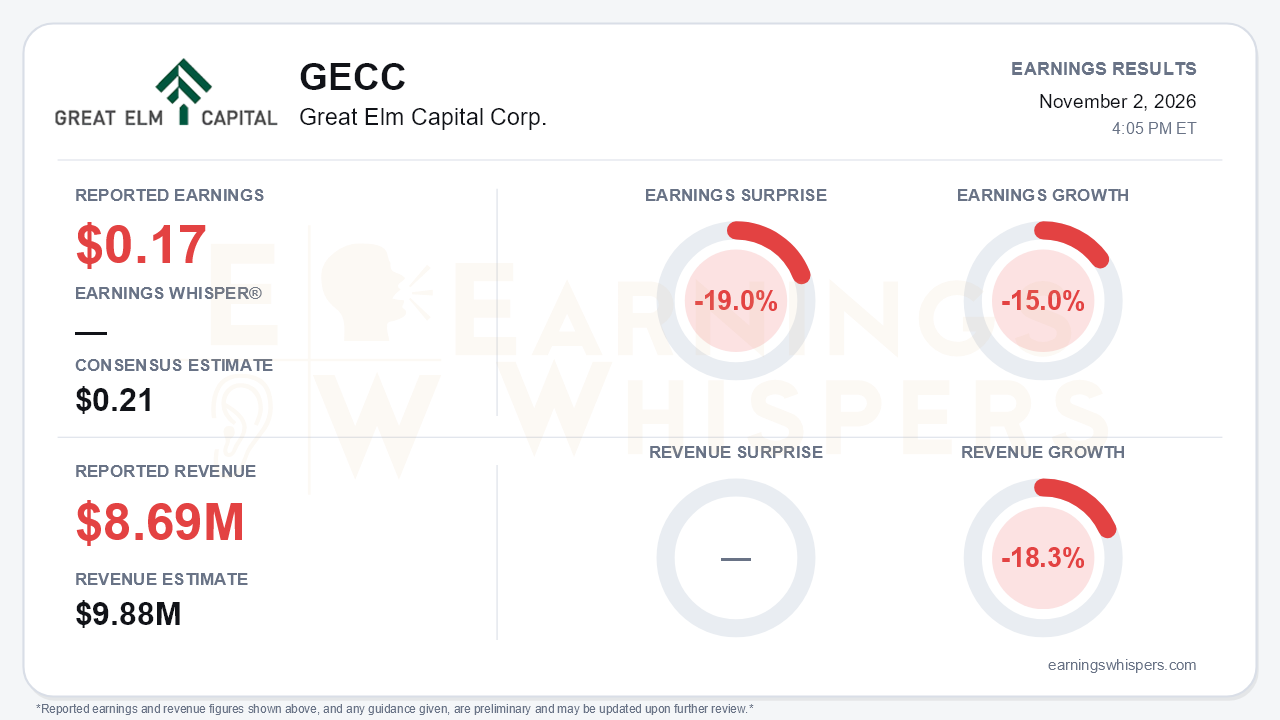
Great Elm Capital Corp. undid much of its second-quarter recovery in the third quarter. Net investment income of $0.17 per share missed the $0.21 consensus by 19.0% and fell 15.0% year over year. Total investment income of $8.69 million missed the $9.88 million consensus by 12.0% and declined 18.3% from a year ago. The sequential picture is worse than the annual comparison. NII per share has gone from $0.36 in Q1 to $0.32 in Q2 to $0.17 now, which leaves earnings $0.08 short of the $0.25 quarterly distribution the board just reaffirmed for 4Q26. Last quarter's story was a dividend that had been reset to a covered level. That coverage has now disappeared.
The quality of the miss deserves scrutiny, because two of the drivers were known. Q2 included a non-recurring $2.0 million dividend from insurance-related preference shares, and incentive fee accruals ($593,000 this quarter) resumed after three quarters of waivers that totaled $3.7 million year to date. Those factors explain much of the step down from Q2, but they do not make the result benign. Management conceded on the call that $0.17 is closer to a sustainable run rate, which means the earlier, higher NII prints were flattered by one-time income and fee relief. The core portfolio is also shrinking. Interest income from non-affiliated investments fell to $3.9 million from $5.9 million a year earlier, and total investments dropped to $251 million from $331 million at year-end. On a GAAP basis, the company swung to a net loss of $0.30 per share from a $0.46 gain in Q2, driven by $6.6 million of net realized and unrealized losses.
NAV erosion remains the most damaging trend. NAV per share fell 6.9% to $7.40 from $7.95, extending a decline from $10.01 a year ago. The largest single hit was a $3.3 million markdown of the CLO Formation JV, which management tied to CCC exposure and higher valuation discount rates. The CEO's tone shifted noticeably from last quarter's "solid progress" to open disappointment, and the release itself pointed to a challenging credit environment. Management still insisted the underlying credit portfolio remains healthy. That claim is hard to square with another quarter of controlled-investment depreciation ($4.6 million) and a realized loss of $2.2 million.
There are genuine offsets, and most sit on the liability side. Total debt fell to $154.9 million from $166.4 million in Q2 and $194.4 million at year-end. The company redeemed $6.5 million of its 8.5% GECCI notes and has no maturities until 2029. Quarterly interest expense dropped to $3.7 million from $5.5 million a year ago. Revolver availability rose to $44 million from $39 million. Specialty finance distributions jumped more than tenfold sequentially as Prestige rebuilt its balance sheet. The CoreWeave-related equity paid another $0.8 million, bringing cumulative distributions to $10.3 million against a $6 million cost. Management described the private credit pipeline as "as great as it has been," citing wider spreads and better documentation. The catch is capacity. Leverage sits at the 1.51x target and asset coverage is 166.3%, so new deployment requires rotating out of existing positions. Deployment slowed to about $20 million across 10 investments, down from roughly $30 million across 14 in Q2. Management also flagged rate-hike risk to borrowers, although fixed-rate notes funding floating-rate assets could widen spreads if rates rise.
Investor sentiment improved modestly ahead of the report, moving from -0.26 to -0.17. It remains negative, which suggests expectations were already subdued rather than optimistic. Price action reflects the same skepticism. At $5.00, shares are 6.5% below the $5.35 open after the Q2 report and 11.8% below the $5.67 200-day moving average. The stock also trades at roughly a one-third discount to NAV, which management is exploiting through buybacks: about 350,000 shares year to date at about $4.96, with $8.3 million of authorization remaining. The Earnings Whispers price and AVWAP trend readings remain negative.
The tension is between a stronger balance sheet and a weaker earnings engine. The headline 20.2% yield on price looks compelling, but on management's own admission it is being funded partly by spillover income rather than current NII. Bears have legitimate ammunition: a dividend that is not covered, a decline in NAV that has not stopped, and CLO exposure that keeps producing markdowns.
The bottom line is that GECC delivered a clear miss on both NII and investment income, lost dividend coverage, and posted another meaningful NAV decline. Deleveraging and a healthier specialty finance contribution keep the story from deteriorating further. Until NII moves back toward $0.25 or CLO marks stabilize, the market is likely to keep treating the deep discount to NAV and the high yield with suspicion.
This earnings review was originally published on Earnings Whispers.
This article is for informational purposes only and is not investment advice. Earnings Whispers and its staff may hold positions in the securities mentioned. It is AI-assisted, based on proprietary Earnings Whispers data and company reports, and edited by Earnings Whispers staff.
Mentioned In This Article
Latest News
| Nov-04 | |
| Nov-03 | |
| Nov-02 | |
| Nov-02 | |
| Oct-30 | |
| Aug-26 | |
| Aug-06 | |
| Aug-05 | |
| Aug-05 | |
| Aug-05 | |
| Aug-03 | |
| May-06 | |
| May-04 | |
| May-04 | |
| May-01 |
