AstraZeneca Beats On Accelerating Core EPS, But Reaffirmed Guidance And 2027 Headwinds Temper The Upside
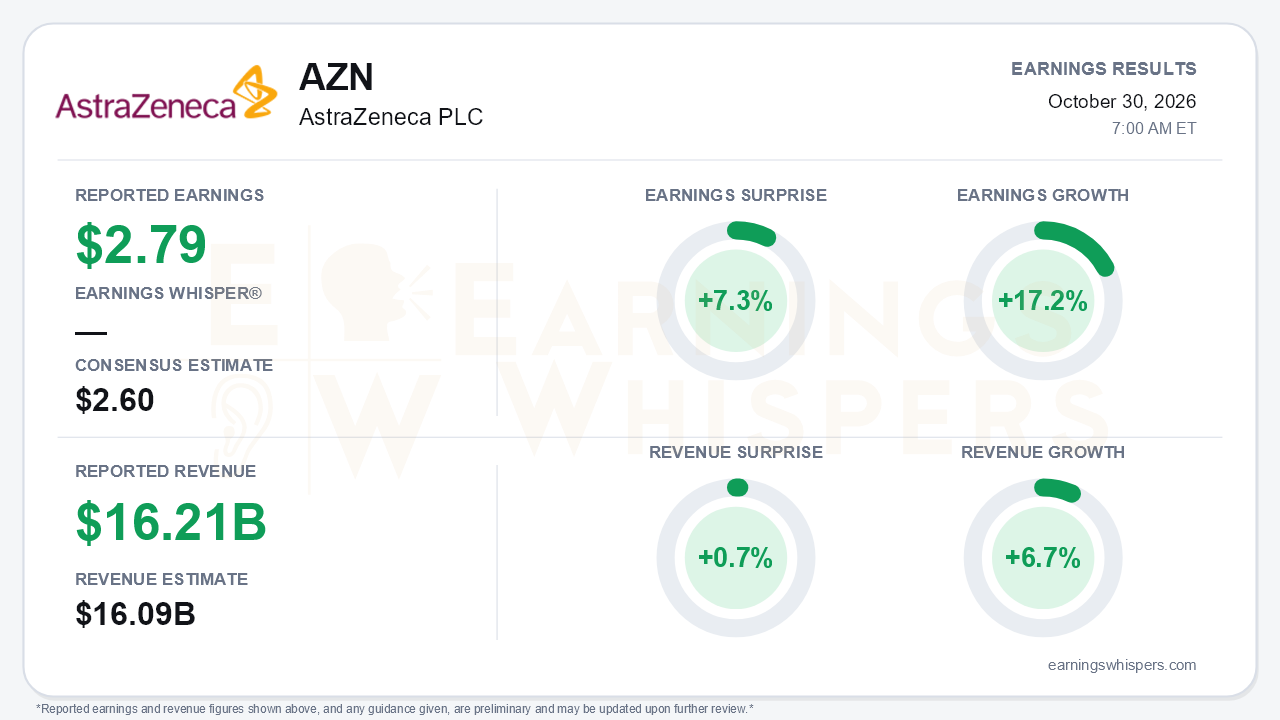
AstraZeneca delivered a clean third-quarter beat. Core EPS of $2.79 topped the $2.60 consensus by 7.3% and grew 17.2% year over year. Revenue of $16.209 billion edged past the $16.09 billion estimate by 0.7%, up 6.7%. The more important development is the trajectory. Nine-month Core EPS growth reached 14%, up from 11% at the half-year and 5% after the first quarter. Reported EPS rose 23% to $2.02. Yet management only reaffirmed full-year guidance for mid-to-high single-digit revenue growth and low double-digit Core EPS growth at constant exchange rates. With nine-month earnings already running at 14%, that leaves room for a softer fourth quarter. That is the central tension: operating momentum is clearly improving, while the formal outlook is staying deliberately conservative.
The quality of the beat deserves some scrutiny. Revenue grew in the high single digits, but Core operating profit climbed 17% (20% at CER) and Core operating margin widened 3 points to 36%. Gross margin played only a modest role, flat at 82% on a reported basis and up a point at CER. Product mix helped, while China volume-based procurement and loss-of-exclusivity pricing hurt. Much of the margin expansion came from expense phasing. Core R&D rose just 3% in the quarter, and the call showed year-to-date R&D growth slowing to 5% from 8% in the first quarter. Core SG&A rose only 2%. Other operating income more than doubled to $277 million, helped by partner milestones and the disposal of the Zoryve interest. None of this is low quality, but part of the upside reflects timing and one-off income rather than pure operating leverage.
Beneath the headline, the portfolio shift is unmistakable. Oncology grew 17% in the quarter, with several franchises accelerating:
- Tagrisso crossed $2.1 billion, up 12% (versus 6% in Q2).
- Imfinzi and Imjudo together topped $2 billion.
- Enhertu rose 35% (versus 31% in Q2).
- Calquence grew 16% to $1.1 billion.
Growth also broadened outside oncology. Tezspire rose 51%, Ultomiris rose 19%, and China excluding VBP grew in the low-to-mid teens. Excluding Farxiga and Brilinta, nine-month revenue grew 12%. The erosion is equally real, however. CVRM fell 18% in the quarter as Farxiga dropped 23% after its US loss of exclusivity, and US Symbicort fell 25% on a second generic. BioPharma's decline has worsened steadily, from -2% in Q1 to -6% now. Operating cash flow of $10.9 billion was lower year over year on Farxiga-related working-capital effects.
The pipeline narrative strengthened materially. Positive Phase III readouts reached 12 year to date, double the half-year count, including SAFFRON, SANOVO, DESTINY-Lung04 and DeLLphi-305. Management argued the net value of 2026 readouts has risen despite several setbacks: SERENA-4 missed, volrustomig's eVOLVE-Lung02 was stopped for futility, and Ultomiris in delayed graft function was discontinued. The 2027 slate is pitched at more than 20 Phase III readouts with over $20 billion in non-risk-adjusted peak revenue potential, and a tozorakimab US launch is expected in early 2027. AstraZeneca also committed fresh capital:
- A $2 billion equity stake in Summit Therapeutics, with combination trials pairing ivonescimab with sonesitatug vedotin and Datroway.
- The Reshaping for Sustainable Growth programme, which carries up to $2 billion in one-time costs and is expected to generate $1.5 billion in annualized savings by 2029, to be reinvested principally in the pipeline.
Bears have legitimate ammunition. Management declined to give 2027 guidance and flagged Farxiga and Symbicort generics, Calquence IRA pricing, MFN-style pricing pressure on launches in Europe and Japan, and higher fourth-quarter finance costs tied to the Summit premium and bond interest. Capex growth was also cut to the low teens from roughly one-third as projects slipped into 2027.
Investor sentiment moved from essentially neutral (-0.02) to modestly positive (0.21), a meaningful but not euphoric shift. The stock has already rewarded the story. Shares are up 9.7% since the open after the July report and have rallied 21.6% from a 52-week low of $153.41 set in early August. At $186.58, the stock sits 3.5% above its 200-day moving average and near the upper end of its report-day range of $183.10 to $188.39. The AVWAP trend is positive while the price trend is neutral, consistent with a stock that has rerated but is not running away.
The bottom line is that AstraZeneca's growth engine is broadening and accelerating. Oncology, respiratory and rare disease are more than absorbing the Farxiga cliff, and the pipeline scorecard has improved sharply. The beat was helped by cost phasing and disposal income, however, and the unchanged guidance implies some fourth-quarter deceleration. Combined with a heavy 2027 headwind list and new restructuring and capital commitments, that means the next leg depends on converting a crowded catalyst calendar into launches rather than on near-term margin upside.
Read our earnings preview for AstraZeneca PLC: https://www.earningswhispers.com/article/AZN/21269
This earnings review was originally published on Earnings Whispers.
This article is for informational purposes only and is not investment advice. Earnings Whispers and its staff may hold positions in the securities mentioned. It is AI-assisted, based on proprietary Earnings Whispers data and company reports, and edited by Earnings Whispers staff.
Mentioned In This Article
Latest News
| 8 hours | |
| Nov-02 | |
| Nov-02 | |
| Nov-02 | |
| Nov-02 | |
| Oct-30 | |
| Oct-30 |
AstraZeneca cans late-stage Ultomiris trial on lacklustre efficacy predictions
AZN +7.02%
Clinical Trials Arena
|
| Oct-30 | |
| Oct-30 | |
| Oct-30 | |
| Oct-30 | |
| Oct-30 | |
| Oct-30 | |
| Oct-30 | |
| Oct-30 |
