Janus Living Beats As Same-Store NOI Hits 25.9%, But Dilutive Growth And Souring Sentiment Cloud The Setup
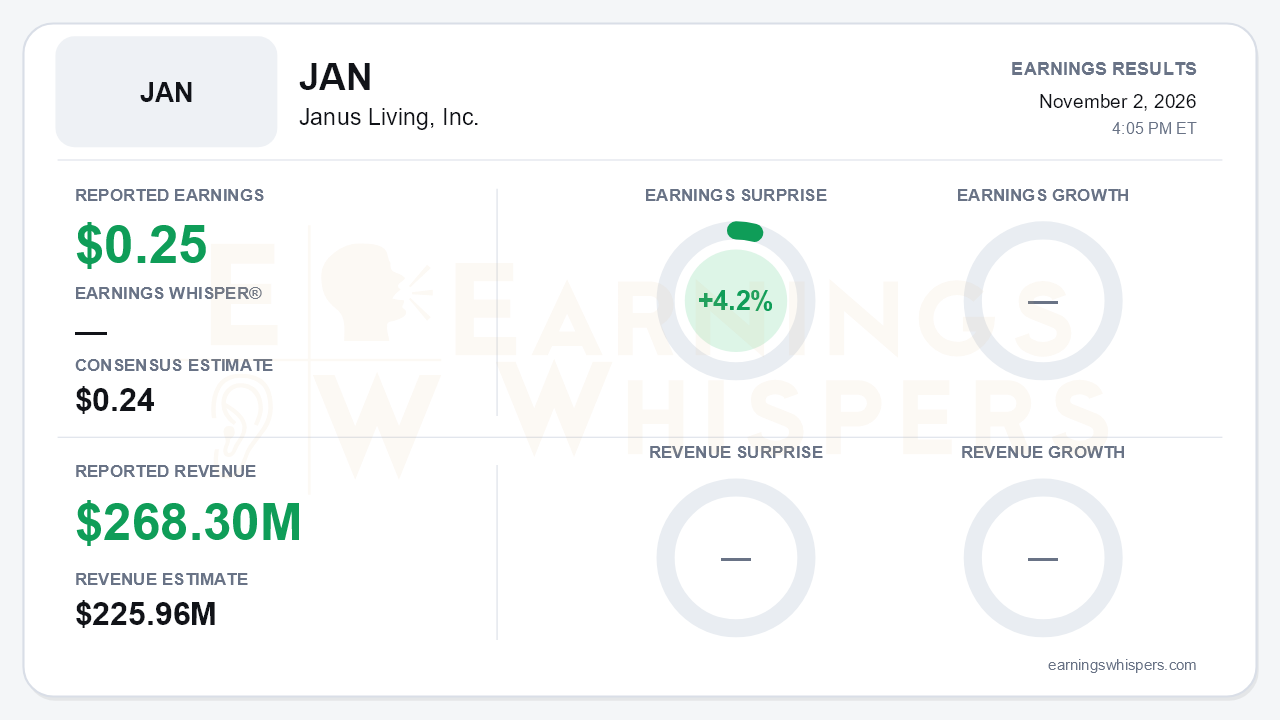
Janus Living (NYSE: JAN) delivered its strongest operating quarter since going public. FFO as Adjusted of $0.25 per share topped the $0.24 consensus by 4.2%, and revenue of $268.3 million beat the $225.96 million estimate by 18.7%. The company reported a 46% increase in FFO as Adjusted and a 78% increase in revenue year over year. Management also raised full-year guidance for the third consecutive quarter. The central tension is that the revenue beat was far larger than the per-share beat. Revenue is being driven by an aggressive acquisition program funded with equity, so growth on a per-share basis is real but much smaller than the top line suggests.
The quality of the beat deserves scrutiny. Most of the revenue upside reflects $1.75 billion of third-quarter acquisitions covering 33 communities, not just organic outperformance. Diluted FFO share count rose to roughly 302 million from about 215 million in the prior-year period. The August follow-on raised $513 million, the company's third equity raise of 2026. On a GAAP basis, Janus swung to a net loss of $(0.02) per share from a small profit a year ago. Depreciation and amortization jumped to $78.7 million from $30.9 million, and the quarter also carried $3.4 million of transaction costs. That same depreciation effect drove a steep cut to GAAP EPS guidance, now $0.08-$0.10 versus $0.34-$0.37. Because depreciation is excluded from FFO, investors should not read the GAAP cut as an operating deterioration. Still, it is a reminder of how much of the story is being bought rather than built.
The organic picture is genuinely impressive and still accelerating:
- Same-store adjusted NOI growth climbed from 13.8% in Q1 to 19.2% in Q2 to 25.9% in Q3.
- Year-over-year margin expansion widened from 150 to 250 to 360 basis points.
- Same-store revenue growth stepped up to 9.8%, supported by 300 basis points of occupancy gains and RevPOR growth of 6.5%.
- Occupancy rose 110 basis points sequentially, versus just 10 basis points in Q2.
- Non-refundable entrance fee sales reached a third-quarter record of $47 million, at prices roughly 11% above last year.
Same-store NOI guidance moved to 16%-19% from 13%-17%, a midpoint now 750 basis points above the original February outlook. FFO as Adjusted guidance rose to $0.97-$0.99. Earnings Whispers characterizes that range as in line with estimates, so the raise largely tracks what the Street already expected.
Bears have legitimate ammunition on sustainability. Management acknowledged that the 26% same-store NOI print benefited from an easy prior-year comparison of roughly 10%, and that growth will likely moderate from here. Several other points also argue for caution:
- Targeted stabilized yields on the Q3 volume stepped down to 7.5%-8.5%, though year-one yields held in the low-6% range and management said underwriting is unchanged.
- The acquired mix tilted toward assisted living and memory care.
- The 18-community transition portfolio is only now stabilizing, pushing meaningful recovery into 2027 rather than the second half of 2026.
- Investors raised housing-market concerns about entrance-fee demand.
- Funding the next leg with debt would be thinner math, since mid-5% swapped term-loan costs leave a narrow spread against roughly 6% initial yields.
The catalyst list remains substantial. Year-to-date acquisitions reached about $2.9 billion through October 30, with another $82 million under binding agreements. The operator roster has expanded from two at the start of the year to 13, with about 20 targeted. The revolver was upsized to $1.25 billion. Management plans to pursue an investment-grade rating in 2027. The balance sheet carried no debt and $338 million of cash at quarter end, with about $1.2 billion of liquidity as of October 30. Acquisitions enter the same-store pool in 2027 at roughly 86%-87% occupancy, which offers a credible runway for continued occupancy-driven growth even as the comparisons get harder.
The market setup is more complicated than the beat implies. Earnings Whispers investor sentiment collapsed from a modestly positive 0.15 to -0.78, a genuinely sharp swing into negative territory. Shares have fallen 10.5% since the open following the August report, from $31.77 to $28.45, a period that included the follow-on offering. Even so, the stock remains about 27% above its 200-day moving average of $22.45, so the longer-term uptrend since the IPO is intact despite the recent pullback. The AVWAP trend reading is negative, consistent with the post-August weakness.
The bottom line is that Janus Living's same-store engine is running hotter than anyone guided to at the start of the year, and management keeps raising the bar. The investment debate, however, is shifting from occupancy recovery to capital allocation. Investors now have to weigh repeated equity issuance, softer stabilized yields, an easy comparison that will not repeat, and thin debt-funded spreads against a durable, acquisition-fed growth runway. The quarter answered the operating question convincingly. Sentiment suggests the market is far less convinced about the price being paid for growth.
Read our earnings preview for Janus Living, Inc.: https://www.earningswhispers.com/article/JAN/21406
This earnings review was originally published on Earnings Whispers.
This article is for informational purposes only and is not investment advice. Earnings Whispers and its staff may hold positions in the securities mentioned. It is AI-assisted, based on proprietary Earnings Whispers data and company reports, and edited by Earnings Whispers staff.
Mentioned In This Article
Latest News
| Nov-04 | |
| Nov-04 | |
| Nov-03 | |
| Nov-02 | |
| Nov-02 | |
| Oct-26 | |
| Oct-01 | |
| Sep-17 | |
| Sep-15 | |
| Sep-14 | |
| Aug-10 | |
| Aug-10 | |
| Aug-05 | |
| Aug-04 | |
| Aug-04 |
