Marzetti's Quarter Falls Short Of Its Own Guide As Cyclospora And Diesel End A 12-Quarter Margin Streak And Force A Cut To The FY27 Margin Outlook
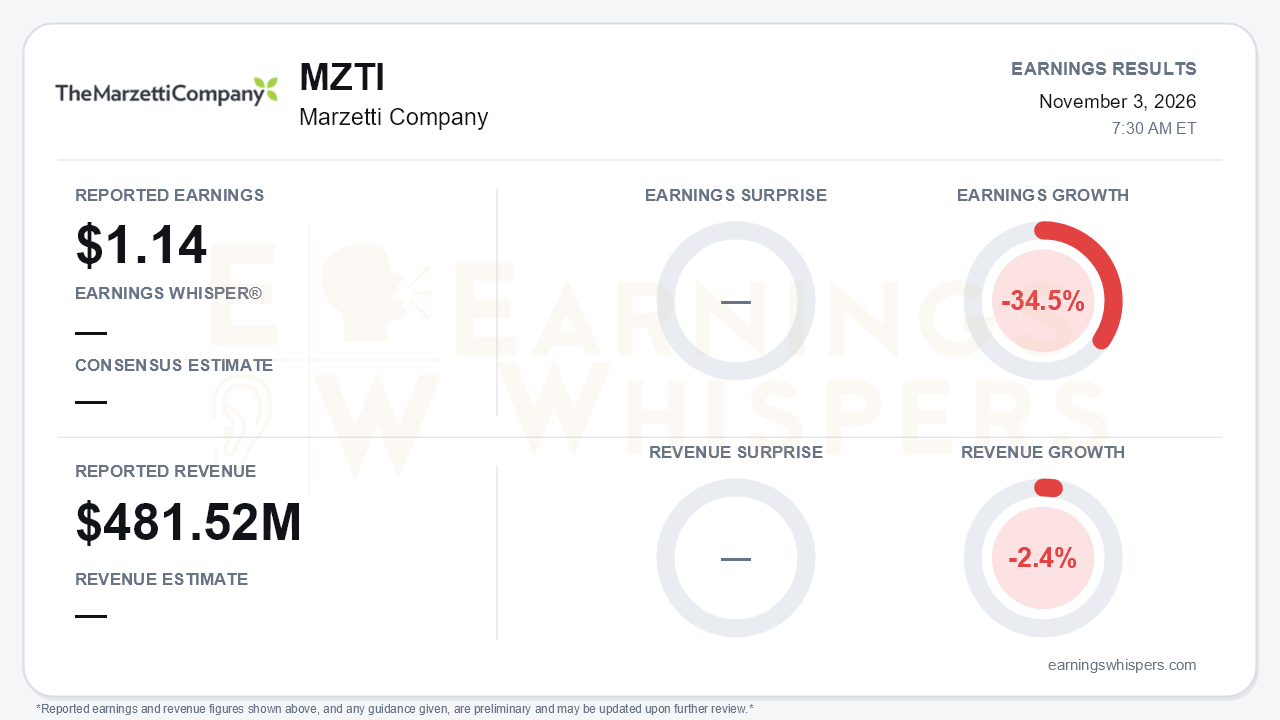
Marzetti (NASDAQ: MZTI) delivered a fiscal first quarter that was weaker than even its own recently issued roadmap. Adjusted EPS of $1.14 fell 34.5% year over year on revenue of $481.52 million, down 2.4%. On a GAAP basis, diluted EPS was $1.07, down 37.4%. No consensus estimate was available for comparison, so the more useful benchmark is management's guidance from the fiscal fourth-quarter call. Against that benchmark the quarter clearly disappointed. Operating income fell 30.1%, compared with a guided decline of about 15%. Gross margin contracted 110 basis points when management had called for it to be flat. That contraction ended 12 consecutive quarters of margin expansion, which is the central development for the stock.
The quality of the quarter deserves scrutiny beyond the cyclospora headline. Retail sales rose 2.0% to $252.7 million, but Bachan's alone contributed 720 basis points of that growth and 750 basis points of volume growth. The legacy retail business therefore shrank meaningfully. Retail segment operating income fell to $37.2 million from $50.6 million, a sharp drop for a segment that just absorbed an acquisition. Foodservice sales declined 6.9% to $228.8 million, or 2.6% excluding the prior-year transition supply agreement (TSA) revenue. Core Foodservice volume fell 4.1%, and segment profit slipped to $30.4 million from $34.8 million. Gross profit fell $8.0 million, and SG&A rose $10.9 million, largely from Bachan's overhead and amortization. Excluding the TSA, gross margin was 23.0% versus 24.6% a year ago, a steeper decline than the reported 110 basis points. The Bachan's deal also brought $2.8 million of new interest expense from the $200 million term loan.
The call explained why the miss was worse than planned. The cyclospora outbreak cost an estimated 300 basis points of revenue, above the roughly 250 basis points guided, and the impact was concentrated in the Great Lakes region, about 30% of the business. The release put the hit at roughly 4% of Retail sales and 2% of Foodservice sales, consistent with the heavier retail exposure in dressings, dips and croutons. Diesel near $6 per gallon in the U.S. and $8 in Canada took about 120 basis points from gross margin. Mix and cost-savings shortfalls cost another 40 basis points, and commissioning costs for new Atlanta capacity added pressure. The more uncomfortable disclosure is that the base business is still down low single digits even excluding cyclospora, with dressings soft for a third straight call. Management's tone shifted notably, from 'record year, strong execution' last quarter to 'substantial headwinds… more significant than anticipated.'
Guidance moved in the wrong direction. Expected fiscal 2027 gross-margin expansion was cut to 25-75 basis points from roughly 100 basis points. The second quarter is guided flat, and the full-year outlook explicitly depends on diesel moderating in the back half. Management reaffirmed mid-single-digit sales growth, $90 million of capex and a 23% tax rate. Still, a recovery weighted toward the back half, with additional pricing in bread, rolls and foodservice, raises execution risk and the possibility that pricing triggers volume losses.
The call did preserve a credible growth narrative.
- **Bachan's:** It contributed $17.8 million, with scan sales up 10.7%, velocity up 13% and distribution points up 7%. Management said the brand exceeded expectations, and roughly $100 million-plus for the fiscal year remains implied.
- **Texas Roadhouse rolls:** Scan sales grew 21.3% with a 270-basis-point share gain.
- **Chick-fil-A spicy sauce:** It launched nationally in restaurants as a permanent item and should lift Foodservice in the second quarter, with retail following in February.
- **Pipeline:** A Tajin licensing partnership, new refrigerated Marzetti sauces and a broader Bachan's mayo rollout are on the way, though much of that benefit lands in fiscal 2028.
- **Retail rebuild:** Former Wingstop executive Mark Christensen was named retail president, dressing advertising restarts around January 1, and the quarterly dividend rose to $1.00 from $0.95.
The market context is thin. Investor sentiment readings and a current share price were not available, so the post-report reaction cannot be measured here. For reference, shares opened at $118.93 after the prior report. That is below the current 200-day moving average of $124.33, suggesting the stock was already trading at a discount to its longer-term trend before this miss. Investors who bought the record-year narrative from the August report now face a lower-margin reset rather than a simple one-quarter disruption.
The bottom line is that cyclospora and diesel explain much of this quarter, but not all of it. A legacy base still declining in low single digits, a broken margin-expansion streak and a trimmed full-year margin outlook give bears legitimate ammunition. Bachan's, Chick-fil-A and the innovation pipeline offer a credible path to back-half recovery. That path now depends on fuel costs, pricing elasticity and a dressings turnaround that management has yet to deliver.
This earnings review was originally published on Earnings Whispers.
This article is for informational purposes only and is not investment advice. Earnings Whispers and its staff may hold positions in the securities mentioned. It is AI-assisted, based on proprietary Earnings Whispers data and company reports, and edited by Earnings Whispers staff.
Mentioned In This Article
Latest News
| Nov-04 | |
| Nov-03 | |
| Nov-03 | |
| Nov-03 | |
| Oct-26 | |
| Oct-20 | |
| Aug-25 | |
| Aug-25 | |
| Aug-25 | |
| Aug-19 | |
| Aug-13 | |
| Jul-15 | |
| Jul-06 | |
| May-20 | |
| May-04 |
