New York Times Beats On Subscriber Strength, But First Digital Ad Miss And Softer Q4 Outlook Show Growth Is Cooling
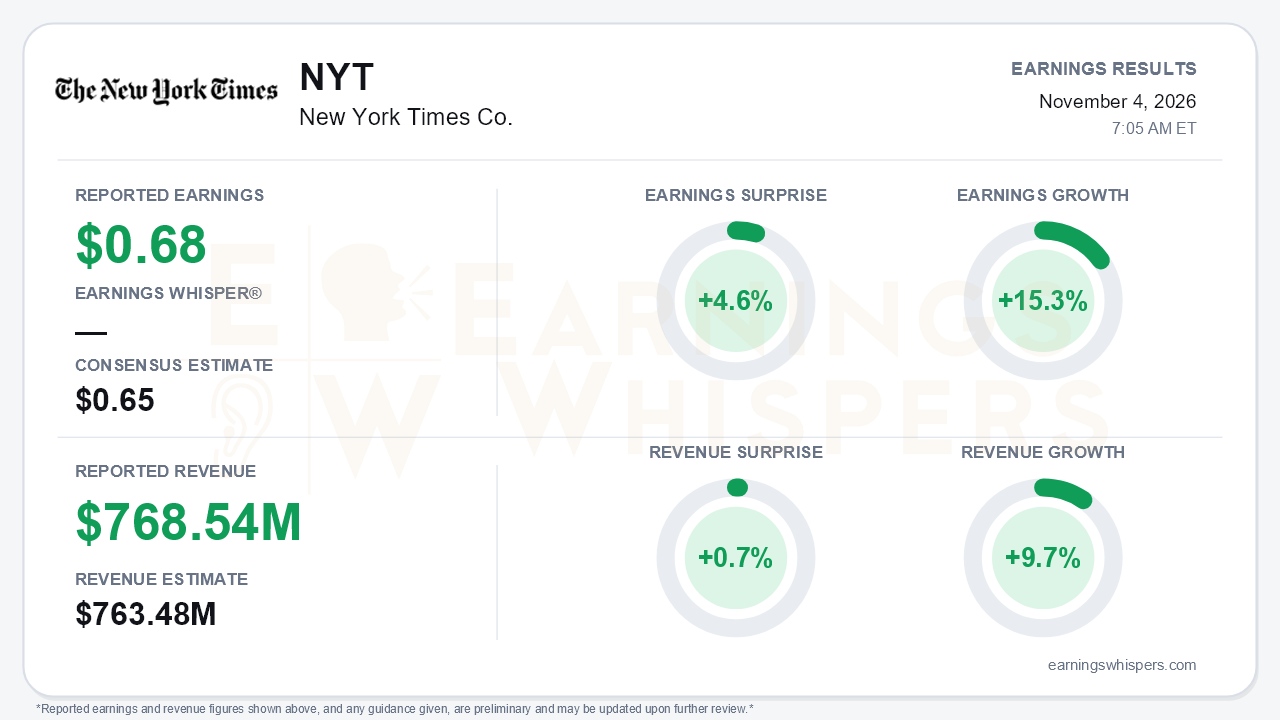
The New York Times Company beat third-quarter expectations, but the bigger story is that its growth is slowing. Adjusted earnings of $0.68 per share topped the $0.65 consensus by 4.6% and rose 15.3% year over year. Revenue of $768.54 million beat estimates by 0.7% and grew 9.7%. Those are solid results for a mature publisher. Still, digital advertising missed management's own guidance for the first time this year, and the fourth-quarter outlook stepped down again. A quarter that looks clean on the surface carries a clear message underneath: nearly every growth line is decelerating, and the subscription engine is gaining volume while losing pricing.
The quality of the beat deserves scrutiny. The release itself only pointed investors to the full results, so the operating detail comes from the call. That detail shows a steady downward slope. Adjusted operating profit rose 14% to roughly $150 million, down from 16% growth in Q2 and 27% in Q1. The year-over-year gain in adjusted EPS shrank from $0.20 in Q1 to $0.11 in Q2 to $0.09 in Q3. Third-quarter G&A also included one-time costs tied to the company's 175th anniversary, so part of the margin pressure is non-recurring. Even so, margins held flat rather than expanding, and the earnings beat came from a business that is still compounding, just more slowly.
Subscriptions remain the bright spot. Net digital subscriber additions reached about 420,000 in the quarter, up from 310,000 in Q1. That brought the total to 13.8 million and keeps the company on track for its 15 million target. Digital subscription revenue grew 14.6%, at the top of the 12-15% guide. The catch is how that growth was achieved:
- Digital ARPU growth slowed to 1.4% from 3.1% in Q2, as the mix shifted toward lower-priced single-product subscriptions such as Games and Cooking.
- Digital subscription revenue growth has eased from roughly 16% in the first half.
- The current 12-15% guide sits below the 14-17% range management offered earlier in the year.
The bundle-and-upsell strategy depends on converting those entry-level subscribers to higher-priced tiers over time. Until ARPU reaccelerates, volume is doing more of the work than price.
Advertising is where bears have legitimate ammunition. Digital ad revenue grew 12%, short of the mid-to-high-teens guide given in August. That follows 21% growth in Q2 and 32% in Q1, both of which beat. The Q4 guide calls for high-single to low-double-digit digital ad growth against a demanding 25% comparison, and total ad growth is expected in the mid-single digits. Analysts pressed management on two possible causes: personal AI agents and the ongoing decline in platform referral traffic to publishers. Management attributed the miss to normal quarterly unpredictability and said it has measured no AI-agent impact. That answer may prove correct, but it is an assertion, not evidence, and the AI question is unlikely to go away.
Capital return gives the stock real support. Buybacks reached $171 million year to date, up from $92 million at mid-year. That lifts capital return to about 60% of year-to-date free cash flow of roughly $436 million, above the 50% midterm target, and management signaled it could exceed the target again. With about $1.3 billion in cash, the company has room to keep doing so.
The Q4 adjusted cost growth guide of 6-8% is lower than the 8-9% guides given for each of the first three quarters, which helps the margin outlook. However, the range is wider than usual because incentive compensation is variable, which leaves some uncertainty around the cost picture. Product catalysts are incremental rather than transformative:
- weekly subscriber-only puzzles in Games;
- an AI-powered recipe adaptation tool in Cooking;
- expanded short-form video franchises;
- a midterm elections hub in the flagship app.
The market had already turned cautious before the report. Shares stood at $67.12 on the eve of earnings, down 4.4% from the open after the August report and 8.5% below the 200-day moving average of $73.37. The path was volatile. The stock peaked at $73.45 in mid-September, slid to $58.95 by early October, and has since recovered nearly 14% off that low. Investor sentiment was slightly negative heading into the August report and was essentially unchanged heading into this one, so the beat met a skeptical rather than euphoric audience. Earnings Whispers sequential-growth and AVWAP trend readings are positive, while price trend and momentum are neutral.
The bottom line is that the Times delivered a credible beat built on strong subscriber additions, disciplined costs, and aggressive buybacks. However, the first advertising miss, a weaker Q4 ad guide, and slowing ARPU show that growth is cooling across nearly every line. Investors will need evidence that bundle upgrades can lift pricing, and that the ad slowdown reflects tough comparisons rather than AI or traffic disruption, before the stock is likely to reclaim its 200-day average.
Read our earnings preview for New York Times Co.: https://www.earningswhispers.com/article/NYT/21723
This earnings review was originally published on Earnings Whispers.
This article is for informational purposes only and is not investment advice. Earnings Whispers and its staff may hold positions in the securities mentioned. It is AI-assisted, based on proprietary Earnings Whispers data and company reports, and edited by Earnings Whispers staff.
Mentioned In This Article
Latest News
| 6 hours | |
| 7 hours | |
| 8 hours | |
| 8 hours | |
| Oct-27 | |
| Oct-21 | |
| Oct-20 | |
| Oct-19 | |
| Oct-14 | |
| Oct-05 | |
| Oct-04 | |
| Sep-26 | |
| Sep-25 | |
| Sep-21 | |
| Sep-19 |
