Viridian's Lumvoa Launch Crushes Revenue Expectations, But Thin Disclosure Leaves Durability Questions Open
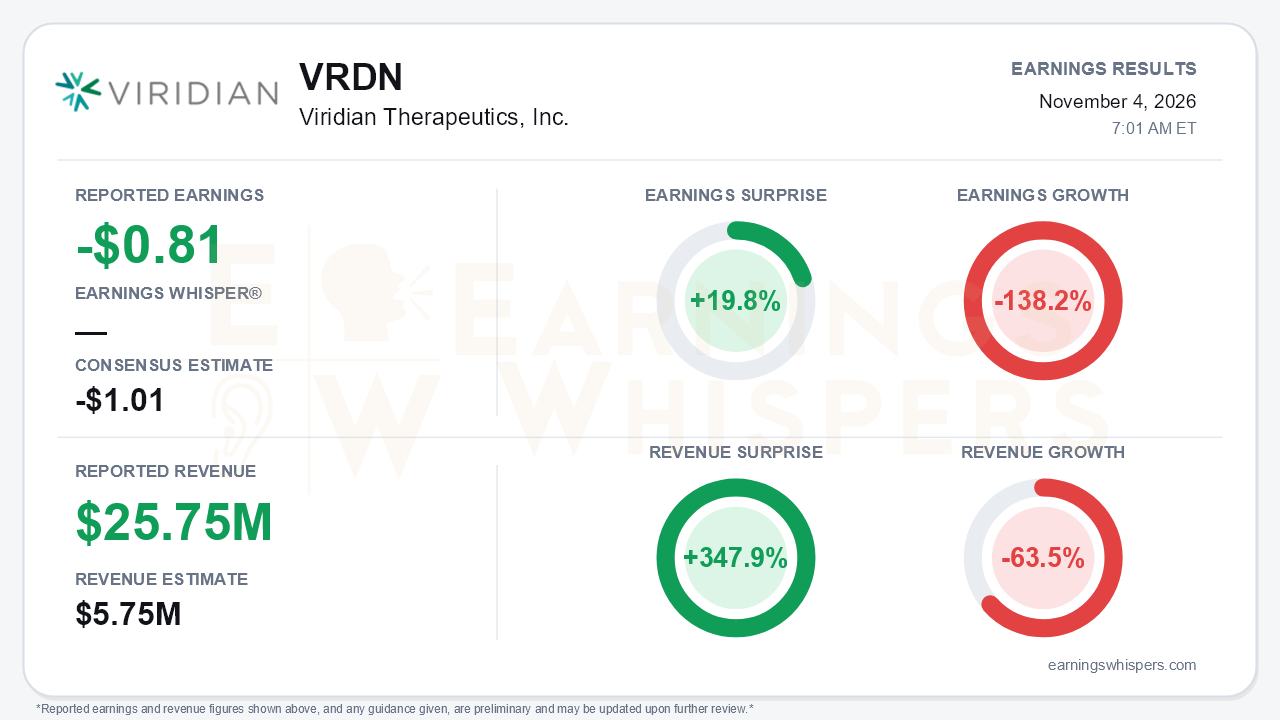
Viridian Therapeutics delivered the kind of first commercial quarter that changes how a biotech is valued. Lumvoa, its IV IGF-1R antagonist for thyroid eye disease, generated $24.7 million in net product revenue in its launch quarter. That lifted total revenue to $25.75 million, 347.9% above the $5.75 million consensus. The net loss of $0.81 per share beat the -$1.01 consensus by 19.8%. On a year-over-year basis, though, the headline comparisons look poor. Earnings fell 138.2% and revenue fell 63.5%. Both declines reflect the $70.0 million license payment booked in the year-ago quarter, not any weakness in the business. Viridian is now a commercial-stage company, and the central question has shifted from whether Lumvoa works to whether this launch curve holds.
The composition of the quarter deserves scrutiny. Product revenue was essentially the entire top line: license revenue was just $125,000, and cost of revenues was only $1.5 million. Spending has shifted sharply toward commercialization. SG&A more than doubled to $57.6 million from $24.3 million, while R&D fell to $70.1 million from $86.3 million as the late-stage veligrotug and elegrobart trials wound down. The net loss widened to $101.2 million from $34.6 million. Accounts receivable of $29.8 million already exceeded quarterly product revenue. Management attributed this to extended payment terms for infusion centers ahead of the permanent J-code (J3242) taking effect January 1, 2027. The balance sheet is strong at $955.2 million in cash and securities, and management now says it is funded through profitability. Investors should note, however, that total liabilities climbed to $448.0 million from $177.3 million at year-end, a change the release does not detail.
On the call, management's tone was markedly more confident. Executives said the launch 'exceeded expectations' and described the organization as 'firing on all cylinders.' They pointed to more than 100 patients on therapy, most of whom started late in the quarter. They also cited early signs of both broad prescriber trial and aggressive switching from Amgen's Tepezza, plus possible market expansion. Payer policies cover about 30% of lives, mostly at parity with Tepezza, and the company is targeting broad coverage within six to nine months of launch. Viridian also denied any meaningful stocking or one-time bolus of demand.
The hedging was just as notable as the enthusiasm. Management offered no Q4 or 2027 revenue guidance and repeatedly stressed that one quarter is too early to judge sustainability. It declined to quantify market share, prescriber breadth, or Q4 patient additions. It also dropped the patient start-form metric it had previously signaled as a launch KPI and will report mainly net revenue going forward. Analysts questioned how roughly 300 doses' worth of revenue reconciles with just over 100 mostly late-quarter patients. Management rejected the stocking explanation, but cutting a visibility metric right after a blowout quarter gives bears legitimate ammunition. Q4 scheduling seasonality and the 70% of lives still lacking formal policies add further uncertainty to the near-term trajectory.
The pipeline gives the story depth beyond Lumvoa. Elegrobart, the subcutaneous follow-on with at-home autoinjector dosing as infrequent as every eight weeks, is on track for a BLA in Q1 2027 after two positive Phase 3 trials. Management expects it to launch on the existing commercial infrastructure with limited incremental investment. Several more catalysts are due before year-end:
- VRDN-008 healthy-volunteer data, along with FcRn portfolio development plans;
- the start of a Phase 1 trial for anti-TSHR antibody VRDN-292 in Graves' disease.
VRDN-006, highlighted in earlier periods, received little attention on the call.
The market had largely positioned for good news before the report. Shares closed at $25.15 the day before earnings. That was up 20.2% since the open following the August report and 15.7% above the 200-day moving average of $21.73. The stock had rallied 43% off its October 8 low of $17.59 and set its inter-earnings high of $26.21 on November 3. Investor sentiment moved the other way, slipping modestly further into negative territory, from -0.12 to -0.20. The Earnings Whispers price, sequential-growth, and AVWAP trend readings are positive, consistent with the stock's recent strength. Still, the combination of a stock near its highs and mildly skeptical sentiment suggests investors want proof of durability, not just a strong debut.
The bottom line is that Viridian cleared its first commercial hurdle decisively: Lumvoa's launch quarter dwarfed expectations, the cash position supports the plan through profitability, and elegrobart offers a credible second leg. However, the absence of guidance, the dropped start-form metric, unresolved questions about dose-versus-patient math, and rising receivables mean the next two quarters must show that this was genuine demand rather than a front-loaded start.
Read our earnings preview for Viridian Therapeutics, Inc.: https://www.earningswhispers.com/article/VRDN/21758
This earnings review was originally published on Earnings Whispers.
This article is for informational purposes only and is not investment advice. Earnings Whispers and its staff may hold positions in the securities mentioned. It is AI-assisted, based on proprietary Earnings Whispers data and company reports, and edited by Earnings Whispers staff.
Mentioned In This Article
Latest News
| 2 hours | |
| 6 hours | |
| Oct-27 | |
| Oct-20 | |
| Sep-02 | |
| Aug-06 | |
| Jun-30 | |
| Jun-29 | |
| Jun-26 | |
| Jun-26 | |
| May-27 | |
| May-06 | |
| May-06 |
Viridian Therapeutics stock up 35% after Phase III TED data release
VRDN -6.51%
Clinical Trials Arena
|
| May-05 | |
| May-05 |
