Ralliant Beats And Raises Again As Growth Accelerates To 17%, But Tariff Refunds And Inventory Build Temper The Margin Story
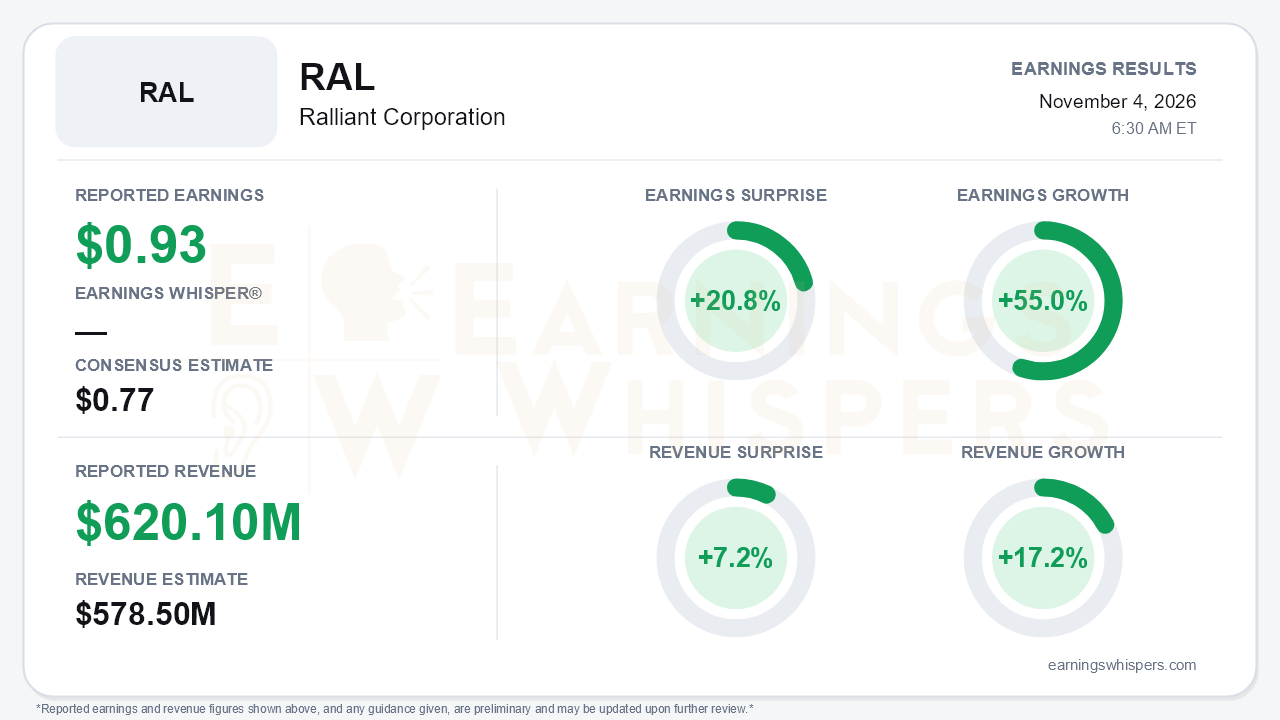
Ralliant delivered its fourth consecutive beat-and-raise, and its strongest one yet. Adjusted EPS of $0.93 topped the $0.77 consensus by 20.8%. Revenue of $620.1 million beat the $578.5 million estimate by 7.2%. Revenue growth of 17.2% year over year continued a clean acceleration: organic growth has stepped up from flat in Q4 FY25 to 9%, 13% and now 17%. Earnings grew 55.0% year over year, and management again lifted full-year guidance by more than the size of the quarterly beat. That pattern is the central takeaway. A post-spin industrial that started 2026 guiding to $2.22-$2.42 in adjusted EPS now expects $3.10-$3.16. The question is no longer whether the RBS-driven turnaround is working, but how much of the margin surge is durable.
On the surface, the margin story is striking. Adjusted EBITDA margin reached 23.5%, up from 19.8% in Q2 and 18.6% in Q1. GAAP net margin improved 630 basis points to 13.9%, and GAAP EPS of $0.77 more than doubled. The quality of the beat still deserves scrutiny. The GAAP comparison is flattered by a year-ago quarter burdened by $22.4 million of stock-compensation modification charges and separation costs. Management's 64% adjusted EPS growth figure uses a normalized prior-year base that layers in standalone public company costs. More importantly, Q3 gross margin included $7 million of non-recurring IEEPA tariff refunds, worth roughly 115 basis points. Excluding the refunds, normalized EBITDA expansion was closer to 290 basis points than 400. That is still excellent, but it sets a tougher 2027 comparison. Lower corporate costs of $15.8 million largely reflect reallocation to the segments rather than true savings.
Beneath the headline, Test & Measurement is the swing factor. The segment grew 21% organically, and its adjusted EBITDA margin jumped to 19.3% from 14.7% in Q2 and 11.9% in Q1. Diversified electronics grew 48% on compute and power-infrastructure spending. The one weak spot was semiconductors, which fell 7% against a large 2025 project comparison, though the call suggested underlying growth was in the high teens. Sensors & Safety Systems grew 15%, and its margin widened to 30.5%. Utilities rebounded to 16% growth from 4% in a Middle East–disrupted Q2 and posted record orders. Book-to-bill stayed above 1.1 in both segments. China surged 39%. Management's tone shifted noticeably: it called the defense environment "generational," described demand with legs into 2027, and framed T&M margins at 20%-plus next year.
Defense is the most consequential new catalyst. Orders began flowing under Lockheed Martin's seven-year undefinitized THAAD and PAC-3 MSE contracts, lifting the defense backlog to more than $1.5 billion from more than $1 billion. The company also cited design wins in affordable mass munitions, autonomous air vehicles and counter-UAS, and is adding capacity in Solon, Ohio and Fairport, New York. The enterprise productivity program now targets $16-18 million of 2026 savings, up from $10-12 million, with a $30-35 million exit run rate. Bears have legitimate ammunition, however:
- Defense programs remain margin-dilutive as they ramp.
- Management newly emphasized input inflation and constrained supply.
- Western Europe declined, and communications growth slowed to 4% from 9%.
- Strategic inventory building cut Q3 free cash flow to $102 million from $127 million a year ago, and TTM conversion slipped to 94% from 114%.
The guidance math supports the bulls but leaves less room for upside. Fourth-quarter revenue of $620-$640 million and adjusted EPS of $0.93-$0.99 imply only modest sequential improvement. That outlook includes another $5 million in tariff refunds, and management already expects a normal Q1 seasonal step-down.
Investor sentiment improved modestly, rising from 0.139 to 0.175. That leaves expectations positive but far from euphoric. The stock has done less than the fundamentals. As of November 3, before the report, shares were at $71.31, just 2.0% above the open after the July report. They had swung between a $60.24 low on September 1 and a $74.89 high on October 5, and entered earnings about 4.8% below that peak. Shares sit 21.7% above the 200-day moving average. Sequential-growth and momentum trend readings are positive, while AVWAP remains negative, reflecting the choppy inter-earnings trading.
The bottom line is that Ralliant's growth acceleration, defense backlog and serial guidance increases make this a high-quality quarter, even after discounting tariff refunds and favorable comparisons. The setup now hinges on whether margins hold once the refunds roll off, supply constraints stay manageable and inventory converts back into cash. A stock that has gone essentially nowhere since July suggests the market had not fully priced the operating momentum this report confirmed.
Read our earnings preview for Ralliant Corporation: https://www.earningswhispers.com/article/RAL/21733
This earnings review was originally published on Earnings Whispers.
This article is for informational purposes only and is not investment advice. Earnings Whispers and its staff may hold positions in the securities mentioned. It is AI-assisted, based on proprietary Earnings Whispers data and company reports, and edited by Earnings Whispers staff.
Mentioned In This Article
Latest News
| 15 hours | |
| Nov-04 | |
| Nov-04 | |
| Nov-04 | |
| Oct-30 | |
| Oct-27 | |
| Oct-14 | |
| Sep-28 | |
| Sep-28 | |
| Sep-02 | |
| Aug-04 | |
| Jul-30 | |
| Jul-30 | |
| Jul-30 | |
| Jul-16 |
