Twin Disc Swings To A Profit As Defense Backlog Doubles, But A Capex Ramp Keeps Margin And Cash Guidance Muted
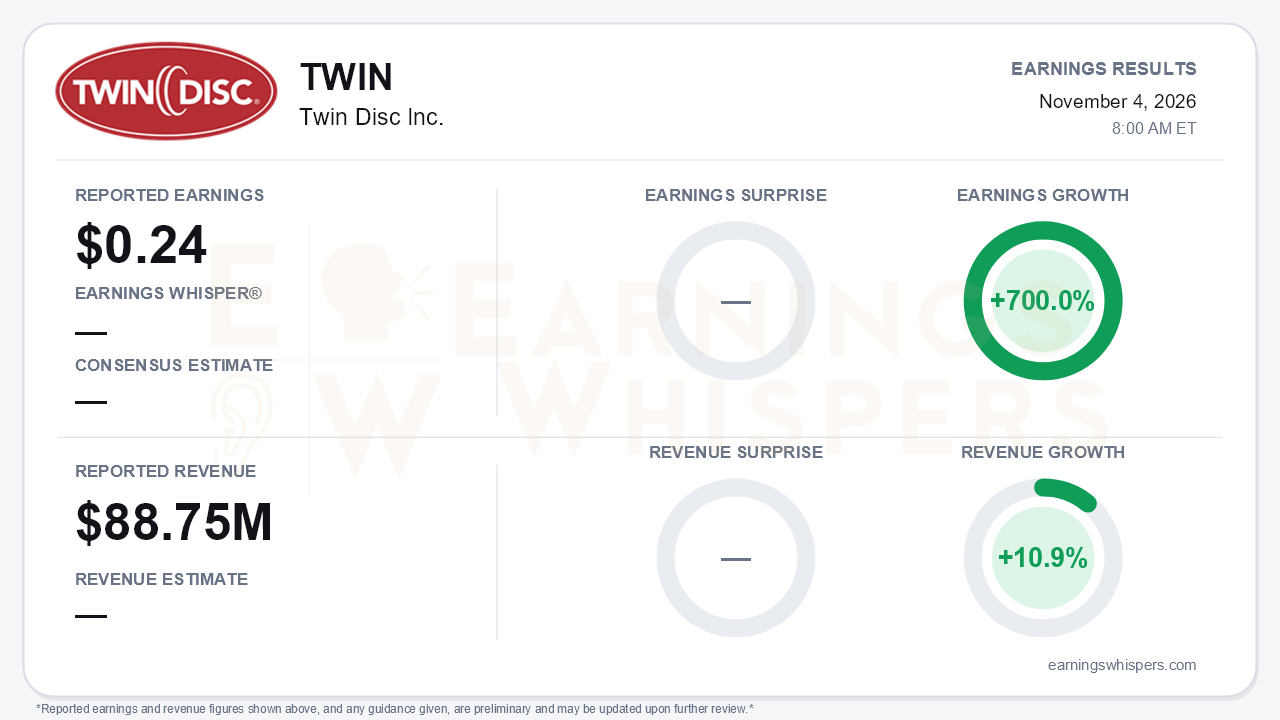
Twin Disc opened fiscal 2027 with a clean earnings swing. It reported $0.24 per share on revenue of $88.75 million, compared with a loss of $0.04 per share a year earlier. That translates to 700.0% year-over-year earnings growth on 10.9% revenue growth. No consensus estimate or Earnings Whisper was available, so the quarter has to be judged on its own trajectory rather than against expectations. On that basis, the most important development is not the income statement. It is the order book. Six-month backlog reached a record $190.6 million, and defense backlog more than doubled. The central tension is that management is converting that demand momentum into a heavy investment year, so margins and cash conversion are guided to stay flat-to-muted even as the top line strengthens.
The quality of the earnings swing deserves some scrutiny. Operating income roughly doubled to $4.6 million, helped by genuine operating leverage. Expenses for marketing, engineering and administration were essentially flat at $20.8 million while sales rose almost $9 million. Below the operating line, however, the year-over-year comparison was flattered by several items:
- Interest expense fell to $428,000 from $800,000.
- Other expense shrank.
- Tax expense dropped to $415,000 from $983,000.
- The prior-year quarter carried a $1.6 million 'cost of goods sold – other' charge that did not recur.
That last point matters for margins. Reported gross margin was flat at 28.7%, but because last year's figure absorbed that charge, the flat comparison implies core product margins actually slipped. That is consistent with management's explanation that the faster-growing Katsa and Veth businesses carry below-average gross margins.
Segment growth also needs context. Marine and Propulsion rose 14.4% to $55.2 million on Veth strength and defense demand, and oil and gas revenue grew 22%. Industrial's headline 35.3% gain, however, includes $4.7 million of Katsa sales reclassified out of Land-Based Transmissions. That same reclassification explains much of Land-Based's reported 14.7% decline. Stripping out the shift, Land-Based would have grown and Industrial would have been softer. One genuine disappointment is that no electric frac (EFRAC) units shipped in the quarter despite heavy emphasis on that product on the prior call. Sales were also seasonally down from the record $114.4 million in the fourth quarter.
The call preserved a credible growth story centered on defense. Defense rose to about 24% of backlog, up from 17% at fiscal year-end and roughly 15% two quarters earlier. Year-over-year growth in defense backlog accelerated sharply over the same span:
- +20% in the third quarter of fiscal 2026
- +56% in the fourth quarter
- +104% this quarter
The first orders tied to the U.S. Navy's initial unmanned vessel program reached the order book, with another bump expected in the second quarter. Katsa added Middle East and Asia programs alongside NATO trucks while holding its pipeline at $30–50 million despite conversions. Data center backup-power orders are small but rising. The Finland assembly plant is now firmly expected to be fully operational in May 2027 and to double gearbox assembly capacity by 2028.
Bears still have legitimate ammunition. Management expects Navy orders to pause for a few quarters after the second-quarter bump, which could make defense intake lumpy. Fiscal 2027 gross margin was guided only broadly in line with fiscal 2026's 26.9%. Free cash flow conversion was guided to just 20–40%, well below the 60% long-term target, as capex climbs to about $25 million from the 'north of $20 million' indicated last quarter. That raises execution and lead-time risk on the capacity build. The 2030 targets of $500 million in revenue, 30% gross margin and more than 60% FCF conversion were reaffirmed but not raised.
Near-term cash and balance-sheet metrics are healthier than the guidance suggests. Operating cash flow was $11.5 million versus an outflow of $7.5 million a year ago, driven mainly by an $11.8 million drop in receivables. The company cited free cash flow of $5.6 million, which is consistent with operating cash flow less capex, even though its stated definition oddly equates free cash flow with operating cash flow. Inventory fell to 94% of backlog from 100% at year-end, and net leverage improved to 0.4x. Net debt fell $16.4 million year over year, although sequential improvement was modest because revolver borrowings rose.
Market context is limited. Shares opened at $24.96 after the August report, comfortably above the current 200-day moving average of $20.56, indicating the market had already been rewarding the defense narrative heading into this period. Current price and sentiment data were not available to judge the immediate reaction.
The bottom line is that Twin Disc delivered a quarter where demand indicators clearly improved: record backlog, accelerating defense orders and new Navy and international programs. The earnings swing, however, owed something to easy comparisons and lower interest and tax costs, and core margins are being diluted by mix. Investors are being asked to accept flat margins and weak cash conversion in fiscal 2027 in exchange for capacity that underpins the 2030 targets. Whether the Navy pause and capex execution disrupt that bridge is now the key question.
This earnings review was originally published on Earnings Whispers.
This article is for informational purposes only and is not investment advice. Earnings Whispers and its staff may hold positions in the securities mentioned. It is AI-assisted, based on proprietary Earnings Whispers data and company reports, and edited by Earnings Whispers staff.
Mentioned In This Article
Latest News
| Nov-04 | |
| Nov-04 | |
| Nov-04 | |
| Nov-02 | |
| Oct-21 | |
| Oct-14 | |
| Aug-20 | |
| Aug-20 | |
| Aug-20 | |
| Aug-20 | |
| Aug-12 | |
| Aug-07 | |
| Jun-29 | |
| Jun-03 | |
| May-28 |
