Sprott's 68.6% EPS Gain Masks A Third Straight Sequential Slide As AUM Resets Lower And Q4 Starts On Weaker Footing
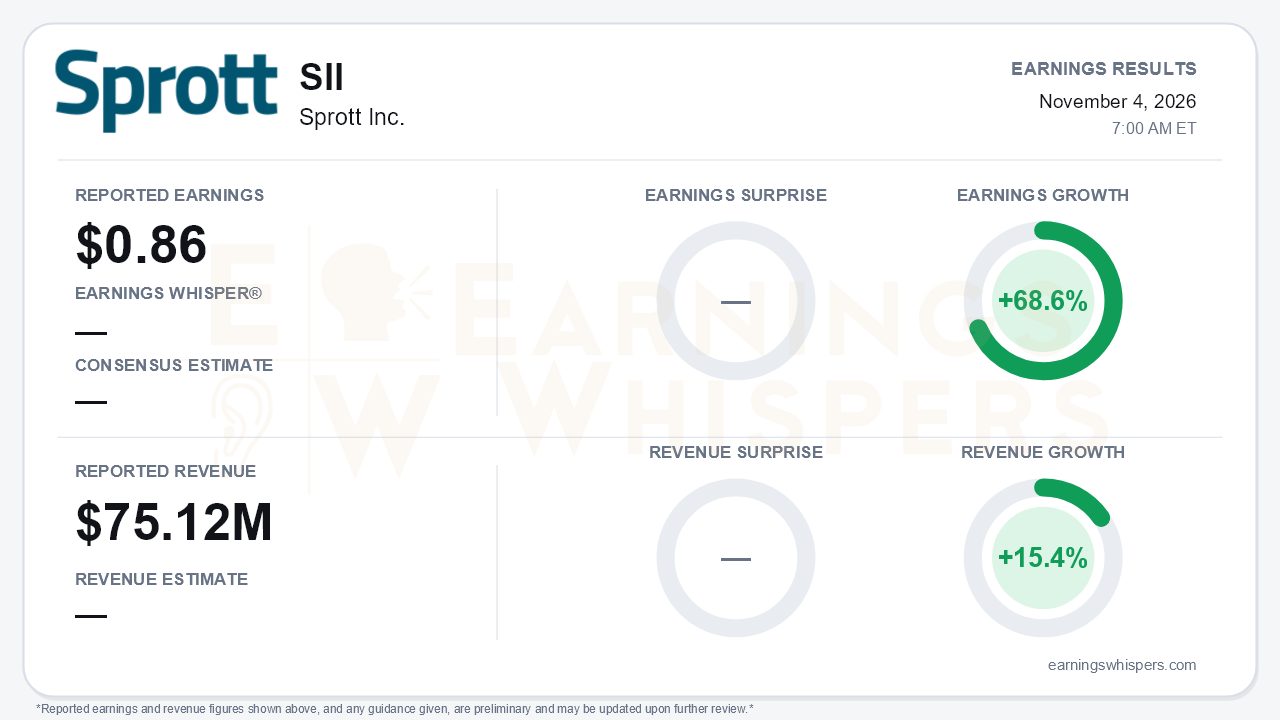
Sprott Inc. (NYSE: SII) reported third-quarter earnings of $0.86 per share on revenue of $75.12 million. Earnings grew 68.6% year over year and revenue rose 15.4%. Those comparisons are flattering, but they are no longer the real story. They are measured against a September 2025 quarter that came before the precious-metals surge pushed average assets under management to a peak of $69.3 billion in the first quarter. Sequentially, the business is shrinking. Net income fell to $22.0 million from $34.3 million in the second quarter. Adjusted EBITDA declined for a second straight quarter, to $46.0 million from $50.8 million and $57.9 million. Year-over-year growth also decelerated sharply from the triple-digit-style gains of the first half. That is the central tension: a strong annual comparison sits on top of a fee base that is resetting lower.
The driver is simple arithmetic for an asset manager. Average AUM dropped to $58.8 billion from $63.9 billion in the second quarter, and management fees followed, sliding to $70.8 million from $76.4 million and $81.5 million over the past two quarters. Performance-fee support has also disappeared. Carried interest was just $0.1 million, compared with the $52 million crystallized in the first quarter. Commissions collapsed to $0.5 million as uranium trust at-the-market issuance dried up. The quality of the GAAP beat deserves some scrutiny as well. Stock-based compensation fell 26% year over year, to $16.5 million, because the mark-to-market on cash-settled RSUs was smaller, and that helped the annual comparison. Sequentially, the same accounting swung the other way and contributed to the drop from the second quarter. Cost discipline itself looks intact. The net compensation ratio was 33%, versus 39% a year ago. The adjusted EBITDA margin was 69%, up from 65%, and management characterized margins as holding around 71% on a year-to-date basis.
The call offered evidence of stabilization rather than recovery. Period-end AUM rose 3% to $57.3 billion, helped by $2.0 billion of market appreciation. Net outflows also narrowed to roughly $207 million from about $0.4 billion in the second quarter. The flow mix was split. The Physical Gold Trust drew $381 million and critical-materials ETFs added $236 million, led by uranium equities and rare earths ex-China. The Physical Silver Trust, however, lost $542 million. Management tied the silver redemptions to India's import restrictions and higher duties, which removed a major physical buyer. Managed equities also saw net redemptions as active ETF flows slowed and the flagship fund faced profit-taking.
The forward picture is where bears have legitimate ammunition. AUM fell to $52.1 billion by October 30, down 9% from quarter-end. That means the fourth quarter begins with a fee base materially below the third-quarter average. Management flagged rising rates and liquidity-driven selling of precious metals after a Fed hike and bond sell-off. It also said third-party distribution partnership interest has gone 'very quiet' over the past three months. In addition, the monthly redemption feature at the physical trusts can produce delayed outflows after price dislocations. On the constructive side, the firm is gaining shelf space at Raymond James, LPL and Stifel. Lending Fund 4 is now in marketing with Sprott co-investment. Management also cited roughly 5% of global copper output offline as support for the copper and uranium trusts.
Capital return is management's clearest signal of confidence. The quarterly dividend rose 25% to $0.50, marking a third straight year of double-digit increases, though the raise was smaller than last year's 33%. Management said post-quarter buybacks were the largest in company history, and year-to-date repurchases are approaching 1% of shares. The balance sheet carries more than $200 million in cash and no debt. Management argued free cash flow is accelerating, citing variable compensation and the lag effect of average AUM.
The market context reinforces how far sentiment has retreated from the first-quarter peak. Shares opened at $105.00 after the August report. That was well below the current 200-day moving average of $126.63 and far beneath the near-record $142.90 the stock touched early in the year. The company noted its share price rose only about 6% during the third quarter, which suggests investors had already been marking the stock down alongside metals prices rather than chasing the year-over-year growth.
The bottom line is that Sprott's headline growth reflects last year's easy comparison, while the current trajectory points down. Average AUM, fees, net income and adjusted EBITDA are all declining sequentially, and October's 9% AUM drop implies further fee pressure in the fourth quarter. The franchise remains highly profitable and debt-free, capital returns are rising, and critical-materials and gold flows offer a credible base. Even so, the next leg depends on precious-metals prices and silver flows that management does not control.
This earnings review was originally published on Earnings Whispers.
This article is for informational purposes only and is not investment advice. Earnings Whispers and its staff may hold positions in the securities mentioned. It is AI-assisted, based on proprietary Earnings Whispers data and company reports, and edited by Earnings Whispers staff.
Mentioned In This Article
Latest News
| Nov-04 | |
| Nov-04 | |
| Nov-04 | |
| Nov-03 | |
| Oct-30 | |
| Oct-20 | |
| Oct-16 | |
| Aug-17 | |
| Aug-14 | |
| Aug-07 | |
| Aug-05 | |
| Aug-05 | |
| Aug-04 | |
| Jul-30 | |
| Jul-15 |
