Avnet Delivers A Blowout Beat-And-Raise, But Memory Pricing And An $842 Million Cash Burn Are Funding The Boom
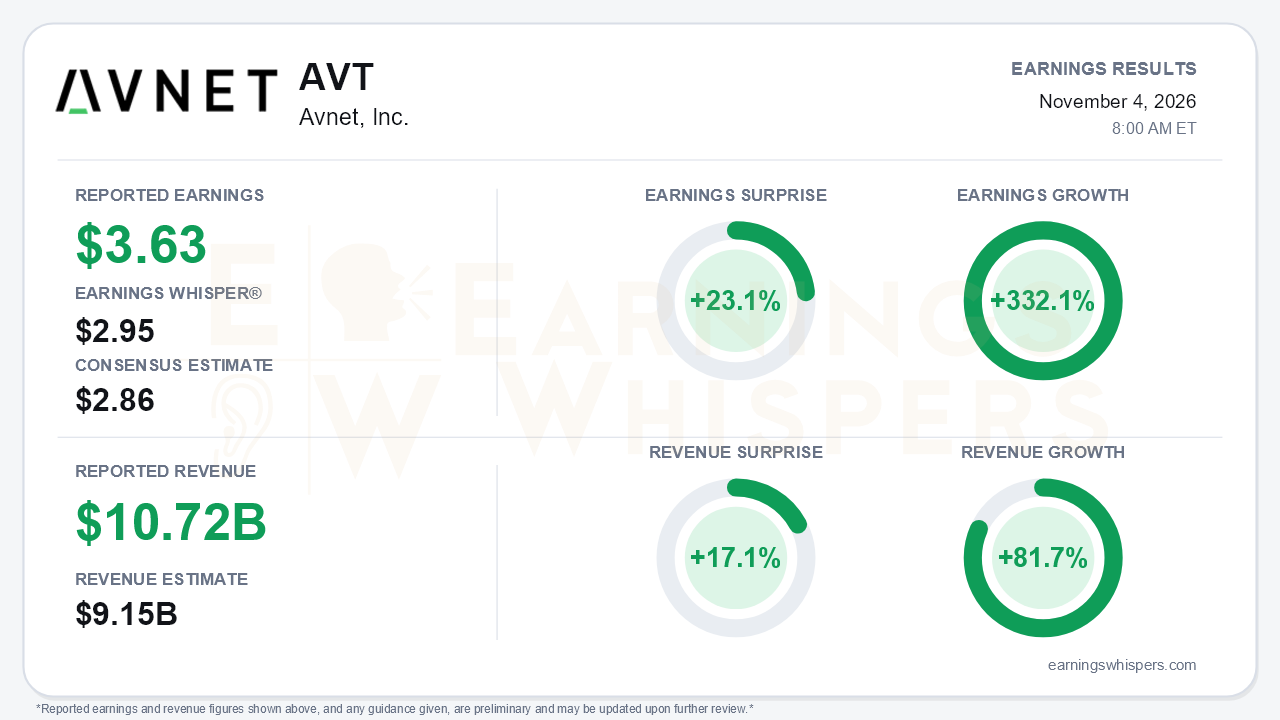
Avnet's fiscal first quarter was the kind of beat-and-raise that resets the earnings base. Adjusted EPS of $3.63 topped the $2.86 consensus by 23.1% and cleared the $2.95 Earnings Whisper number comfortably. It also landed far above the company's own $2.80-$2.90 guide. Revenue of $10.718 billion beat the $9.15 billion consensus by 17.1% and rose 81.7% year over year, while earnings grew 332.1%. Growth is clearly accelerating. Year-over-year sales gains have stepped up from 12% to 34% to 48% and now 82% over four quarters, and adjusted EPS has climbed from $1.05 to $1.48 to $2.28 to $3.63. The central tension is how the growth is being paid for. Avnet is converting a pricing-fueled upcycle into record profits, but it is financing that expansion with borrowed money and a ballooning balance sheet.
The quality of the beat deserves some scrutiny, though less than the headline might suggest. A 14-week quarter flattered the comparison. Stripping out the estimated $654 million extra week, organic growth was still about 71% year over year and 21% sequentially. GAAP EPS of $3.28, up from $0.61, trailed the adjusted figure mainly because of $0.20 in restructuring and integration costs and a $0.09 foreign-currency loss. The real story is operating leverage. Gross margin actually slipped to 10.0% from 10.4% last quarter on Integrated Solutions and customer mix, and Electronic Components gross margin fell to 8.9% from 9.2% a year ago. Even so, adjusted operating margin widened for a fifth straight quarter, reaching 4.7% versus 3.8% in Q4 and 2.6% a year ago. Sales nearly doubled while SG&A rose only about 24%. EC operating margin reached 4.8%, and Farnell hit 10.1%, up from 5.2% just two quarters ago.
The call kept extending the margin story. Management pulled its 5% EC operating-margin target into the second half of fiscal 2027 and framed roughly 6% for EC and low-teens for Farnell over time. Farnell's double-digit margin arrived about a year ahead of the original calendar 2027 target. Avnet Integrated Solutions was named as a new driver, scaling with hyperscale, enterprise and neocloud AI rack integration. Management also argued that demand is broad rather than a replenishment bounce, pointing to:
- book-to-bill above 1 in every region;
- a growing backlog;
- a March quarter that could be better than seasonal.
Return on working capital hit 25%, a 10-year high, and the dividend rose about 6% to $0.37.
Bears still have legitimate ammunition. Management estimates that about one-third of sales growth still comes from memory pricing, and roughly a third of the $2.1 billion inventory build is likewise tied to memory prices. That creates clear reversal risk if the memory cycle turns. Operating cash flow was negative $842 million, against negative $291 million in Q4 and positive $208 million two quarters earlier. Debt rose roughly $950 million, interest expense jumped to $92 million from $66 million (a $0.23 EPS drag), and leverage sits at 3.1x, with the 3x target slipping to the second half of fiscal 2027. Positive cash flow has been pushed to the end of the fiscal year, and more capital raises are expected. Management also flagged early cracks: memory-heavy customers such as tablet makers are slowing production, and backlog delinquencies are rising as lead times stretch.
Guidance nonetheless moved decisively higher. Avnet guided second-quarter sales of $11.1-$11.4 billion and adjusted EPS of $3.90-$4.10, with GAAP EPS of $3.80-$4.05. That implies about 12% sequential growth on a comparable-week basis. The outlook assumes flat pricing and similar supply, and management expects non-memory price increases in power, passives, discretes and controllers in the new calendar year, which could provide upside.
The market setup is more complicated than the surprise implies. Investor sentiment improved meaningfully into the report, rising from 0.18 to 0.32, yet the stock has not followed. Shares hit a 52-week high of $108.63 on October 2 and then slid to an inter-earnings low of $85.07 on October 30. They entered the report at $88.73, down 4.2% since the post-August open and 18.3% below that peak, though still 9.2% above the 200-day moving average. Sequential growth and momentum readings remain positive, while the AVWAP trend is negative, consistent with a recent selloff that has left the stock below where many recent buyers entered. The October drawdown suggests investors were already debating cycle durability and balance-sheet strain before this print.
The bottom line is that Avnet delivered an exceptional quarter on nearly every earnings and margin measure and guided above expectations again. Management's margin targets keep moving up, and the AI data center business is emerging as a real driver. The boom, however, rests partly on memory pricing and is being financed with debt and working capital. Investors' focus will likely shift from how fast earnings are growing to whether cash flow, leverage and pricing hold up long enough to justify those earnings.
Read our earnings preview for Avnet, Inc.: https://www.earningswhispers.com/article/AVT/21675
This earnings review was originally published on Earnings Whispers.
This article is for informational purposes only and is not investment advice. Earnings Whispers and its staff may hold positions in the securities mentioned. It is AI-assisted, based on proprietary Earnings Whispers data and company reports, and edited by Earnings Whispers staff.
Mentioned In This Article
Latest News
| Nov-04 | |
| Nov-04 | |
| Oct-27 | |
| Sep-11 | |
| Sep-09 | |
| Aug-25 | |
| Aug-20 | |
| Aug-15 | |
| Aug-14 | |
| Aug-06 | |
| Aug-06 |
Stock Of The Day In Buy Zone As AI, Tech Trends Fall Into Its Wheelhouse
AVT
Investor's Business Daily
|
| Aug-05 | |
| Aug-05 | |
| Jul-22 | |
| Jul-10 |
