Allegiant Crushes Q3 Loss Estimates As Unit Revenue Accelerates, But Fuel And A Heavier Balance Sheet Keep The Full-Year Outlook Pinned At >$6
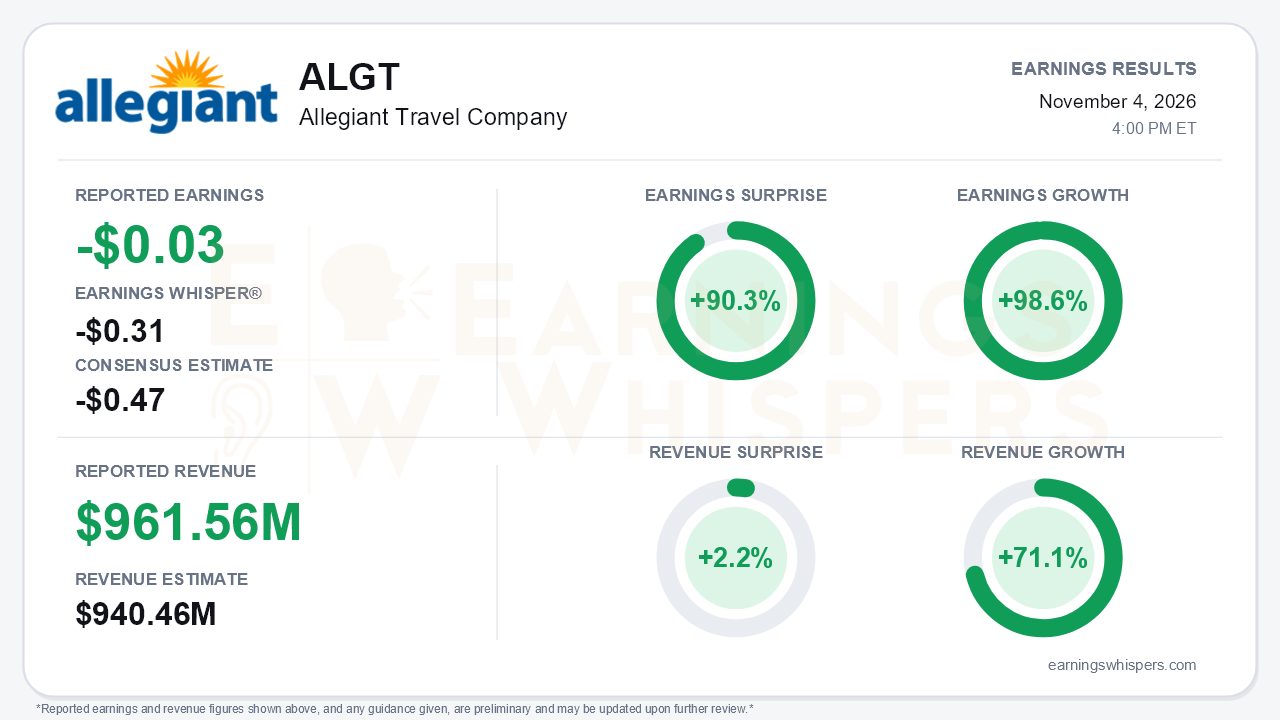
Allegiant Travel Company (NASDAQ: ALGT) delivered a far stronger seasonal-trough quarter than Wall Street expected. It posted an adjusted loss of just $0.03 per share against a consensus of -$0.47 and an Earnings Whisper number of -$0.31, a 90.3% beat. The result also compares with an adjusted loss of $2.09 a year ago, representing 98.6% earnings growth. Revenue of $961.56 million topped the $940.46 million consensus by 2.2% and grew 71.1% year over year, although that headline growth is inflated by the May acquisition of Sun Country. The central tension is clear. Allegiant is executing well on pricing, and unit revenue is accelerating. Even so, a fuel shock forced management to reaffirm, rather than raise, its full-year adjusted EPS target of more than $6.00, a figure that stood above $8 at the start of the year.
The quality of the beat holds up better than the GAAP headline suggests. The GAAP loss was $0.56 per share, but $19.1 million of special charges, $18.9 million of them integration costs, account for most of the gap. On a pro forma basis, revenue rose 19% on 5.7% less scheduled capacity, ahead of the roughly 16.5% management had guided. The adjusted operating margin reached 3.1%, versus -0.3% in the pro forma prior-year quarter and a 2% guidance midpoint. Allegiant achieved that despite fuel averaging $3.98 a gallon, up 55.5% year over year and above the $3.80 it had assumed. The legacy Allegiant segment carried the quarter with a 3.9% adjusted operating margin. Sun Country managed only 1.1% and remained loss-making before taxes on an adjusted basis.
The operating story is one of sharpening pricing power. Pro forma TRASM rose 28.3%, extending an acceleration from 16.4% in the first quarter and 24.6% in the second. The scheduled-service average fare jumped 50.3% and load factor climbed 2.3 points to 86.7%, which suggests capacity discipline is being rewarded rather than punished. Unit costs were the expected drag: CASM excluding fuel rose 9.1%. That was better than the 10% to 12% management had estimated, and the company still expects the third quarter to mark peak cost pressure. Co-brand remuneration of $42.1 million rose 23.6% and now represents roughly 6% of standalone revenue, up from about 5% earlier in the year.
The forward catalysts are real, but they skew toward late 2027. Management signed a five-year co-brand extension with Bank of America, though the improved economics and refreshed card program are not expected until the second half of 2027. Early bookings for Allegiant First, which launches in March 2027, are running ahead of expectations. Expedia already accounts for about 4% of bookings, and management plans to sell ancillaries through that channel within roughly six months. Combined revenue teams delivered ancillary synergies ahead of plan, and management reaffirmed more than $140 million of synergies by 2029. On the risk side, bears have legitimate ammunition:
- The fourth-quarter fuel assumption jumped to $4.75 a gallon from $3.70 at the prior call.
- Sun Country scheduled service will be down about 10% in the fourth quarter because of pilot shortages.
- Liquidity slipped to $1.1 billion from $1.3 billion after a $267 million pilot retention payment, and net debt rose to $2.1 billion.
- 2027 capex will exceed this year's roughly $850 million.
- 2027 capacity growth is now framed at low-to-mid single digits, with January and February already trimmed.
- Pilot wage step-ups will weigh on early-2027 unit costs.
Fourth-quarter guidance calls for adjusted EPS of $1.00 to $1.50, an adjusted operating margin of 6% to 7%, and TRASM growth above 20%, which would be a company record. Earnings Whispers characterized the outlook as above estimates. Still, investors should recognize that pricing strength is being used to absorb fuel rather than to lift the annual bar. Management also flagged a brief hint of demand elasticity around Halloween weekend, which it characterized as a timing blip.
The market setup is more complicated than the surprise implies. Investor sentiment improved meaningfully heading into the report, rising from a near-neutral 0.06 to 0.28, a modestly positive reading. Yet the stock entered earnings at $74.46, down 22.7% from the $96.30 open following the August report and 14.8% below its 200-day moving average of $87.40. The decline came as the fuel outlook deteriorated sharply over the quarter. Price and AVWAP trend readings remain negative, underscoring how poorly the shares have traded despite better operating execution.
The bottom line is that Allegiant proved it can price aggressively, cut capacity and stay profitable at the operating line in its weakest quarter, even with fuel up more than 50%. The beat was substantive, not just a product of low expectations. The investment case now rests on whether record unit revenue can keep outrunning fuel while the company digests Sun Country's staffing problems, a heavier balance sheet and rising capex. Many of the most compelling commercial benefits will not arrive until the second half of 2027. The December 7 investor day, with its long-term framework and synergy timeline, becomes the next important test of whether the market will look past the fuel overhang.
Read our earnings preview for Allegiant Travel Company: https://www.earningswhispers.com/article/ALGT/21774
This earnings review was originally published on Earnings Whispers.
This article is for informational purposes only and is not investment advice. Earnings Whispers and its staff may hold positions in the securities mentioned. It is AI-assisted, based on proprietary Earnings Whispers data and company reports, and edited by Earnings Whispers staff.
Mentioned In This Article
Latest News
| Nov-04 | |
| Nov-04 | |
| Nov-04 | |
| Nov-02 | |
| Oct-27 | |
| Oct-27 | |
| Oct-19 | |
| Oct-08 | |
| Sep-18 | |
| Sep-15 | |
| Sep-14 | |
| Sep-01 | |
| Aug-31 | |
| Aug-24 | |
| Aug-24 |
