Acadia Beats As DAYBUE Acceleration Runs Into A Bruised Pipeline Story
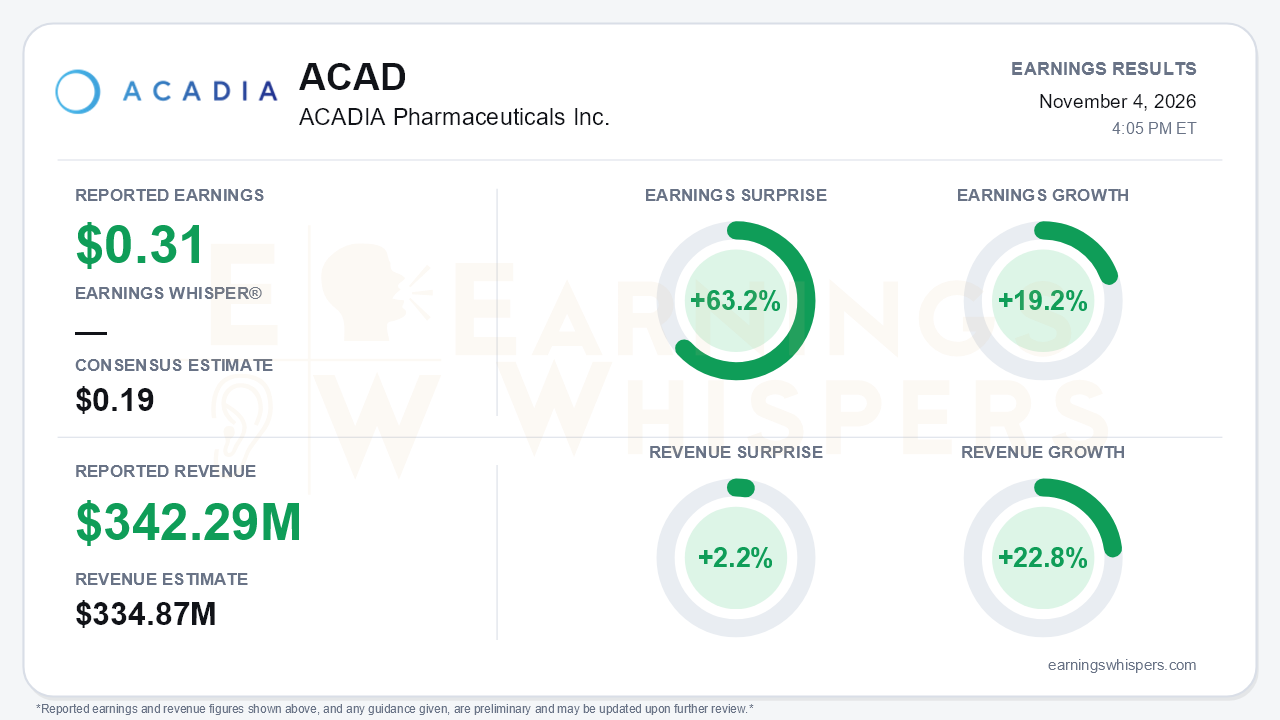
Acadia Pharmaceuticals delivered the cleanest commercial quarter it has posted in some time. Earnings of $0.31 per share beat the $0.19 consensus by 63.2%, and revenue of $342.29 million topped expectations by 2.2%. Earnings grew 19.2% year over year and revenue rose 22.8%. The more important point is that growth is accelerating. On an adjusted basis, total revenue growth stepped up from 11% in the first quarter to 17% in the second and 22% now. That is the central tension: the commercial engine is gaining speed just as the pipeline asset meant to define Acadia's next chapter lost credibility, and the stock has been trading on the pipeline.
The quality of the beat deserves a closer look. GAAP net income actually fell to $54 million from $72 million, and diluted EPS dropped from $0.42 a year ago. That decline reflects taxes, not operations. Last year's quarter carried a $27 million tax benefit, while this quarter absorbed a $27 million tax expense. Below the tax line the picture is strong:
- Operating income roughly doubled to $71.7 million from $35.8 million.
- Pre-tax income rose to $80.4 million from $44.6 million.
- R&D expense fell to $76 million.
- SG&A climbed 19% to $159 million but was flat sequentially, so operating leverage is showing up.
One soft spot is cost of product sales, which includes license fees and royalties. It rose to $35 million from $21.6 million, outpacing revenue growth.
DAYBUE is the story. Sales of $140 million rose 39%, up from 30% growth in the second quarter and 20% in the first. The driver was DAYBUE STIX, which now accounts for more than half of U.S. patients, up from about 40% last quarter. On the call, management noted that more than 80% of lapsed patients have yet to retry therapy, which leaves a reservoir of potential reactivations. Other DAYBUE developments:
- The European Commission approved the drug, and the German launch is under way with patients already on commercial product.
- A newly allowed U.S. patent extends DAYBUE protection to March 2041, adding nearly five years of exclusivity.
- Full-year DAYBUE guidance was raised for the third time, to $505–$520 million from an initial $460–$490 million.
NUPLAZID also accelerated, growing 12% on an adjusted basis versus 10% and 6% in the prior two quarters, with 11% volume growth. Management reaffirmed its 2028 ambitions of $700 million for DAYBUE and roughly $1 billion for NUPLAZID.
The guidance carries some caveats. NUPLAZID's range was narrowed to $760–$775 million from $760–$790 million, lowering the midpoint. Management attributed this to slower-than-hoped conversion from its field-force expansion, a step back from second-quarter expectations for a stronger fourth quarter. Total revenue guidance was tightened to $1.265–$1.295 billion, a modest midpoint lift driven entirely by DAYBUE. Management also expects the pace of STIX conversion to moderate as that launch matures. R&D guidance was cut again, to $325–$340 million from an original $385–$410 million. That supports margins, but it also reflects a narrower pipeline footprint.
That pipeline is where bears have legitimate ammunition. The Phase 2 RADIANT study of remlifanserin in Alzheimer's disease psychosis narrowly missed its primary endpoint (p=0.0603). Its observed effect size of 0.26 fell well short of the 0.4 the trial was powered for, and only CGI-S reached nominal significance. Acadia is calling the data Phase 3-enabling and moving forward with 60 mg only, under undisclosed statistical-plan modifications. An FDA meeting on that plan is expected in the first half of 2027. The language has shifted from "potentially transformational" last quarter to something far more evidence-dependent.
Several other risks sit alongside the pipeline reset:
- Oral argument in the Aurobindo appeal on a NUPLAZID patent is scheduled for November 9.
- The head of R&D position remains vacant.
The next pipeline catalysts are:
- additional RADIANT data at CTAD on November 17;
- an ACP-211 depression readout in the second half of 2027;
- a remlifanserin Lewy body dementia psychosis readout, now guided to the fourth quarter of 2027 and backed by Fast Track designation.
The market has punished the stock hard. Shares fell 26.4% from the open after the August report to $20.57, sliding from a 52-week high of $30.96 on August 19 to a 52-week low of $18.39 on October 13. They now sit 13% below the 200-day moving average and only modestly above that low. Investor sentiment nonetheless improved into the print, rising from 0.21 to 0.33. That is a meaningful but not dramatic shift toward cautious optimism, roughly the commercial-versus-pipeline split this quarter produced. The Earnings Whispers trend readings show the same divide: sequential growth and momentum are positive, while price and AVWAP trends remain negative.
The bottom line is that Acadia's commercial business is getting stronger on nearly every measure that matters: accelerating DAYBUE and NUPLAZID growth, a third DAYBUE raise, exclusivity extended to 2041, a European launch and expanding operating income. The stock's collapse reflects a pipeline that now has to earn back credibility rather than any failure of the core franchises. Until remlifanserin's Phase 3 path is clarified with the FDA, the commercial momentum may have to carry the investment case largely on its own.
Read our earnings preview for ACADIA Pharmaceuticals Inc.: https://www.earningswhispers.com/article/ACAD/21765
This earnings review was originally published on Earnings Whispers.
This article is for informational purposes only and is not investment advice. Earnings Whispers and its staff may hold positions in the securities mentioned. It is AI-assisted, based on proprietary Earnings Whispers data and company reports, and edited by Earnings Whispers staff.
Mentioned In This Article
Latest News
| Nov-04 | |
| Nov-04 | |
| Oct-28 | |
| Oct-27 | |
| Oct-21 | |
| Sep-28 | |
| Sep-28 | |
| Sep-25 | |
| Sep-25 |
Acadia chugs on with Alzheimers psychosis programme despite Phase II miss
ACAD -6.76%
Clinical Trials Arena
|
| Sep-25 | |
| Sep-24 | |
| Sep-24 | |
| Sep-24 | |
| Sep-24 | |
| Sep-24 |
