Sinclair's Record Midterm Haul Powers A Big Beat And Second Guidance Raise, But Core Advertising Keeps Sliding
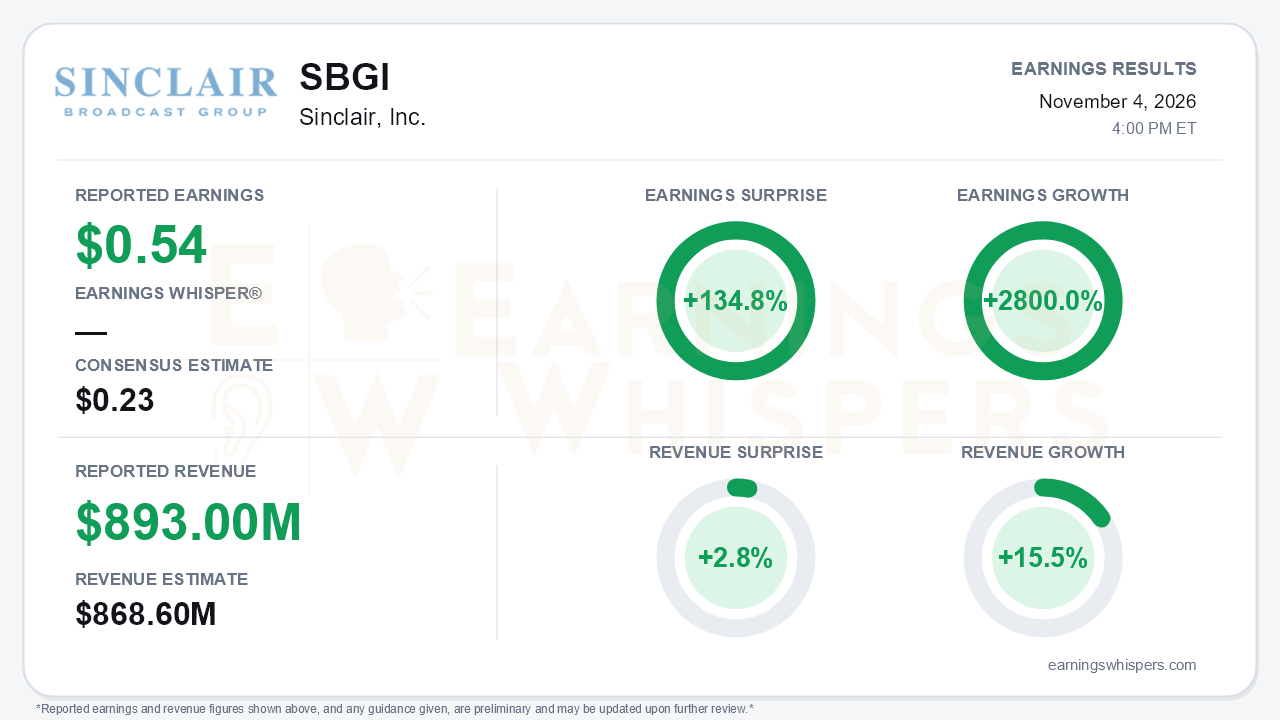
Sinclair, Inc. (NASDAQ: SBGI) delivered a decisive beat-and-raise in the third quarter, powered by record midterm political spending. Earnings came in at $0.54 per share against a $0.23 consensus, a 134.8% surprise. Revenue of $893.0 million topped the $868.6 million estimate by 2.8% and grew 15.5% year over year. Earnings growth of 2800.0% reflects a swing from a GAAP loss of $0.02 per share a year ago to GAAP net income of $43 million, or $0.60 per diluted share. The normalized $0.54 figure is the basis for the comparisons above. Adjusted EBITDA more than doubled to $213 million from $100 million, and management lifted full-year 2026 Adjusted EBITDA guidance to $825 million to $835 million from $730 million to $760 million. The central tension is that nearly all of the upside came from a cyclical revenue stream, while the recurring businesses that must carry 2027 are flat to shrinking.
The quality of the beat deserves scrutiny. Political advertising jumped to $136 million from $6 million a year ago and $59 million in the second quarter. That figure is up 55% versus the comparable 2022 midterm quarter. Strip it out and the picture is far less inspiring. Core advertising fell 4% to $301 million, the third straight quarterly decline after growth of 14% and 4% in the prior two periods. Distribution revenue rose just 1% to $426 million. Local Media revenue excluding political actually slipped year over year. What political did accomplish was spectacular operating leverage. Media programming and SG&A expenses rose only modestly, so Local Media Adjusted EBITDA jumped to $205 million from $92 million. Operating cash flow for the first nine months reached $238 million versus $91 million a year earlier, and that cash funded roughly $355 million of year-to-date debt reduction.
Guidance is where the call preserved a credible near-term story. Full-year political is now expected at roughly $455 million. That compares with the 'at least $375 million' guided in August and 'at least $333 million' at the start of the year. It would top the 2024 presidential-year record of $405 million. According to the call analysis, the EBITDA midpoint rose by $85 million, more than the political step-up alone, which suggests cost discipline is contributing. Total revenue guidance rose $95 million at the midpoint to $3.53 billion to $3.60 billion. The recurring lines moved the other way. The core advertising range narrowed to $1.22 billion to $1.25 billion, down from $1.26 billion to $1.30 billion at the start of the year. The distribution range was tightened with an unchanged midpoint. Management cited softening auto spending in the fourth quarter and pressure on medical, legal and food advertisers from high prices and fuel volatility.
The forward setup carries real catalysts alongside legitimate bear ammunition. On the positive side, Sinclair signed new ABC and CBS affiliation agreements, faces a Fox renewal in December and a heavy MVPD renewal cycle in 2027, and sees subscriber churn moderating. It has also completed three in-market station acquisitions and pointed to more market-optimization deals under a deregulatory FCC. Tennis Channel core advertising grew 21%, and new in-house direct-to-consumer apps arrive in December. On the other side, management itself flagged tough 2027 core comparisons, with no Olympics or World Cup, possible MLB labor disruption, and an off-cycle political year. Tennis EBITDA slipped to $15 million on programming and DTC investment. The standalone Ventures spin, once framed as the preferred path, is now shelved. The $489 million of Ventures cash is instead being held as optionality for a larger broadcast combination, which remains gated by the Nexstar-Tegna outcome. Total leverage of 5.1x is improved from 6.0x a year ago, but it remains elevated against $4.0 billion of debt.
The market had not been rewarding the political windfall before the report. Shares entered at $13.47, down 7.2% since the open following the August report and 4.2% below the 200-day moving average. The stock sat 17.4% below the $16.30 inter-earnings high set the day after that release. It touched a 52-week low of $11.83 on October 27 before rebounding about 14%. Investor sentiment improved from essentially neutral (0.01) to a modestly positive 0.17, a meaningful but not euphoric shift. The trend signals are split: sequential growth and momentum are positive, while price and AVWAP remain negative.
The bottom line is that Sinclair executed the political cycle about as well as possible. It converted record demand into a second consecutive guidance raise, stronger cash flow and lower leverage. That windfall is nonrecurring, however, while core advertising is deteriorating and 2027 lacks both political and marquee-sports support. The stock's depressed technical position suggests investors were already discounting that cliff. The next leg of the story depends on retransmission and affiliation step-ups, market-swap M&A and any broadcast consolidation, not on the quarter just reported.
Read our earnings preview for Sinclair, Inc.: https://www.earningswhispers.com/article/SBGI/21932
This earnings review was originally published on Earnings Whispers.
This article is for informational purposes only and is not investment advice. Earnings Whispers and its staff may hold positions in the securities mentioned. It is AI-assisted, based on proprietary Earnings Whispers data and company reports, and edited by Earnings Whispers staff.
Mentioned In This Article
Latest News
| 2 hours | |
| 5 hours | |
| 5 hours | |
| Oct-27 | |
| Oct-06 | |
| Oct-05 | |
| Sep-16 | |
| Sep-03 | |
| Aug-27 | |
| Aug-25 | |
| Aug-24 | |
| Aug-06 | |
| Aug-06 | |
| Aug-05 | |
| Aug-05 |
