Palmer Square Capital BDC Matches NII Estimates As NAV Recovers, But The Earning Base Keeps Shrinking
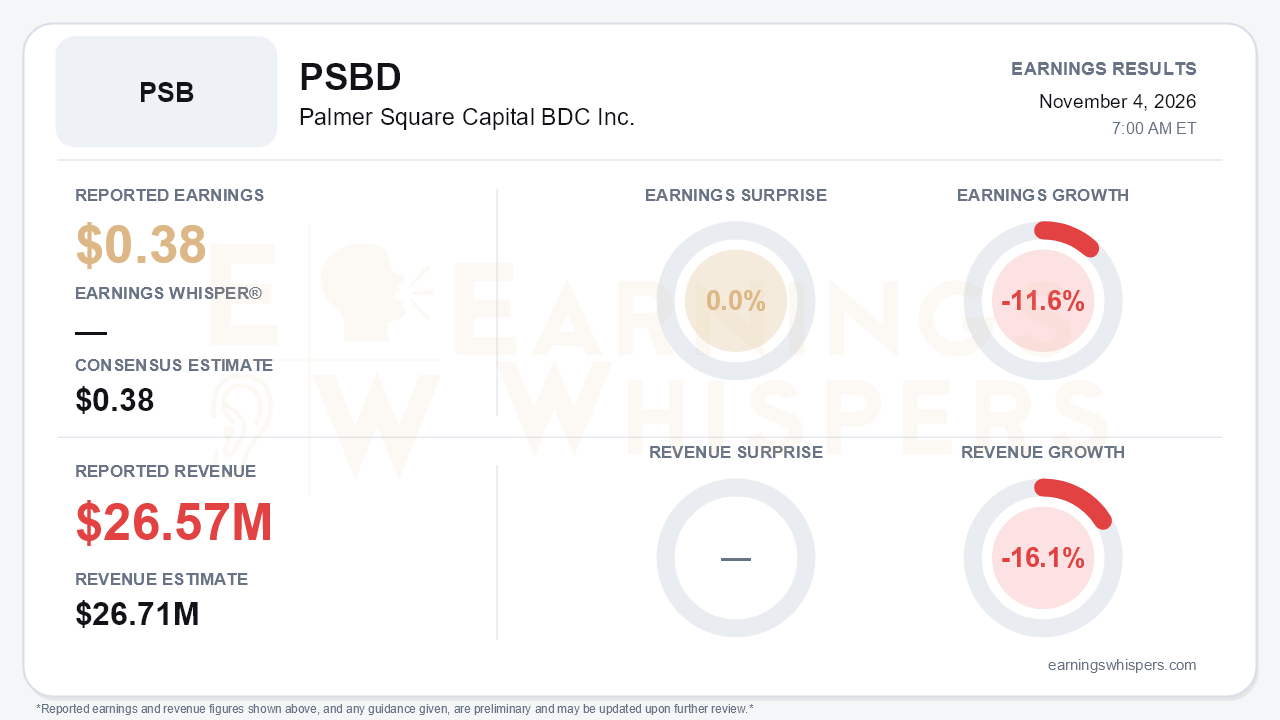
Palmer Square Capital BDC (NYSE: PSBD) delivered a quarter that was cleaner on the balance sheet than in the income statement. Net investment income of $0.38 per share matched the consensus estimate exactly, while total investment income of $26.57 million missed expectations by 0.5%. The year-over-year comparisons remain poor. Earnings fell 11.6% and revenue dropped 16.1%. NII per share has now gone from $0.41 in the fourth quarter of 2025 to $0.35 in the first quarter, $0.39 in the second, and $0.38 in the third. The more important development was net asset value. NAV per share rose to $13.34 from $13.21, the first sequential increase in four reporting periods, after a slide from $14.85 at year-end to $13.30 in the first quarter. That is the central tension: credit and valuation are stabilizing, but the income engine is still contracting.
The NAV gain had several sources. Net realized and unrealized gains totaled $2.4 million, compared with losses of $3.6 million in the second quarter and $48.3 million in the first. Underneath that figure, a $7.0 million unrealized markup more than offset $4.6 million of realized losses, so the portfolio is still crystallizing losses even as marks improve. Non-accruals at fair value fell to effectively zero from 0.29%, and on a cost basis they improved to 96 basis points from 149. The quarterly total return on NAV reached 5.00%. However, year-to-date net assets from operations remain negative at $(0.48) per share. The quality of the earnings line also deserves scrutiny. Interest income fell to $24.8 million from $30.4 million a year earlier, and other income rose to $0.76 million from $0.24 million.
The operating picture reflects deliberate shrinkage. Deployment improved to $115 million from $72.4 million in the second quarter. Even so, $165.8 million of sales and repayments left net exits of about $51 million. The portfolio's fair value fell to $1.09 billion, down from $1.20 billion at year-end. Leverage declined to 1.63x from 1.71x. Liquidity dropped to $195 million from $331 million, but that decline reflects a planned downsizing of the BofA facility to cut carrying costs rather than stress. Several credit metrics also drifted modestly in the wrong direction:
- Payment-in-kind income rose to 2.18% of total investment income from 1.37%. The release presents this as "only" $578.7 thousand, while the call data show it climbing.
- Interest coverage slipped to 2.38x from 2.5x.
- Senior secured leverage rose to 5.71x.
Management laid out a credible set of catalysts. The CLO reset priced at SOFR+139, down from +172, and management expects it to be accretive beginning in the fourth quarter. Management also said interest costs should now be at a steady state. It framed September's Fed rate hike as a tailwind for a portfolio that is 98% floating rate, a notable reversal from 2025, when rate cuts compressed NII. Spreads on new private credit loans widened to 659 basis points, up from 534 in the second quarter and 463 two quarters before that. Management also pointed to more lender-friendly documentation. However, private credit fell to just 12.2% of new investments from 24.1%, so the company captured little of that spread widening. Management expects fourth-quarter deal activity to stay depressed by rate volatility and longer sponsor timelines. That outlook repeats a pattern: the hoped-for April pickup and the second-quarter refinancing wave also failed to materialize.
Dividend coverage is adequate but thin. NII of $0.38 covered the $0.36 base dividend, and management expressed confidence that the base payout is sustainable into 2027. The supplemental dividend, however, slipped to $0.02 from $0.03. Share buybacks of $5.2 million, with $24.8 million of authorization remaining, are accretive with the stock trading near three-quarters of NAV.
The market has not been convinced. Investor sentiment was essentially unchanged and deeply negative, edging to -0.7948 from -0.7987. Shares closed at $9.90 ahead of the report, up 1.7% from the open after the August release but 5.7% below the $10.50 200-day moving average. The stock peaked at $10.88 in late September, then slid to $9.39 in mid-October before recovering. That pattern suggests the brief rally faded as rate volatility and deal-flow concerns resurfaced. The Earnings Whispers AVWAP trend remains negative, while price and momentum readings are neutral.
The bottom line is that PSBD's third quarter met expectations and showed real progress on NAV, non-accruals, and funding costs. However, it did not resolve the core bear argument that a shrinking portfolio and muted deployment keep eroding the earnings base. Rising rates, wider spreads, and the CLO reset give management a plausible path to stabilizing NII. Until net portfolio growth resumes, the deep NAV discount and negative sentiment look less like an overreaction and more like a demand for proof.
Read our earnings preview for Palmer Square Capital BDC Inc.: https://www.earningswhispers.com/article/PSBD/22003
This earnings review was originally published on Earnings Whispers.
This article is for informational purposes only and is not investment advice. Earnings Whispers and its staff may hold positions in the securities mentioned. It is AI-assisted, based on proprietary Earnings Whispers data and company reports, and edited by Earnings Whispers staff.
Mentioned In This Article
Latest News
| Nov-04 | |
| Nov-04 | |
| Oct-28 | |
| Oct-14 | |
| Sep-25 | |
| Sep-22 | |
| Sep-22 | |
| Aug-05 | |
| Aug-05 | |
| Aug-04 | |
| Jul-14 | |
| Jun-24 | |
| May-21 | |
| May-06 | |
| Apr-14 |
