Figma Beats And Raises Again, But A 33% Q4 Guide And Sliding Retention Show The Cost Of Its AI Push
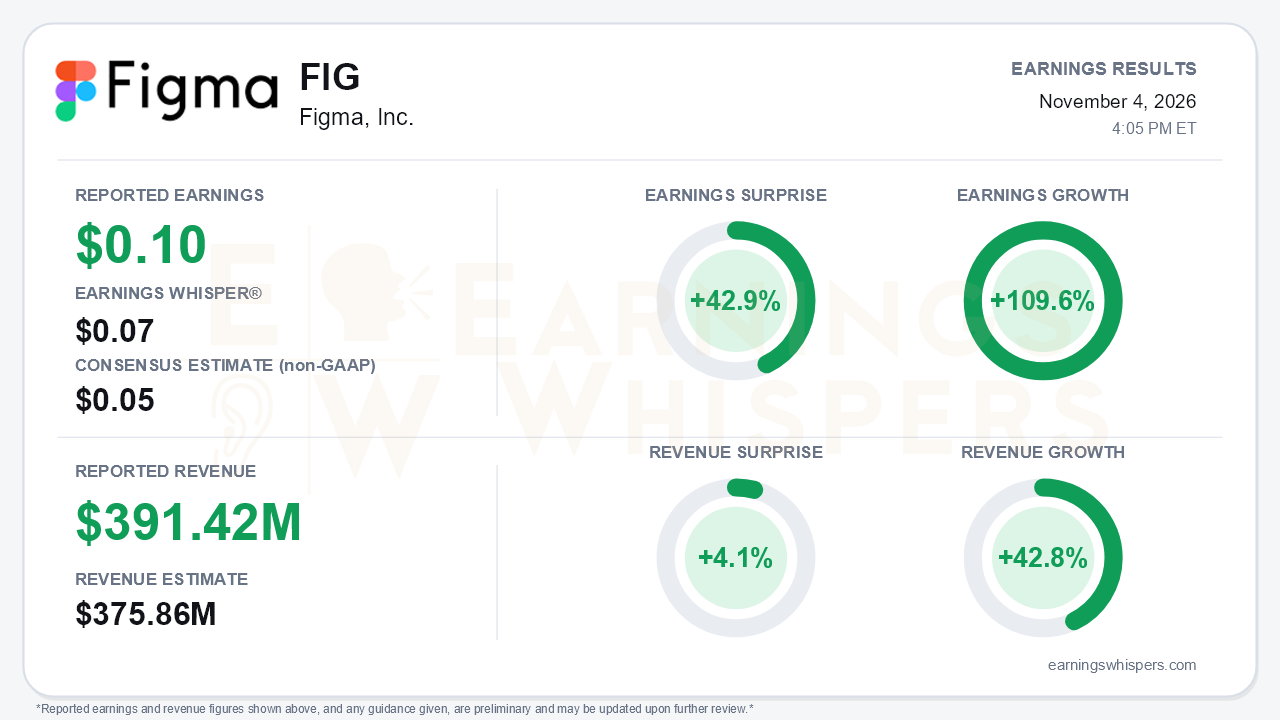
Figma delivered another clean beat-and-raise for the third quarter. Underneath it, the core growth and retention trends are cooling while the company spends margin and near-term monetization to drive AI adoption. Non-GAAP earnings of $0.10 per share topped the $0.05 consensus and the $0.07 Earnings Whisper number, a 42.9% surprise, with earnings up 109.6% year over year on Earnings Whispers' normalized basis. Revenue of $391.42 million rose 42.8% and beat the $375.86 million consensus by 4.1%. It also landed $16.4 million above the top of management's own guidance. Full-year revenue guidance rose by $33 million at the midpoint to $1.497-$1.499 billion. Still, the fourth-quarter outlook of $402-$404 million implies roughly 33% growth, down from 43% in Q3 and 48% in Q2. That is the central tension: the beats keep coming, but the growth curve is clearly bending.
The quality of the quarter deserves some scrutiny. Non-GAAP operating income was $47.0 million, a 12% margin. That was up from 10% in Q2 but flat with a year ago, so the business is not yet showing operating leverage despite 43% top-line growth. Non-GAAP gross margin slipped to 82% from 85% in Q2 and 86% a year earlier as Figma absorbed inference costs for its agent ahead of general availability. Free cash flow of $41.5 million was an 11% margin, down from 14% in Q2 and 18% in the year-ago quarter. Deferred revenue was essentially flat sequentially, and remaining performance obligations dipped. Investors should also note that non-GAAP net income fell to $53.7 million from $62.4 million a year ago. The per-share growth figure therefore reflects the normalized comparison rather than a jump in absolute profit dollars. On a GAAP basis, the net loss narrowed dramatically to $81.3 million from $1.1 billion in the IPO-distorted prior-year quarter. Stock-based compensation of $158.6 million remains heavy at roughly 40% of revenue.
The call made clear that Figma is deliberately trading short-term monetization for AI adoption. The Figma agent reached general availability on October 6, and weekly AI credit consumption rose 2.5x through the transition. Weekly agent usage among $10,000-plus ARR customers reached 65%, up from just over 50% in Q2. The MCP server is approaching one million weekly active users, with usage up 3x sequentially and write-back usage up 4x, and Figma added 20 integration partners. The company also more than doubled the share of agent work handled by its own post-trained design model, which lowers cost per message. That efficiency gain is what management credited for its confidence in raising the full-year non-GAAP operating income outlook to $158-$163 million from $125-$135 million. It is the first operating income raise since Q1.
The retention data is where bears have legitimate ammunition. Net dollar retention fell to 131% from 136% in Q2 and 139% in Q1. Management acknowledged that the August credit repricing could weigh further on NDR in the near term. That repricing lifted add-on utilization by about 40%, but it explicitly gave up some revenue per unit to drive usage. Net additions of $10,000-plus and $100,000-plus customers also stepped back, even though the totals of 16,566 and 1,717 are up more than 3,650 and 450 from a year ago. The offsetting catalysts are real. Large customers are expanding AI commitments 6-8x, drawdown credit agreements account for about 80% of eligible add-on purchases, and Code Layers is now rolling out to all users. Whether those efforts can re-accelerate revenue in 2027 is the open question the Q4 guide leaves unanswered.
The market had already been skeptical heading into the print. Shares closed at $21.03 before the report, down 9.5% from the $23.23 open after the August release. That leaves them 8.7% below the $23.03 200-day moving average. The stock surged to an inter-earnings high of $31.22 on August 27, then gave back the entire spike and more. It sits 32.6% below that peak and only 7.4% above the September 28 low of $19.58. Investor sentiment remained positive but weakened, slipping to 0.08 from 0.14. Momentum readings have turned positive, while the AVWAP trend remains negative, consistent with a stock that has stabilized but not repaired the damage.
The bottom line is that Figma's quarter was stronger than the stock's recent behavior suggests. It produced a sizable beat, a fourth straight full-year revenue raise, and a meaningful operating income raise built on cheaper in-house AI. At the same time, growth is set to slow by ten points in Q4, NDR has declined for two straight quarters, and gross and cash margins are compressing. The bull case now rests on AI credit consumption converting into durable, higher-value commitments before the deceleration in seat-driven expansion becomes the dominant story.
Read our earnings preview for Figma, Inc.: https://www.earningswhispers.com/article/FIG/21839
This earnings review was originally published on Earnings Whispers.
This article is for informational purposes only and is not investment advice. Earnings Whispers and its staff may hold positions in the securities mentioned. It is AI-assisted, based on proprietary Earnings Whispers data and company reports, and edited by Earnings Whispers staff.
Mentioned In This Article
Latest News
| Nov-04 | |
| Nov-04 | |
| Oct-27 | |
| Oct-23 | |
| Oct-15 | |
| Oct-14 | |
| Sep-29 | |
| Sep-28 | |
| Sep-22 | |
| Sep-10 | |
| Sep-04 | |
| Aug-28 | |
| Aug-27 | |
| Aug-26 | |
| Aug-26 |
