Agios Beats On Record Mitapivat Sales, But A Sickle Cell Delay And Slowing Script Adds Complicate The Story
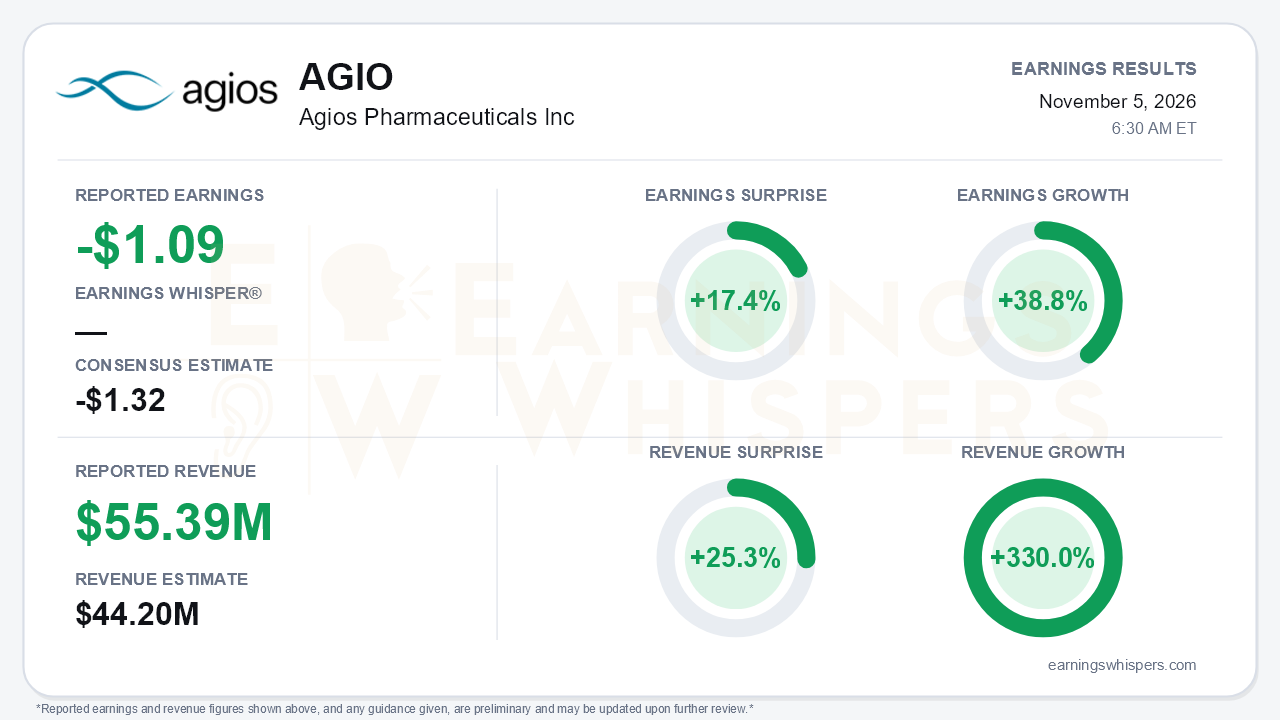
Agios Pharmaceuticals delivered the cleanest commercial quarter in its history and still left investors with more questions than it answered. The company reported a loss of $1.09 per share, beating the consensus estimate of a $1.32 loss by 17.4%, while revenue of $55.39 million topped the $44.2 million consensus by 25.3%. Earnings improved 38.8% year over year and revenue grew 330.0%, as the net loss narrowed to $65.0 million from $103.4 million a year earlier. Mitapivat sales in the third quarter alone exceeded the company's entire 2025 product revenue. The central tension is that this commercial momentum arrived alongside a three-month delay for sickle cell disease, mitapivat's largest opportunity, and evidence that new-patient adds in thalassemia are cooling.
The quality of the revenue beat holds up well. U.S. net revenue rose 20% sequentially to $48.7 million on the AQVESME thalassemia launch. Ex-U.S. revenue jumped 74% to $6.6 million on European early access programs following the May EU approval. The sequential comparison is arguably understated because second-quarter revenue of $44.7 million included roughly $5 million of one-time stocking. The expense line also improved. R&D fell to $73.5 million from $100.8 million in the second quarter, which included in-process R&D, and from $86.8 million a year ago. SG&A rose to $56.5 million to support the current launch and preparation for sickle cell. The bottom-line improvement is still partly a function of spending discipline rather than operating leverage, and interest income declined to $8.9 million from $13.4 million as the cash pile shrank.
Beneath the headline, the demand picture is less linear than the revenue curve implies. Agios added 177 AQVESME prescriptions with completed start forms in the quarter, down from 200 in the second quarter and 242 in the first. That brings the cumulative total to 619, roughly 15% of the approximately 4,000-patient target. Management framed 177 as an appropriate run rate. It also said it will stop reporting the start-form metric, which removes a key window into launch trajectory just as that trajectory flattens. There were offsetting positives. Agios disclosed persistency for the first time, with about 75% of patients still on therapy at six months. Roughly 75% of covered lives face no payer restrictions, demand is broadening into the larger non-transfusion-dependent population, and the August 'Level Up' direct-to-consumer campaign lifted patient website engagement by 65%.
The sickle cell review is now the swing factor. The FDA requested information on whether a REMS is necessary and classified Agios's response as a major amendment, pushing the PDUFA date from November 1, 2026 to February 1, 2027. Labeling discussions now include elements of a potential REMS, a shift from second-quarter commentary suggesting one might not be warranted. A REMS would add friction to a launch where a higher Medicaid mix is already expected to pressure gross-to-net. On the other side of the ledger, ASH 2026 will feature RISE UP extension data showing hemoglobin durability out to 115 weeks and post-hoc kidney and cardiac signals. AG-236 will present first clinical data supporting every-six-month dosing in polycythemia vera, with Phase 2/3 initiation targeted by year-end. Tebapivat, previously billed as a key 2026 catalyst, has quietly dropped out of the focused pipeline.
Management also reset the financial narrative. For the first time, it set a specific target of non-GAAP profitability in 2028, backed by an R&D headcount reduction of more than 35%, or over 100 roles. The savings arrive in 2027, after a roughly $11 million restructuring charge in the fourth quarter. The company also plans to monetize non-core assets, including the vorasidenib royalty and AG181. Cash of $907.0 million, down from about $1.0 billion in June and $1.2 billion at year-end, still provides a substantial runway. However, no 2027 guidance was offered, so the profitability target rests on execution investors cannot yet model.
Investor sentiment turned meaningfully cooler heading into the report, moving from slightly positive at 0.05 to modestly negative at -0.19. Shares sat at $31.38 on the eve of the release, up 6.4% since the open after the July report but nearly 19% below the $38.69 inter-earnings high set on October 29. The stock was also hovering just 1.1% below its 200-day moving average. The trend readings are mixed: sequential growth and momentum are positive, while AVWAP remains negative. That pattern fits a stock whose recent run was unwound before the numbers arrived.
The bottom line is that Agios beat on both lines and showed real commercial traction, with a sharper cost structure and a dated profitability goal. The investment debate, however, has shifted to sickle cell timing, the possibility of a REMS, and a thalassemia launch whose new-patient pace is moderating just as visibility into it is being reduced. Bulls get a credible revenue ramp; bears have legitimate ammunition in the regulatory delay and the decelerating script adds.
Read our earnings preview for Agios Pharmaceuticals Inc: https://www.earningswhispers.com/article/AGIO/22038
This earnings review was originally published on Earnings Whispers.
This article is for informational purposes only and is not investment advice. Earnings Whispers and its staff may hold positions in the securities mentioned. It is AI-assisted, based on proprietary Earnings Whispers data and company reports, and edited by Earnings Whispers staff.
Mentioned In This Article
Latest News
| Nov-05 | |
| Nov-05 | |
| Nov-05 | |
| Nov-04 | |
| Oct-30 | |
| Oct-28 | |
| Oct-20 | |
| Oct-19 | |
| Oct-08 | |
| Jul-30 | |
| Jul-30 | |
| Jul-30 | |
| Jul-21 |
Agios scraps sickle cell drug programme on underwhelming Phase II data
AGIO -6.74%
Clinical Trials Arena
|
| Jul-21 | |
| Jul-21 |
