Micron: Is the Recent Selloff a Buying Opportunity?
Over the past few months, Micron (MU), the leading AI chip memory maker, has seen shares plunge due to a mix of cyclicality and pricing fears, political policy concerns, and profit taking. Let’s unpack why these fears are overblown:
Cyclicality & Pricing Fears
Micron bears argue that the record-high DRAM and NAND pricing may have a reached a peak and increased competition will only exacerbate these concerns. However, there is no evidence to support this bearish argument. Micron has confirmed that 2026 and 2027 capacity is completely sold out. Additionally, Micron CEO Sanjay Mehrota believes that tight memory storage supply conditions will persist through 2028.
Wall Street analysts agree with this bull scenario. Zacks Consensus Analyst Estimates suggest that Micron’s earnings and sales will maintain explosive, triple-digit year-over-year earnings and sales growth through 2027.
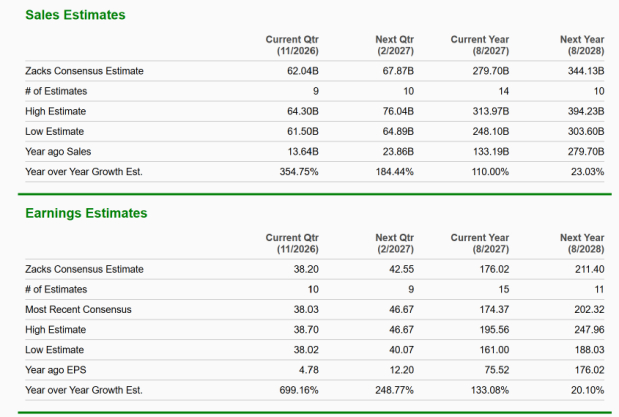
Image Source: Zacks Investment Research
Political and Policy Concerns
The Democratic sweep of in the midterm elections has raised investor concerns of legislative scrutiny that will slow down the massive AI data center buildout. However, the market and AI stocks have been pricing in a Democratic sweep for months. Additionally, hyperscaler CAPEX spending is expected to explode to $1.4 trillion next year. In other words, regardless of who is in office, there is no evidence that the AI buildout is slowing.
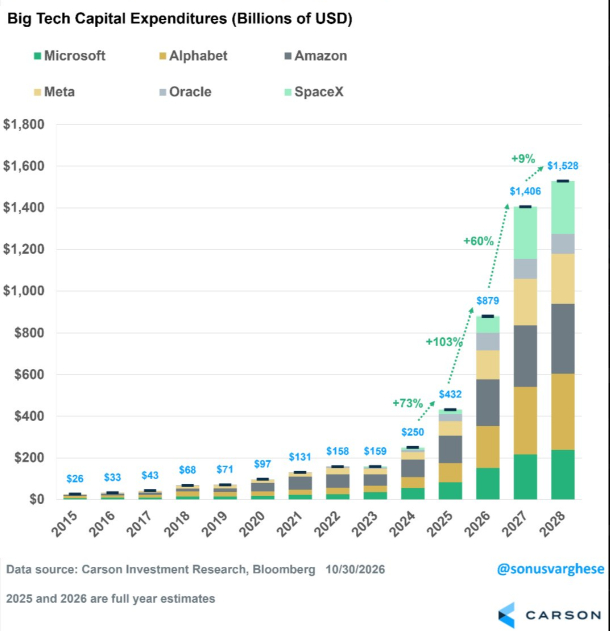
Image Source: Carson Investment Research
Micron Retreats to Key Technical Zone
Because of its rare mix of liquidity, triple-digit top-and-bottom line growth, and stock performance, Micron has attracted numerous institutional investors like David Tepper over the past few years. After a 1,000% upside move, some profit taking is to be expected. However, Micron shares are retreating to the 200-day moving average for the first time. The 200-day moving average provides an attractive reward-to-risk zone for investors because institutional investors tend to “defend” leaders at this level. Additionally, the 200-day moving average provides investors with a logical risk level to trade against.
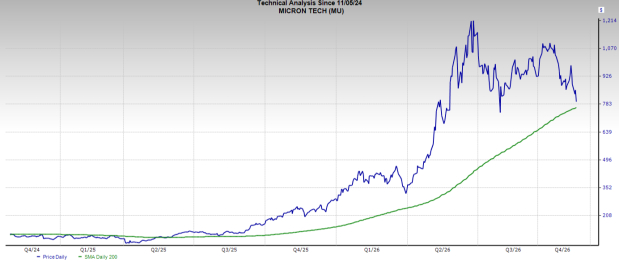
Image Source: Zacks Investment Research
Micron’s Valuation is Historically Cheap
Over the past decade, Micron’s average historical price-to-earnings ratio has been ~20x. Today, its valuation is currently 11x. For context, the S&P 500’s current P/E ratio is ~18x. Meanwhile, Micron’s forward P/E ratio is an unheard of ~5x.
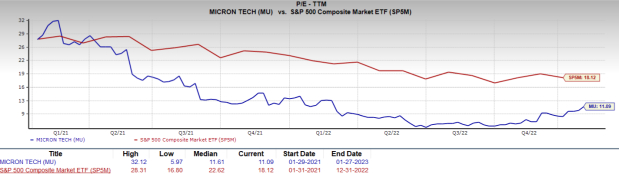
Image Source: Zacks Investment Research
Micron Will Benefit from Agentic & Physical AI
As AI evolves from simple text generation to agents and robots, Micron will experience even more demand. For example, robots and robotaxis rely on the continuous sensory data that Micron provides. In addition, agentic AI platforms performing multi-step work flows require immense memory.
Bottom line
Despite recent market jitters over pricing cyclicality, political policies, and profit-taking, the underlying fundamentals for Micron remain exceptionally strong. With memory capacity fully booked through 2027, robust hyperscaler spending, an attractive valuation near key technical support, and long-term tailwinds from agentic and physical AI, this pullback offers an appealing entry point for long-term investors.
Want the latest recommendations from Zacks Investment Research? Today, you can download 7 Best Stocks for the Next 30 Days. Click to get this free report
Micron Technology, Inc. (MU): Free Stock Analysis Report
This article originally published on Zacks Investment Research (zacks.com).
Mentioned In This Article
Latest News
| 9 min | |
| 32 min | |
| 1 hour |
Amazon and Google Could Outperform Nvidia as AI Trade Enters New Phase, Says Joseph Carlson
MU -12.04%
Benzinga Prediction Markets
|
| 1 hour | |
| 2 hours | |
| 5 hours | |
| 6 hours | |
| 11 hours | |
| Nov-04 | |
| Nov-04 | |
| Nov-04 | |
| Nov-04 | |
| Nov-04 | |
| Nov-04 | |
| Nov-04 |
