Great Elm Group's Narrower Loss Masks A Shrinking Fee Base As GECC NAV Slides And REIT Deployment Stalls
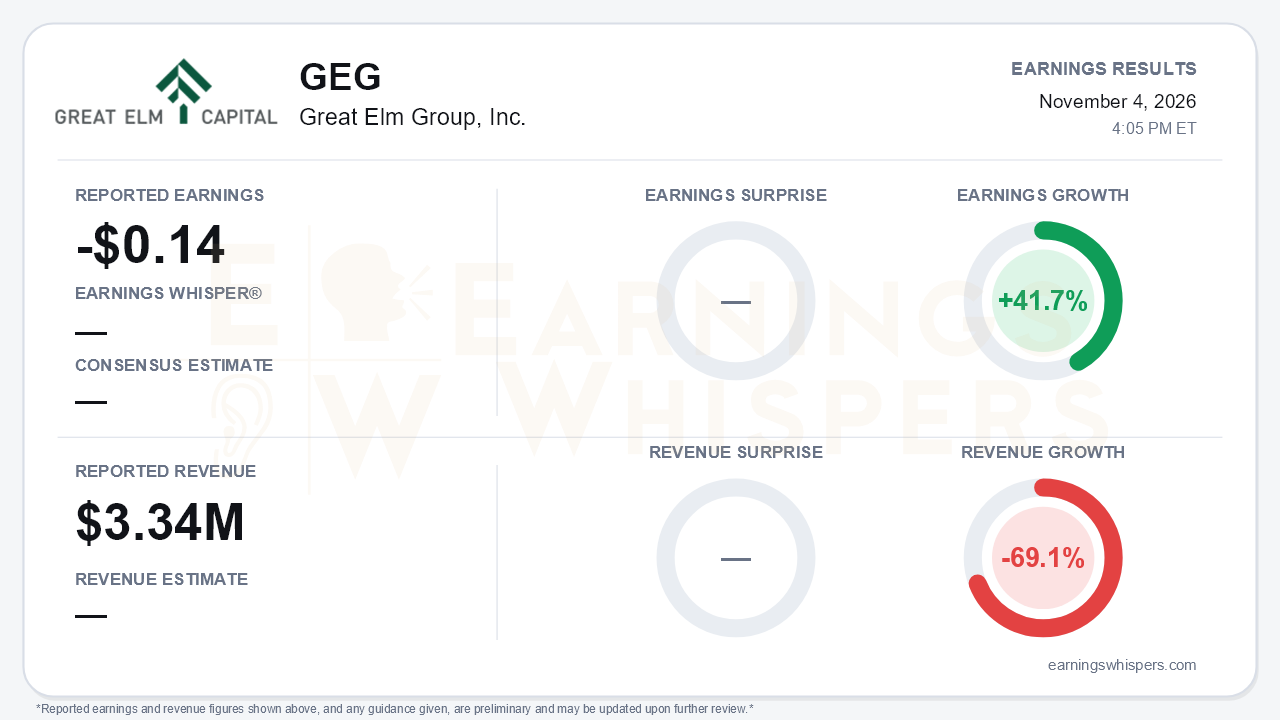
Great Elm Group (NASDAQ: GEG) reported a fiscal first-quarter loss of $0.14 per share, an improvement from the $0.24 loss a year ago that Earnings Whispers calculates as 41.7% earnings growth. Revenue fell 69.1% to $3.34 million. There was no consensus estimate or Earnings Whisper to measure the result against, so the quarter has to be judged on its internals, and those are weaker than the narrower loss suggests. The improvement came from smaller investment markdowns, not from better operations. Meanwhile, the metrics that matter most for an asset manager trying to scale (fee-paying AUM, the NAV of its flagship credit vehicle, and real estate deployment) moved in the wrong direction. That is the central tension: the headline loss improved while the franchise-building story lost ground.
The quality of the improvement deserves scrutiny. Net realized and unrealized losses fell to $0.8 million from $2.9 million, and last year's results also carried a $1.8 million loss in consolidated funds that has since rolled off. The operating loss barely moved, at $3.5 million versus $3.7 million. The revenue collapse is mostly a comparison problem. The prior-year quarter included roughly $7.4 million from a build-to-suit property sale, and no such sale closed this time. Strip that out and the recurring revenue base looks roughly flat year over year. That base is modest:
- **GECC management fees:** about $1.0 million
- **Monomoy CRE fees:** $1.1 million
- **Construction services:** $0.7 million
Those figures sit against $6.8 million in operating expenses, including $5.0 million of compensation. Adjusted EBITDA, which the release reports, worsened to a loss of $0.9 million from a $0.5 million loss. The call analysis indicates this figure was not disclosed or discussed on the call itself, so investors leaning only on management's spoken remarks would have missed that the non-GAAP measure deteriorated.
The call made clear that the "improving momentum" framed last quarter did not carry through:
- **GECC NAV:** fell $0.55 to $7.40 per share, reversing the roughly 3% sequential gain reported in the fiscal fourth quarter. The drop includes a $3.3 million markdown on its CLO formation joint venture, and management said it was "not satisfied."
- **Fee-paying AUM:** shrank to $564 million from $590 million last quarter. It is now down 5% year over year after having grown 7% in the prior period.
- **Total AUM:** slipped to $760 million.
- **Monomoy REIT deployment:** slowed sharply to about $8 million, versus roughly $34 million in the fourth quarter and $28 million in the third.
- **CRE fee growth:** decelerated to 18% from 29%.
The tone shifted accordingly. Last quarter's "position of strength" gave way to an acknowledgment that results "fell short."
The call did preserve a credible, if still prospective, growth story. Monomoy REIT's acquisition pipeline reached nearly $90 million, its largest to date, and management is pursuing new institutional capital for the REIT and the broader real estate platform. The build-to-suit arm bought two development properties for about $4 million and a third for about $5 million after quarter end, and it is nearing completion of its fourth project. That points to future lumpy sale revenue rather than steady fees. At GECC, management retired another $6.5 million of its highest-cost notes, bringing calendar-year debt reduction to roughly $40 million with no maturities until 2029. Liquidity rose to about $50 million. The CoreWeave-related stake keeps paying off, with $0.7 million in distributions this quarter and $8.6 million cumulative on a $5 million investment.
The balance sheet gives bears legitimate ammunition. Cash fell to $43.2 million from $53.5 million in a single quarter, partly because real estate assets on the books rose to $9.0 million from $2.4 million. GEG's $26.9 million (face value) debt facility was reclassified from long-term to current liabilities, which implies it comes due within twelve months. The $36.8 million in convertible notes also remains outstanding. Stockholders' equity declined to $36.6 million from $40.8 million. The company kept buying back stock for a twelfth straight quarter, repurchasing about 266,000 shares at an average of $2.20. That is roughly in line with the $2.16 opening price after the August report. About $23.2 million remains under the authorization, but continued buybacks compete for cash with the growth initiatives management says it is funding.
Current price, sentiment and technical readings were not available for this review. The investment setup therefore rests almost entirely on whether management can convert the pipeline and capital-raising efforts into fee-paying AUM before the cash cushion thins further.
The bottom line is that the narrower loss reflects smaller investment markdowns rather than operating progress, and the quarter undercut the momentum narrative from just three months ago. A record REIT pipeline, active capital raising and debt reduction at GECC keep the growth thesis alive. But shrinking fee-paying AUM, another GECC NAV decline, stalled deployment, a worse adjusted EBITDA and a near-term debt maturity mean the burden of proof has shifted back to execution.
This earnings review was originally published on Earnings Whispers.
This article is for informational purposes only and is not investment advice. Earnings Whispers and its staff may hold positions in the securities mentioned. It is AI-assisted, based on proprietary Earnings Whispers data and company reports, and edited by Earnings Whispers staff.
Mentioned In This Article
Latest News
| Nov-05 | |
| Nov-04 | |
| Nov-03 | |
| Aug-27 | |
| Aug-26 | |
| Aug-25 | |
| May-06 | |
| May-05 | |
| Mar-03 | |
| Feb-05 | |
| Feb-05 | |
| Feb-04 | |
| Feb-03 | |
| Dec-09 | |
| Nov-13 |
