Akebia Misses As Vafseo Destocking And A Sharply Lower Post-TDAPA Price Overshadow Its Best Clinical Evidence Yet
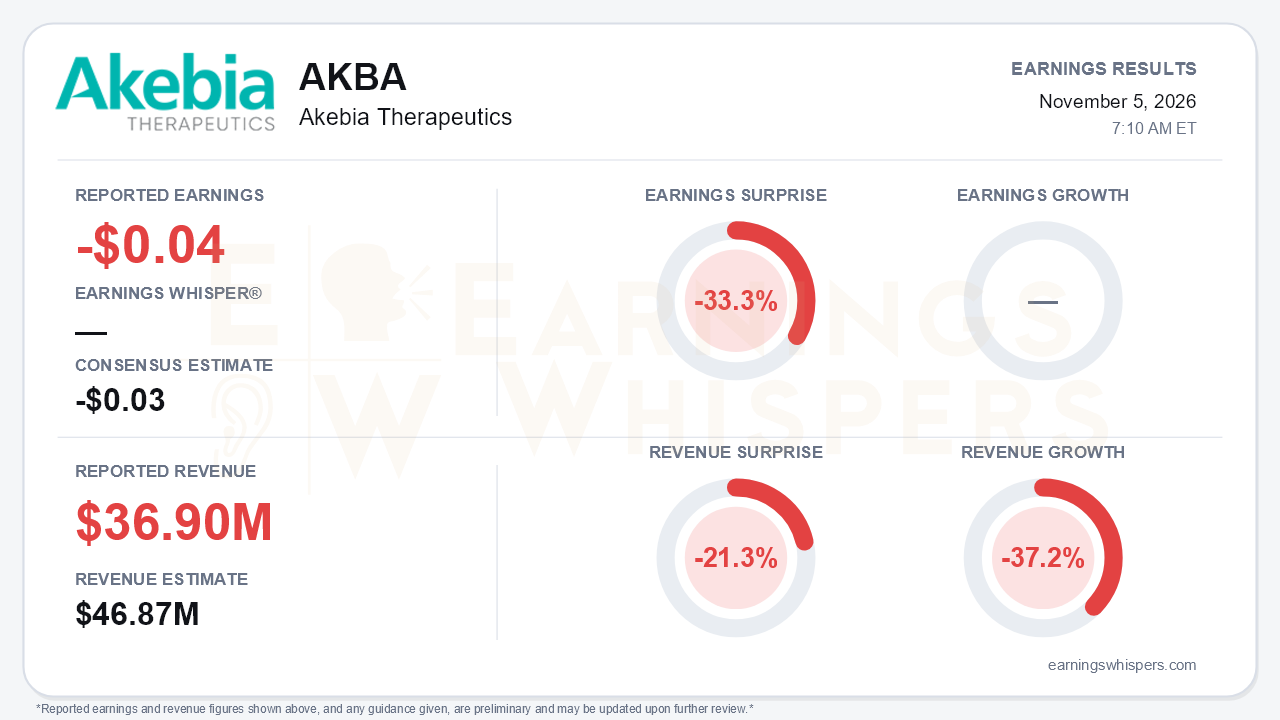
Akebia Therapeutics (NASDAQ: AKBA) reported a third-quarter loss of $0.04 per share on revenue of $36.9 million. That missed the consensus estimate of -$0.03 by 33.3%, and revenue came in 21.3% below the $46.87 million consensus. Revenue fell 37.2% from a year ago. The press release shows a GAAP net loss of $14.4 million, or $0.05 per share, compared with a $0.5 million profit in the year-ago quarter. That is a clean swing from profitability back into the red, and the loss widened from $8.9 million in the second quarter. The miss matters less than what sat behind it. Akebia delivered the strongest clinical case for Vafseo since launch, and in the same report it reset the drug's post-TDAPA economics sharply lower. That is the central tension.
The quality of the top line deserves scrutiny because the two products are moving in opposite directions, and neither is moving cleanly. Auryxia revenue collapsed to $20.0 million from $42.5 million a year ago and $25.5 million in the second quarter, as generic competition and pricing pressure take hold. Vafseo should be offsetting that decline. Instead, Vafseo net revenue fell to $14.8 million from $21.3 million in the second quarter, and was up only about 3% year over year despite roughly 140% patient growth. Management attributed roughly $4–5 million of the shortfall to an inventory drawdown at its largest customer. Average dose ran near 810mg against an expected 900mg, and dialysis compliance was weaker than assumed. As a result, total revenue has now declined three straight quarters: $53.5 million, then $49.1 million, then $36.9 million. Cost cutting cushioned the hit. SG&A dropped to $23.5 million from $28.2 million in the second quarter, aided by a restructuring that added a $1.3 million charge. R&D rose to $16.2 million as the mid-stage pipeline advanced.
Underneath the reported numbers, demand improved. Patients on Vafseo reached about 11,500, up from more than 10,500 in the second quarter and about 7,500 in the first. Prescribers rose more than 7% sequentially to about 1,300. Management estimated end-user demand at $19–20 million, up from $17–18 million. The clinical story also strengthened materially. Full VOICE data presented by U.S. Renal Care showed a statistically significant win on the mortality-and-hospitalization composite (win odds 1.16), driven by about 10% fewer hospitalizations. Topline VOCAL results showed three-times-weekly vadadustat was non-inferior to ESA in maintaining hemoglobin. DaVita asked to extend its post-TDAPA contract over multiple years and plans a slow rollout beginning in the fourth quarter, with a larger push in early 2027.
The forward economics are the problem. For the first time, management quantified the post-TDAPA annual cost of therapy at only $1,000–$1,500 per patient. That figure is pressured by ESA price cuts and by the same lower dose and compliance that hurt this quarter. Management now frames peak potential as "multi-hundred million" dollars at 200,000–250,000 patients, a meaningful step down from the earlier emphasis on a roughly $1 billion ESA market. Management also expects further destocking ahead of TDAPA's January 1, 2027 expiration. Fresenius adoption looks slower still amid leadership turnover there, and Akebia's own Chief Commercial Officer resigned. Bears have legitimate ammunition: Akebia is broadening Vafseo access just as the value of each patient shrinks.
The balance sheet buys time but not much margin for error. Cash rose to $159.3 million, helped by $6.6 million of at-the-market equity proceeds. Management still expects at least two years of runway, but that projection leans partly on refinancing its senior secured term loan. Stockholders' equity has thinned to $20.4 million. The ebribafusp alfa basket trial dosed its first patient, with initial data in 2027, which offers a longer-dated pipeline option.
The market had already priced in considerable doubt. Shares were $0.69 heading into the report, down 23% from the $0.90 open after the August release and about 39% below the 200-day moving average of $1.14. The stock set a 52-week low of $0.54 on October 22 and had rebounded roughly 28% from that level, though it remained about 34% below its September high of $1.05. Investor sentiment slipped modestly further below neutral, from -0.020 to -0.032, a small change that points to fatigue rather than capitulation. Most Earnings Whispers trend signals remain negative. Momentum is the exception, reflecting the bounce off the October low.
The bottom line is that Akebia's quarter split cleanly between evidence and economics. VOICE, VOCAL, rising patient counts and DaVita's commitment show that Vafseo is gaining clinical credibility and real-world use. But destocking, weak dosing and compliance, and a $1,000–$1,500 post-TDAPA price point mean that adoption may not translate into revenue at anything like the scale once implied. Until reported Vafseo revenue begins tracking end-user demand after the TDAPA transition, the miss and the reset outlook will likely weigh more heavily than the improved data.
Read our earnings preview for Akebia Therapeutics: https://www.earningswhispers.com/article/AKBA/22447
This earnings review was originally published on Earnings Whispers.
This article is for informational purposes only and is not investment advice. Earnings Whispers and its staff may hold positions in the securities mentioned. It is AI-assisted, based on proprietary Earnings Whispers data and company reports, and edited by Earnings Whispers staff.
Mentioned In This Article
Latest News
| 12 hours | |
| 15 hours | |
| 15 hours | |
| 16 hours | |
| Oct-29 | |
| Oct-29 | |
| Oct-26 | |
| Oct-07 | |
| Oct-06 | |
| Oct-01 | |
| Sep-14 | |
| Sep-01 | |
| Sep-01 | |
| Aug-06 | |
| Aug-05 |
