Arq Posts A Record Quarter And Narrows EBITDA Guidance To The Top End, But Flat Revenue Guidance Points To A Soft Q4 And Puts PFAS On The Clock
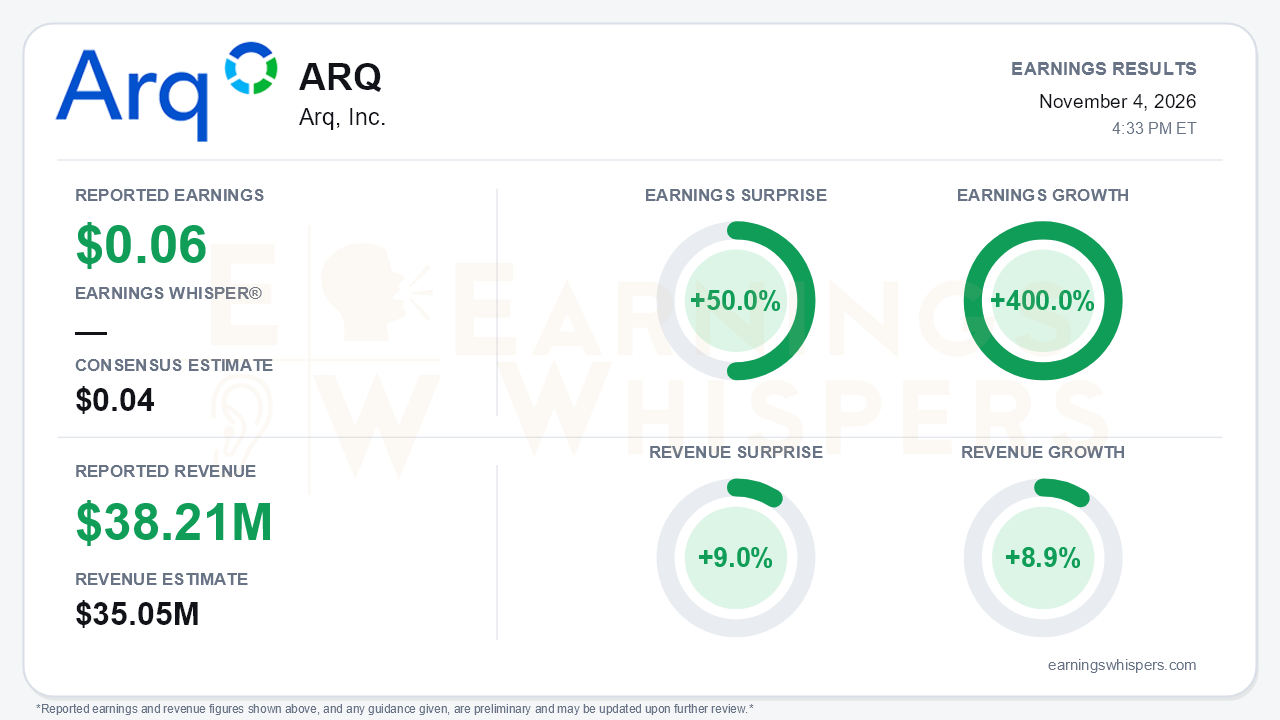
Arq delivered the cleanest quarter of its post-restructuring era. Earnings came in at $0.06 per share, beating the $0.04 consensus by 50.0% and growing 400.0% year over year. Revenue was a record $38.21 million, topping the $35.05 million consensus by 9.0% and growing 8.9%. In plain terms, the company swung from a net loss of $0.9 million a year ago, and a $0.7 million loss in Q2, to $2.5 million of net income. Management tightened full-year Adjusted EBITDA guidance to $19-20 million from $17-20 million. The central development is not the beat itself. It is that the core powdered activated carbon (PAC) business is now producing real earnings, while the investment narrative has shifted decisively from the troubled granular activated carbon (GAC) project to PAC for PFAS.
The quality of the quarter holds up well. Volume drove the revenue gain, yet cost of revenue fell about 8% to $23.0 million. That pushed gross margin, which excludes depreciation, to 39.7% from 28.8% a year ago and 38.5% in Q2. Adjusted EBITDA rose 71% to $8.8 million, up from $5.8 million in Q2 and the tenth straight positive quarter. Year-to-date Adjusted EBITDA of $17.4 million already exceeds all of fiscal 2025's $13 million.
Two caveats deserve scrutiny:
- Part of the year-over-year improvement came from R&D falling to $0.8 million from $2.6 million, because GAC ramp-up costs did not recur. That is less a gain in operating power than a decision to stop spending on GAC.
- SG&A jumped to $7.2 million from $4.6 million on incentive compensation and legal and professional fees. On a GAAP basis, nine-month net income is just $0.6 million.
The balance sheet improved meaningfully. Nine-month operating cash flow reached $7.7 million versus essentially zero a year earlier, despite a $5.2 million build in receivables. Unrestricted cash rose to $7.8 million, and total debt fell $2.5 million to $28.2 million.
The guidance is where the setup gets more complicated than the surprise implies. Management raised only the low end of its EBITDA range and left revenue guidance at $120-125 million, unchanged since last year's fourth-quarter call. With $97.1 million of revenue and $17.4 million of Adjusted EBITDA booked through September, the reiterated ranges imply Q4 revenue of roughly $23-28 million and Q4 EBITDA of only about $1.6-2.6 million. The CEO stressed that Q3 is seasonally strong and that this has been "a strong year, not just a great quarter." Still, the implied fourth quarter is a sharp step down that investors annualizing Q3 should not ignore.
The call added substance to the forward story. PAC for PFAS was introduced in Q2 with no expected 2026 contribution. It has now moved to customer testing, and test volumes were sold, not given away, at prices materially above traditional PAC pricing. Other progress on the call:
- More than 12 customer opportunities have been identified, with testing cycles of one to three months.
- Management sized the addressable market at about 160 million pounds a year by 2029.
- Patents covering the products are pending.
- The EPA's April 2027 PFAS monitoring deadline is the key regulatory milestone.
- The roughly $30 million exit-2027 EBITDA run-rate target was reiterated, and it excludes GAC.
Additional levers include refinancing the MidCap facility, more than 15 cost initiatives under the new CFO with SG&A savings expected in 2027, and a hoped-for monetization of the Corbin Facility within about 12 months. Corbin costs roughly $2.6 million a year to carry and is tied to about $8 million of debt.
Bears have legitimate ammunition. PFAS revenue in 2027 is expected to be back-end loaded, and volumes remain unquantified. A fast ramp could strain PAC capacity and force Arq to displace lower-margin volumes. GAC is now deferred indefinitely pending funding. That is a notable retreat from management calling it an emphatic go less than a year ago, and it leaves a large asset idle. Corbin timing is speculative and excluded from 2027 expectations.
Investor sentiment shifted substantially, rising from a marginally positive 0.15 at the prior report to 0.64. Price action tells a different story. Shares sit at $1.85, down 21.3% from the $2.35 open after the August report and about 24.6% below the $2.45 200-day moving average. The AVWAP trend remains negative, while other trend readings are largely neutral. Expectations have warmed considerably, but the stock has not yet reflected the operating progress.
The bottom line is that Arq proved its PAC business can generate genuine GAAP profits and cash, and the call gave PAC for PFAS more commercial credibility than it had a quarter ago. The flat revenue guide and the thin EBITDA it implies for Q4 temper the headline, as do rising SG&A and a 2027 PFAS ramp that remains unquantified and back-end loaded. With shares well below their 200-day average and sentiment now considerably more positive, the next test is whether paid PFAS testing converts into orders before the April 2027 deadline.
Read our earnings preview for Arq, Inc.: https://www.earningswhispers.com/article/ARQ/21787
This earnings review was originally published on Earnings Whispers.
This article is for informational purposes only and is not investment advice. Earnings Whispers and its staff may hold positions in the securities mentioned. It is AI-assisted, based on proprietary Earnings Whispers data and company reports, and edited by Earnings Whispers staff.
Mentioned In This Article
Latest News
| Nov-05 | |
| Nov-04 | |
| Oct-27 | |
| Oct-13 | |
| Sep-30 | |
| Sep-16 | |
| Aug-28 | |
| Aug-24 | |
| Aug-11 | |
| Aug-10 | |
| Jul-21 | |
| May-27 | |
| May-06 | |
| Apr-22 | |
| Apr-14 |
