Core Scientific's Colocation Ramp Delivers A Real Operating Inflection, But A Warrant-Driven EPS Beat And Unfunded AMD Buildout Leave Financing As The Story
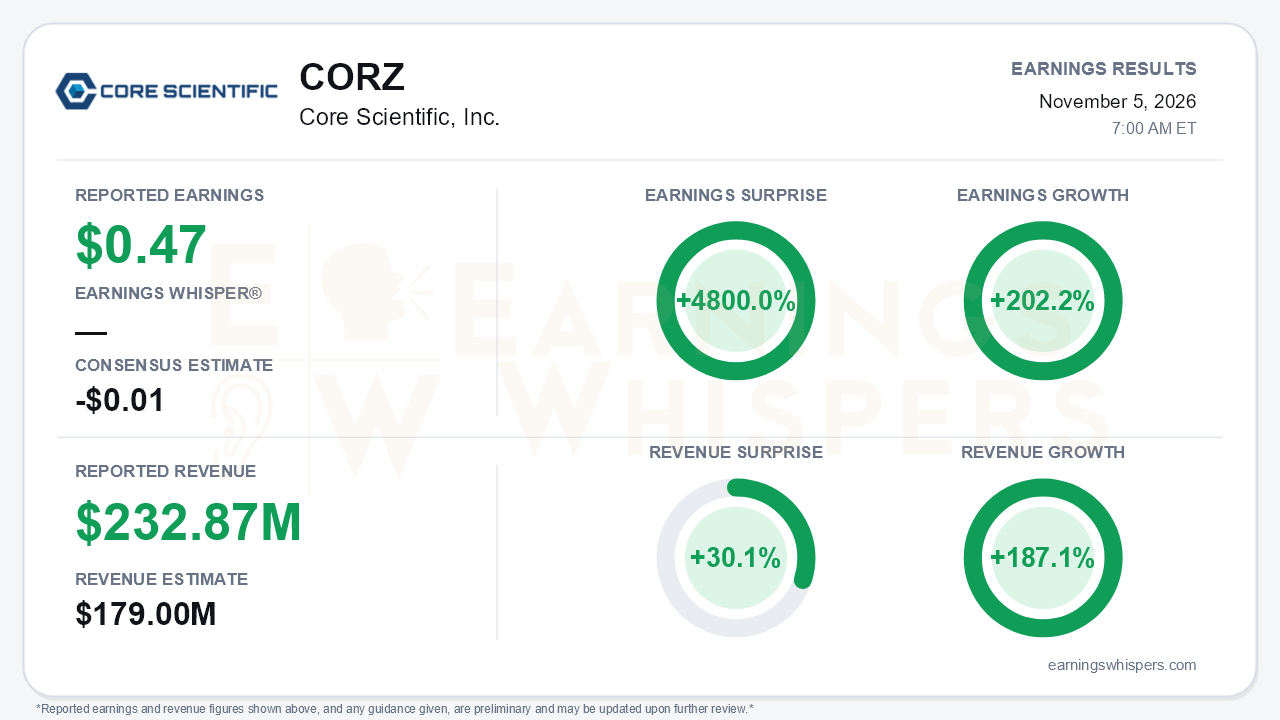
Core Scientific reported third-quarter earnings of $0.47 per share on revenue of $232.87 million. The consensus estimate called for a loss of $0.01 per share, so the result beat by 4800.0%. Revenue topped the $179.0 million consensus by 30.1%. Earnings grew 202.2% year over year and revenue grew 187.1%, a sharp swing from a $0.45 loss a year ago and a $3.32 loss last quarter. The headline EPS, however, overstates the change. Net income of $1.18 billion came mostly from a $1.03 billion non-cash gain on the fair value of warrants and a $106.5 million tax benefit. That gain is the mirror image of the $1.05 billion warrant charge that drove last quarter's loss. The real story is beneath that noise, and it is genuinely improving, but it now runs into a financing question the call did not resolve.
The quality of the beat deserves scrutiny, yet the operating core holds up. Operating income was $72.4 million, compared with a $78.5 million loss in Q2. Adjusted EBITDA more than tripled sequentially to $133.6 million, and margin expanded to 57% from 25%. Colocation revenue rose nearly 60% sequentially to $215.4 million, up from just $15.0 million a year ago. License fees climbed to $157.3 million from $98.8 million.
The margin step-up came less from better unit economics than from mix and fewer one-time costs. Colocation gross margin was essentially flat at 60% versus 59%. The bigger contributors were:
- startup costs falling to $12.9 million from $27.0 million;
- the absence of Q2's $41.9 million contract-termination loss;
- a shrinking Bitcoin self-mining business, which ran a negative 61% gross margin and is slated for full exit by year-end.
Following that exit, Core Scientific enters 2027 as a pure-play colocation provider.
Billing capacity reached 485 MW as of September 30, on 590 MW contracted per the call. The comparison base is inconsistent across sources. The release table lists 395 MW for Q2, while call commentary cited 437 MW. Either way, management says it is nearing full delivery under its first colocation agreement. For the first time it framed run-rate economics: roughly $1.8 billion of annual revenue and $1.6 billion of NOI on 1.1 GW contracted. Q4 is guided to double-digit sequential revenue growth.
AMD's initial 530 MW remains on schedule. Pecos is due in 1H27, with about half the capacity delivered in 2027 and the rest in 2028. Build costs are held at $11-12 million per MW, and management said no new equity will be issued for phase one.
The tone of the call shifted from winning deals to defending execution. There was no new customer or contract, following the AMD deal in Q2. The roughly $6 billion AMD project-bond financing is still not secured. Management called lender diligence "more comprehensive" and said alternatives are under evaluation, a notable step back from the "incredibly high confidence" expressed last quarter. Demand language moved from "significant demand" to "capital is the throttle." The AMD reservation was framed as roughly 1.9 GW, versus "up to 2 GW" previously. Bears have legitimate ammunition elsewhere too:
- election-driven regulatory scrutiny in Texas and Georgia;
- behind-the-meter power plans with air permits not yet filed;
- an extended defense of CoreWeave counterparty exposure.
The balance sheet shows the strain. Cash fell to $804 million from $1.77 billion after $985 million of quarterly capex, which included the roughly $440 million Polaris payment. The release puts liquidity including DSRA at $1.74 billion versus $2.60 billion in Q2. The call compared it with a roughly $1.8 billion Q2 headline, a difference that reflects restricted cash now being included. Long-term debt stands at $4.3 billion, against a stockholders' deficit of $1.09 billion.
Several offsets could ease the pressure:
- about $650 million of expected warrant proceeds around January 2027;
- 385 MW of incremental grid power at Muskogee and Hunt by mid-2028;
- potential distressed M&A as capital-constrained developers sell powered land.
The market had already priced in much of that anxiety. As of November 4, shares at $12.76 were down 39.1% from the $20.95 open after the July report. They sat 34.8% below the 200-day moving average and just 3.7% above the October 15 52-week low of $12.31, nearly 46% off the August high. Investor sentiment improved from -0.18 to -0.04 but remains slightly negative, reflecting less pessimism rather than conviction. Price and AVWAP trend readings remain negative even as momentum has turned positive. That pattern fits a stock whose fundamentals are inflecting while its financing narrative is not.
The bottom line is that Core Scientific delivered the operating inflection colocation bulls were waiting for. Revenue is surging, EBITDA margins are above 50%, and a pure-play profile is weeks away. The $0.47 EPS print, though, is largely an artifact of warrant accounting. With no new contracts, a still-unfunded AMD buildout and liquidity down sharply, the next leg of the story depends on securing capital. Until the AMD financing is closed, execution on existing capacity carries the investment case, and the stock's position near its lows suggests investors want that proof first.
Read our earnings preview for Core Scientific, Inc.: https://www.earningswhispers.com/article/CORZ/22075
This earnings review was originally published on Earnings Whispers.
This article is for informational purposes only and is not investment advice. Earnings Whispers and its staff may hold positions in the securities mentioned. It is AI-assisted, based on proprietary Earnings Whispers data and company reports, and edited by Earnings Whispers staff.
Mentioned In This Article
Latest News
| 12 hours | |
| 14 hours | |
| 14 hours | |
| 16 hours | |
| Nov-04 | |
| Nov-04 | |
| Nov-04 | |
| Nov-04 | |
| Nov-04 | |
| Nov-04 | |
| Nov-04 | |
| Nov-03 |
Bitcoin Miners Pivoted to AI-Only to Find It's Just as Turbulent as Crypto
CORZ +13.87%
The Wall Street Journal
|
| Nov-02 | |
| Oct-28 | |
| Oct-27 |
