Goodyear Misses As Sequential Rebound Falls Short; Wider Cash Burn And Target-Free 'Transformation' Reset The Story
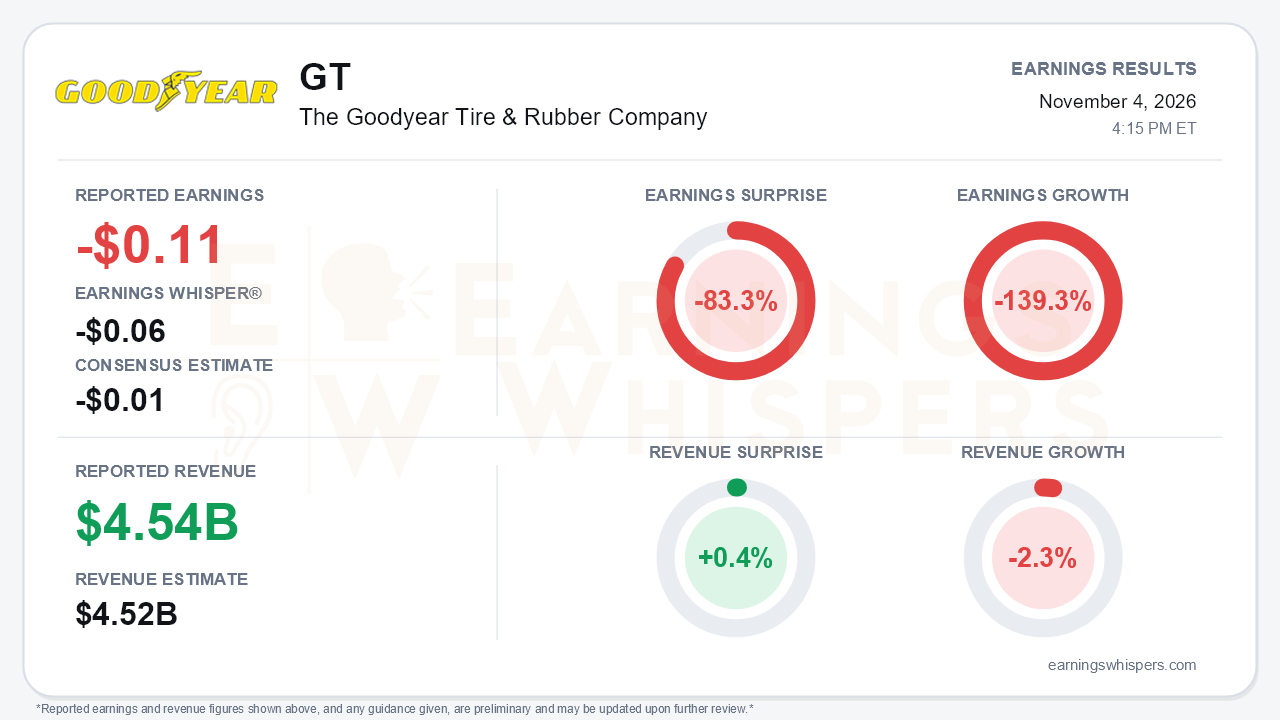
Goodyear's third quarter delivered the rebound bulls wanted on paper but not the one they needed. The company posted an adjusted loss of $0.11 per share, well short of the $0.01 loss consensus expected and the Earnings Whisper of a $0.06 loss, an 83.3% miss. Earnings fell 139.3% from the prior year's adjusted profit of $0.28. Revenue of $4.54 billion edged past the $4.52 billion consensus by 0.4% but declined 2.3% year over year, largely because of the Chemical and Dunlop divestitures. Organic sales rose 1.6% on price/mix. The central tension is that segment operating income recovered sharply from a dismal second quarter but still missed management's own plan. That shortfall pushed Goodyear away from incremental self-help and toward a broader, still-undefined transformation.
The sequential improvement is real. Segment operating income reached $174 million, up from $36 million in Q2 and $95 million in Q1. Even so, it was down from $287 million a year ago, and total segment margin compressed to 3.8% from 6.2%. The year-over-year bridge shows where the pressure sits. Lower volume cost $77 million, inflation $69 million, and tariffs and other costs $48 million. Those headwinds outweighed $90 million of Goodyear Forward savings and a $76 million price/mix-over-raws benefit. The Americas carried most of the damage, with margin halving to 3.6% from 7.5% on factory under-absorption. EMEA eked out 0.9%. Asia Pacific was the standout at 12.9%, up 270 basis points. On a GAAP basis, the $238 million net loss looks far better than last year's $2.2 billion. However, the prior-year figure was inflated by a $674 million goodwill impairment and roughly $1.45 billion of discrete tax charges. This quarter's loss included $148 million of rationalization charges.
The call made clear how far the quarter drifted from the roadmap laid out in August:
- **Volume:** fell about 3% against roughly flat guidance.
- **Other costs:** rose $40 million versus $15 million planned.
- **Raw materials:** were a $29 million drag versus $20 million.
- **Gross margin:** fell two points.
- **Regional demand:** EMEA consumer replacement and Americas commercial replacement both came in weaker than expected.
The tone shifted noticeably. Management moved from 'stabilization' language in Q2 to Mark Stewart conceding that results 'remain below our expectations' and that incremental improvements 'won't get us to where we need to be.' Earlier this year management explicitly ruled out a 'restructuring 2.0.' It now has a dedicated transformation office reviewing where to compete, the manufacturing footprint and capital deployment, with no financial targets until the Q4 call.
The forward picture is where bears have the most ammunition. Free cash flow guidance for 2026 widened to a $300-400 million use, from a $200-300 million burn on the Q2 call and a slightly positive outlook at the start of the year. Q3 free cash flow was -$283 million. Fourth-quarter guidance points to:
- a roughly $170 million raw-material headwind;
- only about $60 million of price/mix, down from $105 million in Q3;
- about $45 million of unabsorbed fixed costs;
- modestly lower volume.
Raw-material pressure is expected to persist into the first half of 2027. Those drivers leave full-year segment income well below the roughly $600 million-plus framework reaffirmed in August. Meanwhile, long-term debt climbed to $6.03 billion from $5.33 billion at year-end, and the CFO seat remains interim.
There is a credible core underneath the noise. U.S. consumer replacement volume grew low single digits against an industry down about 1%, a sharp turn from double-digit declines earlier in the year. The mix of 18-inch-and-larger tires reached 44% of the consumer portfolio, up from 39% a year ago. OE share gains continued, with EMEA marking its 11th straight quarter. Goodyear Forward beat its Q3 target and is guided to roughly $110 million in Q4. Two chemical plant closures should add $15-20 million annually from 2027, and EU anti-dumping tariffs on Chinese tires could help EMEA.
The market had already priced in much of the disappointment. As of the report date, shares sat at $4.55, down 37.1% from the $7.23 open after the August report and about 31% below the 200-day moving average of $6.59. Investor sentiment was essentially unchanged and mildly negative, inching from -0.218 to -0.212, which suggests expectations were already low rather than shifting materially. Price and AVWAP trend readings remain negative. The sequential growth reading is positive, reflecting the rebound from the Q2 trough.
The bottom line is that Goodyear proved Q2 was a low point but not that its earnings framework is intact. The miss against both consensus and internal plans, a deeper cash burn, a weak Q4 setup and a target-free transformation shift the debate from execution toward balance sheet and strategy. Share gains and mix improvement give management something to build on, but the Q4 call now carries the burden of turning 'transformation' into numbers.
Read our earnings preview for The Goodyear Tire & Rubber Company: https://www.earningswhispers.com/article/GT/21846
This earnings review was originally published on Earnings Whispers.
This article is for informational purposes only and is not investment advice. Earnings Whispers and its staff may hold positions in the securities mentioned. It is AI-assisted, based on proprietary Earnings Whispers data and company reports, and edited by Earnings Whispers staff.
Mentioned In This Article
Latest News
| 2 hours | |
| 8 hours | |
| Nov-04 | |
| Nov-04 | |
| Nov-02 | |
| Oct-30 | |
| Oct-29 | |
| Oct-28 | |
| Oct-27 | |
| Oct-27 | |
| Oct-20 | |
| Oct-09 | |
| Sep-15 | |
| Sep-08 | |
| Aug-06 |
