Genie Energy's Margin Rebound Drives 48% EPS Growth, But A Shrinking Retail Book Keeps Revenue Falling
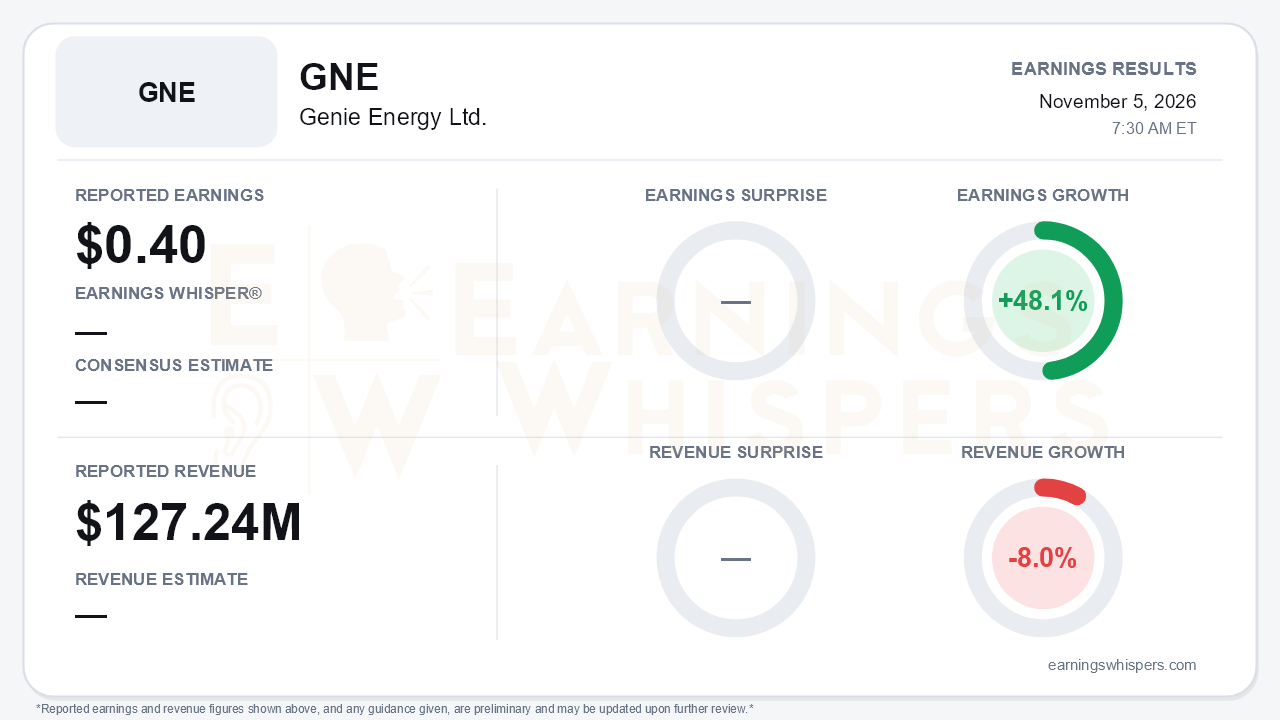
Genie Energy (NYSE: GNE) earned $0.40 per share from continuing operations in the September quarter, up 48.1% year over year, while revenue fell 8.0% to $127.24 million. Including a small loss from discontinued operations, GAAP diluted EPS was $0.39 versus $0.25. No consensus estimate was available to frame a surprise, so the quarter has to be judged on its own trajectory. That trajectory has a clear split. Profitability is rebuilding quickly. The customer base that generates that profit is still contracting. That is the central tension.
The earnings gain came almost entirely from margin. Consolidated gross margin rose to 32.4% from 21.7%, and gross profit climbed to $41.2 million from $30.0 million despite $11 million less revenue. At Genie Retail Energy, gross margin reached 31.0% versus 20.8% in the release's year-ago figure. The call materials cite 21.8%, a minor discrepancy that does not change the story. Management framed this as a return to long-term average margins after last year's exceptional price volatility, not as a structural step-up. That framing matters, because the comparison is flattering. Operating income rose 72% to $12.7 million, and Adjusted EBITDA rose 67% to $13.7 million, up from $7.5 million in Q2 and $2.8 million in Q1. This quarter's quality is also arguably better than Q2's. That quarter's $0.43 EPS leaned on $3.8 million of other income and a minimal tax charge, while Q3 was driven by operating income. Bears do have a cash-flow point, however. Nine-month operating cash flow from continuing operations was just $2.5 million versus $28.1 million a year earlier, weighed down by lower income taxes payable and accounts payable.
Beneath the margin recovery, the retail franchise is eroding. RCEs fell to 337,000 from 345,000 in Q2, 354,000 in Q1 and 395,000 a year ago, a 15% annual decline. Meters fell 13% to 351,000, and kWh sold dropped 18%. Part of the decline reflects low-margin aggregation contracts that expired in late 2025. The rest reflects churn, which rose to 6.3% from 5.1%. Gross meter additions improved to 61,000 from 47,000, but the call characterized them as below replacement level. Acquiring those customers is getting more expensive. GRE SG&A jumped nearly 30% on costlier acquisition channels, and consolidated SG&A rose 26%. Revenue declines also steepened from roughly 4.6% in Q2 to 8% in Q3. Genie is currently earning more per customer while losing customers, and that trade-off has limits.
The renewables segment, GREW, is where the narrative improved most. Its Adjusted EBITDA turned positive at $1.1 million versus a $0.2 million loss a year ago. The new disclosure splitting operating-profitable entities from early-stage ventures shows Diversegy and Genie Solar generating $2.0 million, roughly eight times the prior-year level. Both the Lansing and Perry, NY community solar arrays are fully operational, and a Delhi, NY project is targeted for late 2027. Roded, the recycled-plastic pallet business, is the clearest growth catalyst:
- A second Israeli production line is running, and per the call, all current output is spoken for.
- A new Israeli facility with more than three times current capacity is planned, with Israeli government financial support.
- U.S. expansion is advancing, with machinery ordered and a site selection near.
The cost is rising early-stage losses, about $0.9 million this quarter, which management indicated will grow as Roded scales.
Guidance did not move. Management reaffirmed 2026 Adjusted EBITDA of $32.5 million to $40.0 million, a range that was already cut from $40 million to $50 million earlier in the year. With $24.0 million generated through nine months, Q4 needs roughly $8.5 million to $16.0 million. The low end looks achievable given Q3's run rate, but a reaffirmation of a reduced range is not a vote of confidence in the retail book. Capital returns provide some support. Cash, restricted cash and marketable securities rose to $213.8 million, buybacks increased to $2.0 million from $659,000 in Q2, and the $0.075 quarterly dividend continues.
Market context is limited. Investor sentiment and current price data were unavailable. Shares opened at $14.18 after the August report, below the 200-day moving average of $14.66. That suggests the stock entered this period without technical momentum behind the margin recovery.
The bottom line is that Genie delivered a cleaner, operationally driven earnings quarter, and GREW is finally contributing rather than consuming. However, the core retail business is producing higher earnings from a smaller, costlier-to-replace customer base. The next leg of the story depends on two things: whether margins hold as acquisition spending rises, and whether Roded's expansion can turn into material earnings before customer attrition outweighs the margin gains.
This earnings review was originally published on Earnings Whispers.
This article is for informational purposes only and is not investment advice. Earnings Whispers and its staff may hold positions in the securities mentioned. It is AI-assisted, based on proprietary Earnings Whispers data and company reports, and edited by Earnings Whispers staff.
Mentioned In This Article
Latest News
| Nov-05 | |
| Nov-05 | |
| Nov-05 | |
| Oct-22 | |
| Sep-24 | |
| Aug-27 | |
| Aug-07 | |
| Aug-06 | |
| Aug-06 | |
| Jul-22 | |
| Jun-24 | |
| May-14 | |
| May-14 | |
| May-08 | |
| Apr-07 |
