McGraw Hill Edges Past Estimates And Holds Guidance, But K-12 Math Weakness And A Sharp Slowdown In Recurring Growth Shift The Story To FY2028
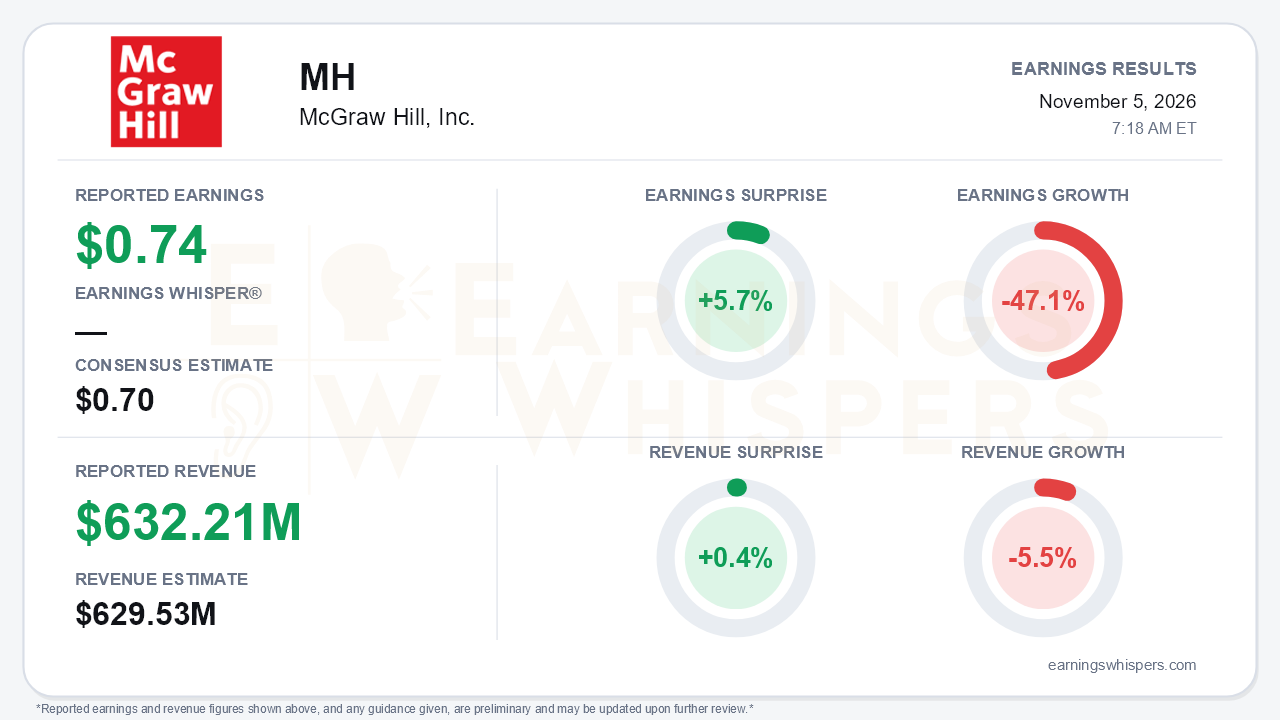
McGraw Hill (NYSE: MH) cleared a modest bar in its fiscal second quarter. Earnings were $0.74 per share, 5.7% above the $0.70 consensus, on revenue of $632.2 million, 0.4% ahead of estimates. On a year-over-year basis, though, the numbers went backward. Earnings fell 47.1% and revenue fell 5.5%, a sharp reversal from the 2.6% revenue growth reported in the first quarter. Management reaffirmed full-year guidance for the third consecutive quarter. It then spent much of the call steering investors toward agentic AI partnerships, tuck-in acquisitions and an explicitly promised growth acceleration in fiscal 2028. That is the central tension: the outlook was held, but the run-rate business decelerated noticeably beneath it.
The quality of the quarter is mixed and needs unpacking. The 47.1% earnings decline overstates the deterioration. The company reported adjusted diluted EPS of $0.75, but the prior-year adjusted figure of $1.40 was inflated by a large favorable tax effect. GAAP results tell a similar story. GAAP EPS fell to $0.45 from $0.57, yet pre-tax income rose to $93.0 million from $84.2 million. Two factors drove that improvement: interest expense dropped by nearly $10 million after debt paydowns, and debt-extinguishment losses were smaller. The prior-year quarter had a $21.1 million tax benefit. The operating picture is less flattering. Adjusted EBITDA fell 12.5% to $250.6 million, and margin compressed to 39.6% from 42.8%, even as gross margin held at 79.2%. Margin did improve sequentially from 37.7% in the first quarter. Cash generation looks healthier on the surface: operating cash flow rose to $190 million in the first half. However, product development spending and capex climbed to $123 million from $87 million, and net leverage still stands at 3.2x against a 2.0-2.5x target.
The weakness sits squarely in K-12. Segment revenue fell 9.6% as lower capture rates in California and Texas math, a problem flagged since June, offset strength in Science and ELA. K-12 print revenue dropped roughly 15%, and implied bookings declined year over year for a second straight quarter. Companywide, recurring revenue slipped 2% after rising 9.8% in the first quarter, and digital growth slowed to 2.6% from roughly 9%. Higher Education remains the anchor. Its revenue was flat against a tough transactional comparison, recurring revenue grew 5.5%, and first-half segment revenue rose 4.5%. Inclusive Access reached 58% of first-half higher-ed revenue, and management cited ~2% pricing gains sticking better than expected. The notable offset is a cut to the enrollment assumption, from +1% to flat-to-down 1%. Management is now relying on pricing and share gains to carry the higher-ed plan.
The catalyst list grew meaningfully:
- **AI integrations:** Proprietary content now connects through Model Context Protocol to Microsoft Copilot and Anthropic's Claude for Teachers.
- **Medical AI:** A UCSF School of Medicine deal puts Harrison's content to work in a clinical AI tool.
- **Acquisitions:** TeachFX and Teachally add AI teacher-coaching and curriculum-customization capabilities.
- **K-12 adoption pipeline:** ELA approvals in Pennsylvania and Colorado ahead of a multi-year ELA super-cycle beginning in fiscal 2028, plus California math pilots running about four times last year's pace.
- **Investor Day:** A November 18 event with a multi-year outlook is the next checkpoint.
Bears have legitimate ammunition, however. Management acknowledged that AI monetization models will not be fully formed until fiscal 2028. The acquisitions are slightly dilutive to EBITDA this year. Long-tenured leaders in both Higher Education and K-12 are being replaced, albeit by internal successors.
Investor expectations swung dramatically into the report. Earnings Whispers sentiment moved from -0.57 after the August release to +0.60, a genuine reversal from clearly negative to clearly positive. The stock tells a more restrained story. Shares were $12.76 heading into the print, up just 2.5% from the post-August open and only 1.2% above the 200-day moving average. They sat 14.2% below the October 22 inter-earnings high of $14.88, meaning most of an autumn rally had already been surrendered. The trend readings are modestly constructive, with AVWAP positive and momentum neutral. Even so, the market has not paid up for the optimism that sentiment reflects.
The bottom line is that McGraw Hill delivered a narrow beat and preserved its full-year guidance. Year-over-year comparisons were distorted by prior-year tax items, while RPO rose to $1.79 billion from $1.67 billion in March, supporting the visibility argument. But the second quarter showed decelerating recurring and digital growth, persistent K-12 math share problems and a softer enrollment backdrop. With sentiment already turned decisively positive and the investment case increasingly resting on fiscal 2028, the November 18 Investor Day will need to convert AI partnerships and adoption pipelines into credible numbers.
Read our earnings preview for McGraw Hill, Inc.: https://www.earningswhispers.com/article/MH/22144
This earnings review was originally published on Earnings Whispers.
This article is for informational purposes only and is not investment advice. Earnings Whispers and its staff may hold positions in the securities mentioned. It is AI-assisted, based on proprietary Earnings Whispers data and company reports, and edited by Earnings Whispers staff.
Mentioned In This Article
Latest News
| 5 hours | |
| 10 hours | |
| 10 hours | |
| Nov-02 | |
| Oct-29 | |
| Oct-28 | |
| Oct-16 | |
| Oct-09 | |
| Oct-05 | |
| Oct-01 | |
| Sep-25 | |
| Sep-23 | |
| Sep-21 | |
| Sep-17 | |
| Sep-14 |
