Allstate's 30% Beat Leans On Reserve Releases As Auto Margins Slip And Policy Growth Accelerates
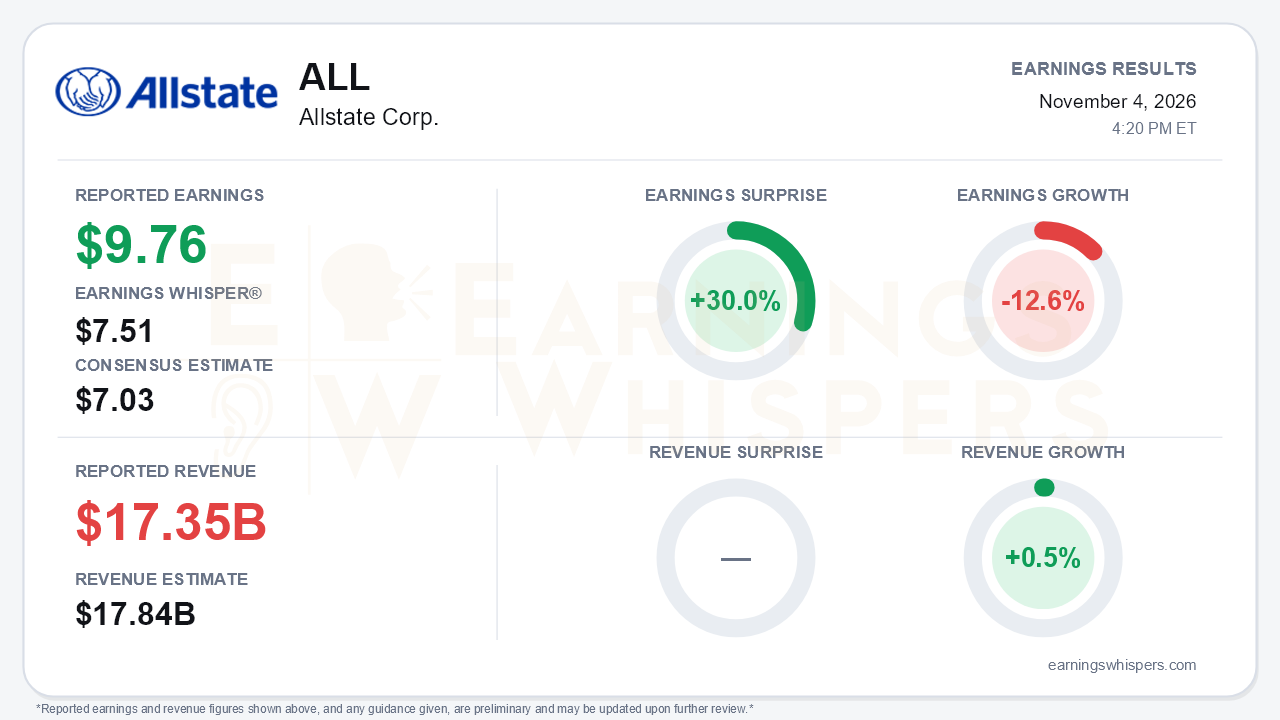
Allstate (NYSE: ALL) cleared the bar by a wide margin in the third quarter, reporting adjusted earnings of $9.76 per share against a $7.03 consensus and a $7.51 Earnings Whisper number, a 30.0% surprise. The headline beat sits alongside a less flattering trend. Adjusted earnings fell 12.6% year over year. Revenue of $17.348 billion rose only 0.5% and missed the $17.84 billion consensus by 2.8%. GAAP net income fell to $8.03 per share from $13.95, though the prior-year figure included a $720 million gain on the sale of the group health business. That is the central tension: Allstate is growing faster than it has in years, but it is giving back auto margin to do it, and this quarter's earnings power was propped up by items management itself cautioned against extrapolating.
The quality of the beat deserves scrutiny. Catastrophe losses nearly tripled to $1.65 billion from $558 million, adding 7.1 points to the Property-Liability combined ratio, which rose to 86.6 from 80.1. Two cushions offset part of that damage. The first was 5.1 points of favorable non-catastrophe prior-year reserve releases, including 9.1 points in auto alone. Management told analysts not to model more of them. The second was net investment income, which jumped $228 million to $1.18 billion. Of that increase, $128 million came from private equity valuation gains in the performance-based portfolio, a source the company itself describes as periodically variable. On the revenue side, net investment and derivative losses of $545 million, versus $252 million in gains a year ago, flowed directly into the reported top line. That swing goes a long way toward explaining the revenue shortfall, even as earned premiums grew 3.8%.
Beneath the headline, auto underwriting is the real story. The underlying auto combined ratio rose to 89.8 from 86.0, and that figure already included 1.6 points of favorable development on first-half 2026 claims. On the call, the adjusted underlying measure was 91.4, versus 89.5 in the first quarter. One analyst flagged roughly 600 basis points of year-over-year deterioration in the underlying loss ratio. Average auto premium fell 2.7% as the mix shifted toward the cheaper Affordable, Simple, Connected product. Meanwhile, management cited inflation in physical damage and bodily injury costs and reintroduced rate increases (+0.4 points across 39 locations) after two quarters of neutral pricing. Homeowners remains a clear strength by contrast: the underlying combined ratio held near 60, and earned premiums rose 11.5%.
The call preserved a credible growth story. Property-Liability policies in force grew 3.3%, the fourth straight quarter of acceleration, up from 2.3% in the first quarter and essentially flat in the earliest comparison. Auto policies grew 3.4% and homeowners policies 3.3%, with new business up 6.3% and 10.2%, respectively. Management says policy growth now outpaces growth in the number of cars and homes, implying market share gains. The catch is that earned premium growth slowed to 3.8% from 5.5% in the first quarter, and written premiums rose just 2.5%. Units are outrunning dollars.
Forward catalysts lean toward technology and distribution:
- a proprietary agentic shopping assistant that quotes 30-plus carriers, targeted for early 2027;
- the INRIX acquisition and pending Replica deal for Arity;
- an expanded ALLIE AI service platform;
- new exclusive-agent operating models for 2028;
- a possible reopening of growth in New York.
Bears have legitimate ammunition as well. Technology and compute costs are rising, third-party AI shopping assistants raise disintermediation risk, and post-election political turnover clouds the regulatory outlook. The exclusive agent count is down about 5% from a year ago. Higher interest rates also pushed unrealized losses to $2.6 billion, and holding-company deployable capital slipped to about $9 billion from $9.5 billion. Capital returns still stepped up to $1.5 billion, and book value per share rose 25.3% to $120.23.
The market setup is more muted than the surprise implies. Investor sentiment remained negative, improving only marginally from -0.487 to -0.464. Shares have drifted 1.7% lower since the open following the August report, to $269.06, yet they still sit 17.4% above the 200-day moving average of $229.22. The stock has consolidated a sizable prior advance rather than broken down. Momentum and AVWAP trend readings remain positive, while price trend is neutral.
The bottom line is that Allstate delivered a large headline beat with accelerating policy growth and strong homeowners profitability. However, reserve releases and private equity gains did much of the lifting while auto margins eroded and earned premium growth slowed. The market's lukewarm reaction suggests investors already see the shift from margin expansion to volume. The next test is whether renewed auto rate increases can stabilize underlying loss trends without stalling the market-share gains management has worked to build.
Read our earnings preview for Allstate Corp.: https://www.earningswhispers.com/article/ALL/21775
This earnings review was originally published on Earnings Whispers.
This article is for informational purposes only and is not investment advice. Earnings Whispers and its staff may hold positions in the securities mentioned. It is AI-assisted, based on proprietary Earnings Whispers data and company reports, and edited by Earnings Whispers staff.
Mentioned In This Article
Latest News
| 10 hours | |
| Nov-04 | |
| Nov-04 | |
| Oct-29 | |
| Oct-27 | |
| Oct-27 | |
| Oct-26 | |
| Oct-15 | |
| Oct-12 | |
| Oct-06 | |
| Oct-05 | |
| Sep-30 | |
| Sep-23 | |
| Sep-22 | |
| Sep-22 |
