Oxford Lane Halves Its Payout As CLO Equity Cash Flows Keep Shrinking And NAV Resumes Its Slide
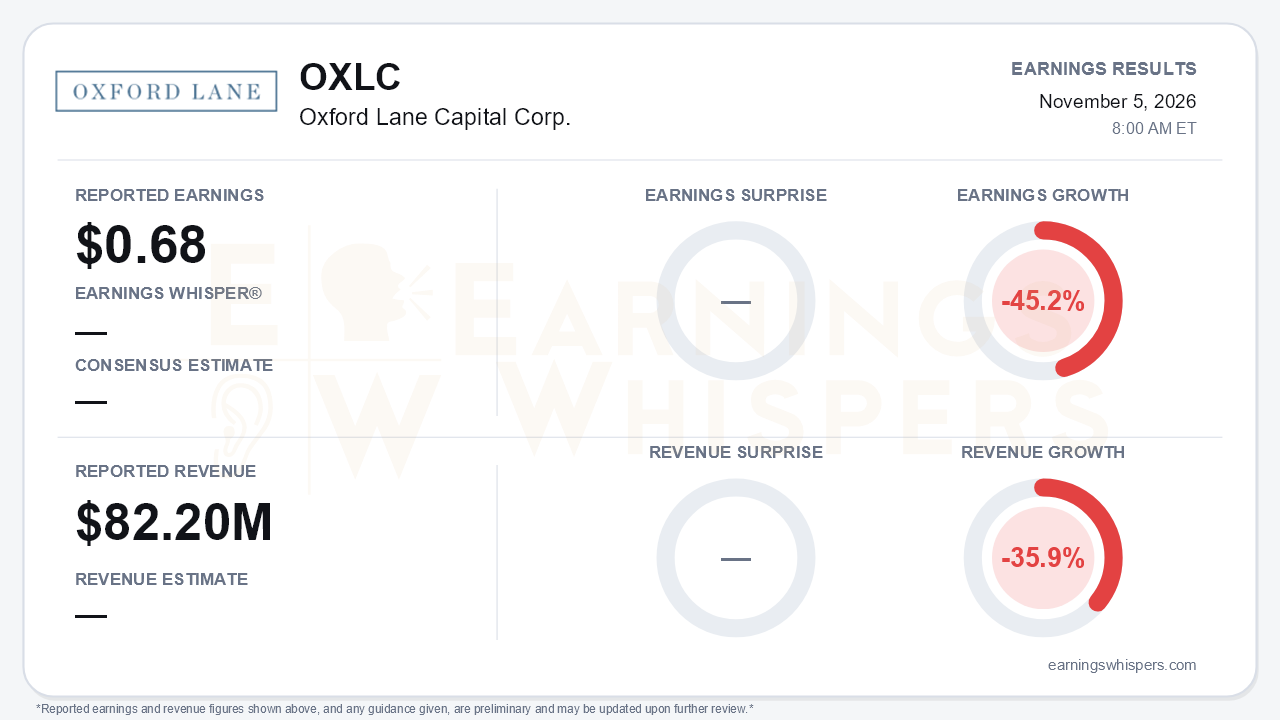
Oxford Lane Capital (NASDAQ: OXLC) reported core net investment income of $0.68 per share on total investment income of $82.2 million for its fiscal second quarter ended September 2026. Earnings fell 45.2% year over year and revenue fell 35.9%. The deterioration is speeding up. Core NII had slipped from $1.12 to $1.03 to $0.95 over the prior three quarters, then dropped roughly 28% sequentially to $0.68. The most consequential number was not in the income statement. The board cut the monthly common distribution in half, to $0.10 from $0.20, for January through March 2027. That makes this a reset quarter rather than a soft patch.
The quality of the quarter deserves scrutiny on several fronts. The $0.68 headline is a non-GAAP figure. GAAP NII was $0.49 per share, down from $0.51, and the $0.19 gap reflects CLO equity cash distributions running ahead of effective-yield accruals. Even on that basis, the cash engine is weakening. The weighted average cash distribution yield on CLO equity fell to 12.4% from 16.3% a quarter earlier and 19.0% three quarters ago. The effective yield declined to 10.5% from 11.1%. Below the NII line, the picture worsened further:
- Net realized losses were $22.6 million.
- Net unrealized depreciation was $43.8 million.
- Together they produced a net decrease in net assets of $0.19 per share, versus a $0.78 increase in the prior quarter.
- NAV fell to $9.95 from $10.74. That reversed the modest recovery from $10.56 the quarter before and leaves NAV far below the $15.51 reported three quarters ago.
The call made clear that management's earlier optimism did not hold up. On the prior call, management had hoped July CLO payments marked the trough. Instead, cash flows fell further, and management cited Barclays data showing 2026 broadly syndicated CLO equity payments at their weakest since the financial crisis, with spread compression persisting. Deployment also slowed. New investments fell to $18.7 million from $37.8 million, against $31.2 million of sales and repayments, so the portfolio shrank on a net basis. The pipeline of new CLO equity that has not yet made a first distribution fell to $7.5 million from $66.2 million. That removes a source of incremental future income that had partly cushioned prior quarters. The tone was defensive. Q&A focused on roughly 49% NAV erosion and about 78% in cumulative distribution cuts over six quarters, and management largely attributed the damage to asset-class conditions while expressing hope for a reversal.
There is a constructive counterpoint, and it is the central tension. The credit backdrop is improving even as CLO equity cash yields deteriorate:
- Loan prices rose to 95.32% from 94.96%, lifting median CLO equity NAVs about five points.
- Trailing defaults fell to 0.55% from 0.97% last quarter and 1.4% two quarters ago.
- CLO new issuance climbed to about $46 billion from roughly $33–34 billion.
- Resets and refinancings extended the portfolio's weighted average reinvestment period to January 2030.
Management described secondary CLO equity pricing as compelling on a cash-on-cash basis. However, the company deployed less capital, not more, this quarter. The core problem is not defaults but compressed arbitrage. Tighter loan spreads squeeze the excess interest that flows to equity tranches, and better loan prices do not fix that by themselves.
Balance-sheet actions cut both ways. Oxford Lane is retiring the remainder of its 5% notes due 2027, with $30 million redeemed October 2 and $40 million scheduled for December 4. That removes a near-term maturity. Over the same period, however, it issued an additional $40 million of 8.25% Series 2031 term preferred. The 8.25% preferred replaces 5% debt, so near-term refinancing risk falls but the cost of leverage rises at a time when asset yields are falling.
On distribution coverage, the new $0.30 quarterly payout sits well below both Core NII of $0.68 and GAAP NII of $0.49. That suggests either a deliberate cushion or an expectation of further income erosion; management did not specify which. Market context is limited. Shares opened at $8.35 after the July report, already a sizable discount to the $10.74 NAV reported then and below the current 200-day moving average of $9.39. Updated sentiment and price data were not available, so it is unclear how much of this reset the stock had absorbed going into the report.
The bottom line is that Oxford Lane delivered a quarter in which every core income and value metric moved the wrong way: Core NII, GAAP NII, investment income, cash yield, effective yield, NAV, deployment and the dividend. Improving loan prices, lower defaults and stronger issuance give bulls a plausible path to stabilization. Until CLO equity cash distributions stop compressing, though, the halved payout looks like an acknowledgment of a lower earnings base rather than excess caution, and bears have legitimate ammunition.
This earnings review was originally published on Earnings Whispers.
This article is for informational purposes only and is not investment advice. Earnings Whispers and its staff may hold positions in the securities mentioned. It is AI-assisted, based on proprietary Earnings Whispers data and company reports, and edited by Earnings Whispers staff.
Mentioned In This Article
Latest News
| 4 hours | |
| 8 hours | |
| Nov-04 | |
| Oct-29 | |
| Oct-22 | |
| Sep-16 | |
| Sep-14 | |
| Sep-02 | |
| Aug-17 | |
| Jul-29 | |
| Jul-28 | |
| Jul-28 | |
| Jul-21 | |
| Jun-15 | |
| May-26 |
